Judge David Harvey spikes ‘the enemy’ guns

David Lange once said, ‘He who lives by the quip, dies by the quip’.

Sometimes Justice can be blonde.

“The problem is not technology. The problem is behaviour. We have met the enemy and he is us.”
— Justice David Harvey at NetHui

Judge David Harvey’s later pun about the United States being ‘the enemy’ in a discussion about the American push in the Trans Pacific Partnership ‘free trade’ talks to extend the copyright period to 70 years after the creator’s death and impose other moves has led today to him withdrawing from the Kim Dotcom extradition case.

The reference to ‘the enemy’ was a play on words referencing the Walt Kelly quote ‘We have met the enemy and he is us’.

It’s been interpreted by the simple, the gullible and Judge Harvey’s enemies as a POSSIBLE indicator of bias, hence his decision to withdraw. Better to stand aside than to offer scope for an appeal on such spectral grounds.

Too bad. Judge Harvey was, arguably (and certainly in my opinion), our best-qualified jurist to deal with the case. But never mind.

His enemies delight in this, of course — including those he has convicted of varieties of moral turpitude (or ‘summary offences‘, as one of the grossest of them has spluttered bitterly, demonstrating — if such evidence was needed — that the convict remains stuck in the ‘denial’ or ‘bargaining’ phase of the grief process.)

It seems plain Judge Harvey was being a bit of a wit, a raconteur, rather than displaying a lack of impartiality.

Still, better safe than sorry. Justice has to be seen to be done.

Them’s the breaks.

– P

Flacks will always try this on. Resist.

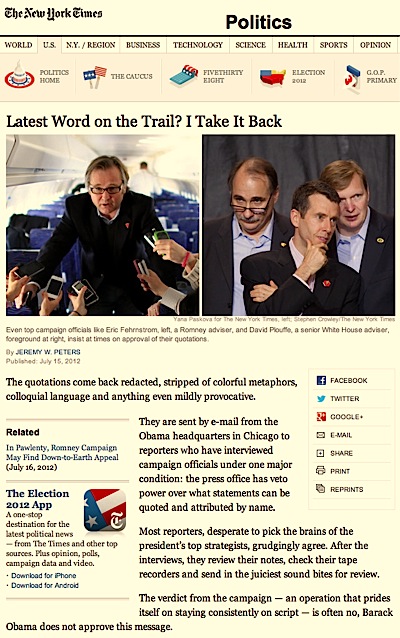
Reporter or campaign mouthpiece? Make a choice. (NY Times - click)

The New York Times reports in a vaguely-nauseating article ‘Latest Word on the Trail? I Take It Back‘ on the increasing use of ‘quote approval’ by the US presidential campaigns as a condition of interviews with people associated with the campaigns.

I’ve never agreed to that request when asked by ‘newsmakers’ at all levels, or their minders. It crosses a line. That’s not news, it’s PR …

Journalism is printing what someone else does not want printed: everything else is public relations
— George Orwell

An interview can be an adversarial event, or a collaborative one. But giving your subject a right of veto over any part of your article (as opposed to fact-checking) is a ludicrous loss of posture.
It also severs the fair expectation of truthfulness our readers/audience have a right to expect.

Who are you working for?

Many journalists spoke about the editing only if granted anonymity, an irony that did not escape them. No one said the editing altered the meaning of a quote. The changes were almost always small and seemingly unnecessary, they said.

Those who did speak on the record said the restrictions seem only to be growing. “It’s not something I’m particularly proud of because there’s a part of me that says, ‘Don’t do it, don’t agree to their terms,’ ” said Major Garrett, a correspondent for The National Journal. “There are times when this feels like I’m dealing with some of my editors. It’s like, ‘You just changed this because you could!’ ”

– P

The Warrior – by Chuck Girard

I mentioned Chuck Girard’s album Written on the Wind recently as part of my eclectic musical ‘heritage’.
My pal Graeme and I remembered Girard (who always struck me as a lost Beach Boy) and a few of his fellow inspirers like Barry McGuire and Larry Norman at lunch today… so I pulled this track up, moved by nostalgia. Wooooah! Goosebumps.

The Warrior. Play it loud.


MP3 file (6MB)

Wow. Still moves me.

– P

PS It’s right at home, musically, next to The Who’s Tommy.

There goes the whole appeal of Facebook for some personality types … well, not really

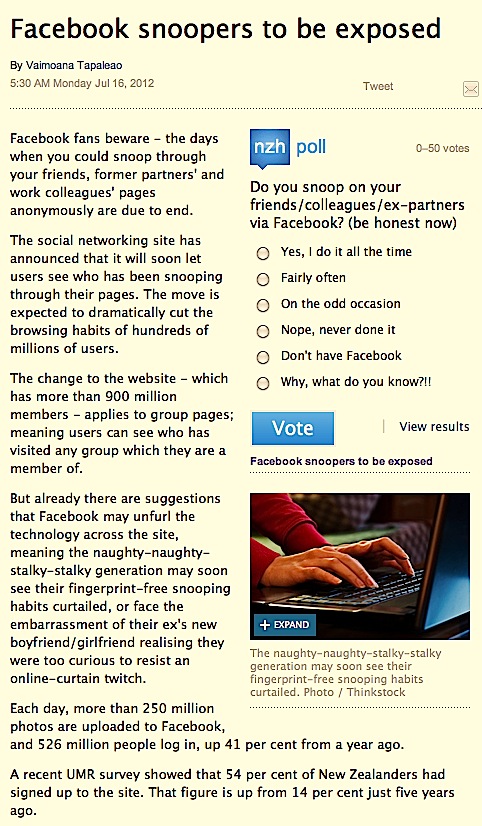
Glad tidings? Pfft! (NZ Herald - click)

In the same way that locks are only really designed to keep out honest people, this ‘dramatic’ change to how Facebook operates will, in reality, be of minimal effect.

We’ve discussed the (lack of) privacy of material posted on the world’s largest social network before. Birds gotta fly, fish gotta swim, some people gotta SNOOP.

With Facebook, like everything from cars to massage oil, how you use it makes all the difference. And how you use it reflects your character, in my opinion.

There are plenty of fake profiles and stalking going on. Not just ex-spouses etc. Some social media battledogs like you-know-who admit they create fake profiles to ‘follow’ or ‘friend’ (as a verb!) their prey. We’ve seen that.

The rather odd spectacle of former ACT acolyte Clint Heine being pursued by an online adversary … now in the ongoing trainwreck of a couple of comment threads here at The Paepae (of all places) should be instructive.

Fake people are not the same as anonymous people, as I tried to explain here. Sometimes there are good reasons to remain anonymous.

But with impersonation, unless it’s art or satire (like the absolutely-superb-by-anyone’s-standards parodies: @DrBrash or @MayorEmanuel) the deceit is fatal to credibility (e.g. property spruiker Sean Wood’s sockpuppet performance as his own satisfied customer ‘MUFFIT’).

Call me naive (I’ve been called worse) but I put astro-turfing, the faking of grass roots support or a ‘movement’ in the same class. Deceit.

But things can evolve, like bacteria.

Facebook, so much a part of hundreds of millions of people’s lives, will of course, reflect humanity’s greatness and our wretchedness. What else should we expect?

– P


IDEA: Turning payphones into free Wi-fi hotspots

Read at gigaom: New York starts turning payphones into free Wi-fi hotspots

20120715-163510.jpg

Smart idea.

-P

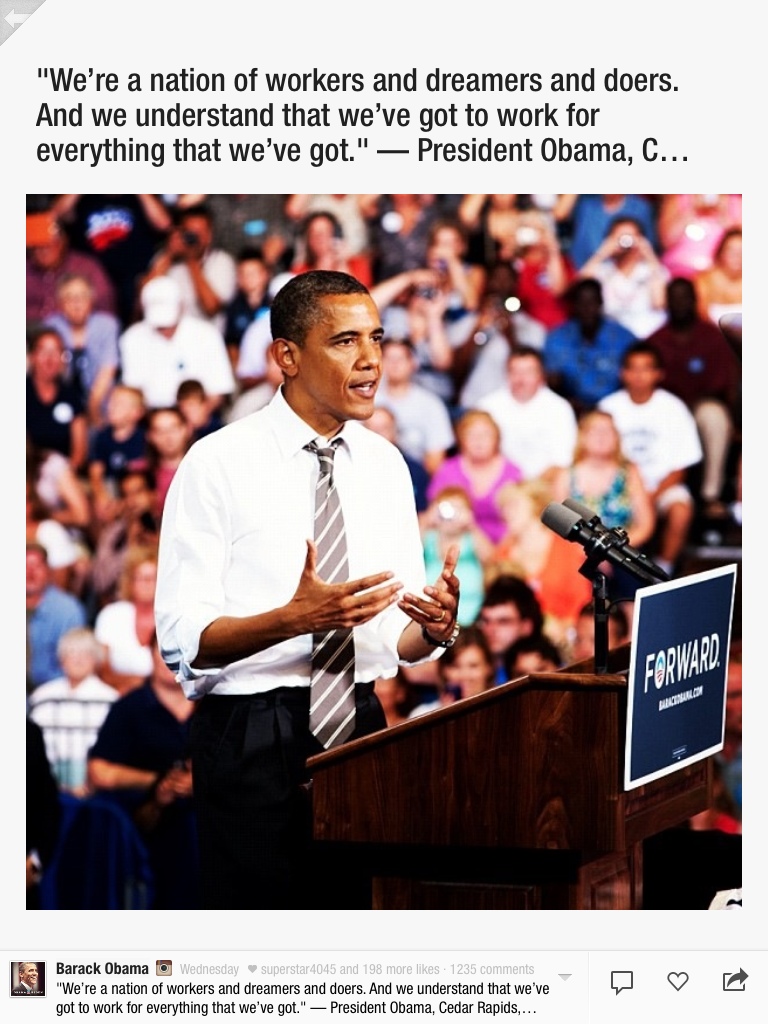
Obama: love him or hate him, his election changed something forever

This image, of a black man as the President of the United States, was barely imaginable by most of us ten years ago. Colin Powell,* maybe. Jesse Jackson, not really. But Powell (fairly) considered the cost to his family, and the very real risk to his life.

This guy Obama made history, and his electoral success broke a barrier. And I think that’s good. Whether you like his politics or not.

20120714-203923.jpg

– P

* First African American US Secretary of State. http://www.biography.com/people/colin-powell-9445708

Someone who asks questions for a living does a good job of answering some

Journalist Anita McNaught (pic: via NZ Herald)

From one of the most thoughtful and illuminating* ‘Twelve Questions’ columns I’ve read …

NZ Herald: Knowing what you know now about the media, would you still want to be a journalist if you were starting out in 2012?

Anita McNaught: It has changed, but with a few reservations I love the way it has evolved. I value the expansion of input sources, citizen journalism, blogging and Twitter. I am so excited by what technology can offer as tools to tell stories and verify claims – satellites; smaller, simpler cameras; smart phones; Wi-Fi. But journalism is still too much a corporate commodity. And it’s hard now for journalists to openly question – let alone oppose – those who ultimately pay their salaries. Climate change is a much bigger story than Al Qaeda. The world economic crisis is the greatest unfolding investigative story ever still to be completely told. People are living in a criminal system masquerading as “free market economics”. But is the corporate media equipped to tackle this?

Read Twelve Questions with Anita McNaught at the NZ Herald website.

– P

* in stark contrast to a local politician whose opaque responses recently (‘Q: Why do you think you polarise people? A: I have very clear views.) struck me as … lacking in that regard.  See: Twelve Questions with Judith Collins.

Bad behaviour online – NetHui

These notes (by Nat Torkington @gnat — available as google doc here) are from discussion/part of Judge David Harvey‘s presentation at Nethui underway now in Auckland. They directly touch on some of the recent discussion we’ve had on the topic of online free speech and harassment.

[Harvey:] This session looking at bad behaviour online. Law Commission said that existing law does address bad behaviour. First question: what do we understand by “bad behaviour” and what extent are we prepared to see restriction on free speech and expression online? Look at the harms that are occurring and take it from there.

Audience: Back in the days of Usenet, online forums, every other community that existed online, common practice that community established its own standards. I have a problem with this because I see a lot of abuse of the idea of “bad behaviour” to be anything from disagreeing with someone. I see it misapplied liberally these days. Not in favour of harassment, but allowed to have a personal opinion.

Harvey: If you used Usenet, you’ll recall there was some robust discussion.

Audience: That’s where “trolling” came from At that point does community enforcement and banning users become a civil issue?

Harvey: You’re suggesting online communities should regulate themselves?

Audience: At what point does say “get out” not enough, become a case for the legal system?

Harvey: Will avoid the second part, go to the first part and ask for some views. Within an environment, a community such as Usenet, that could be fine. But the problem that we’re getting is people setting up web pages that can be used for abuse, going beyond defamation, very hurtful. Bloggers using blogs as means of causing other people distress. People using Twitter and FB as means of upsetting people. Twitter and FaceBook may be examples of your community, but what about blogs and webpages, what community will regulate those? [Audience: ah, yes!] We are looking at a whole range of protocols across the Internet.

Audience: I had a question (relating to publications and books) … … … the difference between hurtful speech and things that are causing people distress. What are facts for one person can be distressing for another. Do we have a definition for what is required? Is it sufficient that something causes someone distress?

Harvey: The answer to your question is yes, and indeed it can be true. It comes under the umbrella of the Harassment act. At the moment there’s a two-stage test: there’s something that’s hurtful to me, and I’m disturbed by it. You might say “what? He’s disturbed by it? That’s nothing”. You must look at it from my subjective point of view. Then you must have an objective test: is it reasonable for a person in my circumstances to see it that way. There are circumstances when the truth has given offence. …

Have a read of his notes thanks to @gnat

There’s quite a bit of discussion about ‘take-down’ orders as a remedy (or not) and Russell Brown shares the idea that moderating ‘defamatory or offensive’ content in a comment stream or [annotating] ‘invalid materials’ is worthwhile.

In my own case, I sometimes add a note that an assertion is being questioned or disputed by the relevant party. It’s not ideal, but a sort of half-way house when something is beyond the scope of this blog to determine the objective ‘truth’ and discussion about it seems reasonable.

It seems eventually a video of Judge Harvey’s presentation will be available — here for instance: http://www.r2.co.nz/20120711/recordings.htm

– P

PS This thought in the notes, from blogger/propagandist David Farrar (I think), echoes my own philosophical approach to ‘derogatory’ comment about me sitting on the web:

If [the] commission made a finding of fact [about false information published on the web], media would link to it and it’d be high rank on Google. I think the best way to fight bad information is to put out more good information.

Yeah, agreed. As I said to Sarah recently about the tweebs trying to mess with my reputation:

My own approach was to just keep blogging good stuff and let the search engines eventually work out what was irrelevant.

That’s sort of where I was heading, too, with the ideas in ‘The curse of hypervigilance‘. Try to keep things in perspective in the ‘wild west’ of cyberspace.

I wonder how common this combination is?

From a blogger’s potted bio on a review of the excellent Scrivener software I use:

About Brian xxxxxxx

Computer programmer by day; horror and post-apocalyptic thriller writer by night.

Bless him!

– P

(Reminds me of you JT.)

Distribute comment spam. Get pinged. Ask that YOUR OWN SPAM be removed. Hahahaha!

talkingpointsmemo.com (click)

From Josh Marshall at talkingpointsmemo.com. He calls it ‘chutzpam’.

I call it bleurgh!

In other words, the estimable businessmen and women at realinsurance.com.au have been paying SEO companies to spam the comment sections of sites around the globe. But now Google’s new search algorithms are making that legacy spam really damaging. So now they’re sending out cease and desist notices to the victims of their earlier spamming demanding that they search their archives and remove their spam.

Crikey! “shameless and awful” sounds about right.

The company is Australian, apparently. Remind you of anyone?

– P

via John Gruber daringfireball.net

Untangling from emotional habits

Reviving memories of Edie Brickell got me thinking about her, how happy she seemed, and how she seemed to disappear after marrying Paul Simon.

Here’s a line from a Jan 2011 AP interview ‘Edie Brickell releases records full of joy‘ talking about how her long-awaited 2011 CDs, the eponymous “Edie Brickell” and “The Gaddabouts”. Both had been in the works for a decade and both were received as “joyous“, each with a really positive vibe, despite some tragedy occurring in her circle of concern.

[…] Was that positive vibe by design?

Brickell: It’s just an evolution of spirit and consciousness, I think. In my late 20s, I thought, “Wow, things are fine for me. Why do I write sad songs? Why am I melancholy?” And I realized that I had emotional habits from my youth. … I think you get stuck in those emotional habits. If you don’t express a lot of joy early on, I don’t think you know how to later. [emphasis added]

Wow. That idea about getting stuck in emotional habits strikes me as worth letting in — and contemplating. (As in asking: ‘How do I do that?’)

It resonates with me, given also what we’ve been discussing here, in parts: Disengaging from destructive, hurtful situations and actions that perpetuate conflict.

Good thought.

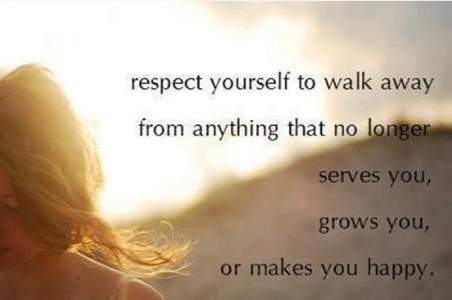
Someone I love popped this up on her Facebook wall recently and I saw it tonight:

20120709-212352.jpg

Nice. I would have written ‘respect yourself enough to …’ But still nice.

– P

What am is what I am. Are you what you are, or what?

I had this Edie Brickell and the New Bohemians album Shooting Rubberbands at the Stars virtually on permanent rotate in my car’s cassette player (!!) when it came out. Along with Chuck Girard’s Written on the Wind, Paul Clark’s Hand to the Plow and Vangelis’ Chariots of Fire. Good times.
Fantastic music.

Dedicated to Cally.

– P

Comments, classified

pic: Bob Biess - click

I don’t enjoy navel gazing about comments and moderation here at The Paepae. Every now and then I’m forced to think about it again because someone wants to have a crack at me or someone else in low-value terms. Usually anonymously.

I tend towards no censorship beyond filtering spam (thank you Akismet) and throwing out the garbage. Recently scrubone and I had a wee interchange over his desire to call someone ‘crazy’ and I’ve filtered a few other rants just ‘cos. No big deal. Those people are welcome to comment — as is anyone — if they bring some value. Some of Jacqueline and Cally’s comments, among others, can be pretty brusque but, well, OK. We’re adults.

In the spirit of the excellent terms and conditions of the gay dating website that someone subscribed this blog to (see ‘Some useful cyber citizen guidelines‘), here’s another dose of thoughtfulness considering internet comments:
From www.aranyilaci.neobase.hu‘s guide to the Slashcomments moderation system (1):

What is a Good Comment? A Bad Comment?

  • Good Comments are insightful. You read them and are better off having read them. They add new information to a discussion. They are clear, hopefully well written, or maybe amusing. These are the gems we’re looking for, and they deserve to be promoted.
  • Average Comments might be slightly offtopic, but still might be worth reading. They might be redundant. They might be a ‘Me Too’ article. They might say something painfully obvious. They don’t detract from the discussion, but they don’t necessarily significantly add to it. They are the comments that require the most attention from the moderators, and they also represent the bulk of the comments. (Score: 0-1)
  • Bad Comments are flamebait. Bad comments have nothing to do with the article they are attached to. They call someone names. They ridicule someone for having a different opinion without backing it up with anything more tangible than strong words. Bad comments are repeats of something said 15 times already making it quite apparent that the writer didn’t read the previous comments. They use foul language. They are hard to read or just don’t make any sense. They detract from the article they are attached to.

What do the choices in the moderation drop-down boxes mean?

  • Offtopic — A comment which has nothing to do with the story it’s linked to is Offtopic.
  • Flamebait — Flamebait refers to comments whose sole purpose is to insult and enrage. If someone is not-so-subtly picking a fight (racial insults are a dead giveaway), it’s Flamebait.
  • Troll — A Troll is similar to Flamebait, but slightly more refined. This is a prank comment intended to provoke indignant (or just confused) responses. A Troll might mix up vital facts or otherwise distort reality, to make other readers react with helpful “corrections.” Trolling is the online equivalent of intentionally dialing wrong numbers just to waste other people’s time.
  • Continue reading →

Egregious

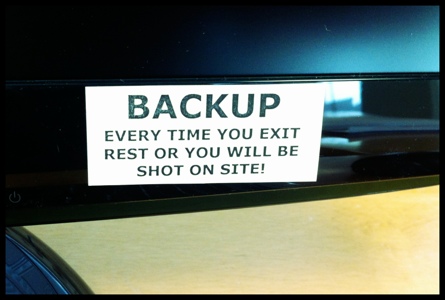
20120706-192126.jpg

When I gently pointed to what some might call errors in this notice I was assured the threat of being shot on the premises was what was intended.

Really.

– P

Declaring where you’re coming from

image: cover of Hallucination - Famous Stranger (visualcrack.info - click)

Like most people (I think), I find it interesting, at times fascinating, to speculate about WHY people do and say what they do … WHY they might express views that they hold in the way they do … and WHY they enter into discussions or debates (and sometimes flame wars) on the internet.

But I’ve learned it’s pretty futile.

Futile? Yep. Because reliably identifying people’s motivations for anything is an all-but-impossible task at the best of times — even if it seems obvious, and, perhaps surprisingly, even if they tell you what they think is driving their actions.

I described in another context (see ‘When propaganda turns into ‘demonizing’ …

Targeting individuals is always tricky. Motivations are near-impossible to divine. ‘Sympathies’ even more so. There’s usually a whole lot of hallucination going on.

or here when discussing what psychology calls the fundamental attribution error in a context of ‘I know why you’re being so mean’:

Essentially, the fundamental attribution error involves placing a heavy emphasis on internal personality characteristics to explain someone’s behaviour in a given situation, rather than thinking about external situational factors.

Amateur psychologists are everywhere — quick to offer a ‘diagnosis’ like ‘That b*tch is crazy’ or the more academic ‘Judging by his pattern of behaviour, he appears to be a sociopath … with narcissistic personality disorder. And a compulsive liar’.

Wearing a mask: Aggressive, anonymous comment makes me ponder. (image: AP - click)

I got to thinking about this again because I’ve recently expressed disrespect for an anonymous blogger’s published comments. (For a change. Ha!) This anonymous blogger is someone with whom I sense I might agree about all number of other matters, and whose company I might enjoy.

My lack of respect for his actions (leading me to label him ‘nasty’) is on the basis of his willingness to repeatedly denigrate someone: insulting them and describing them as ‘crazy’ on the basis of their written remarks. His anonymous condemnation of this person (who blogs in their own name) and his on-going aggressive treatment of them is, in my view, largely an expression of tribalism.

See what I’m doing there? Projecting. It’s natural to reinforce previously held beliefs by filtering or constructing arguments that ‘fit the thesis’. (Yes, it’s shallow, I know, but we all fall into that trap.)

‘Us’ and ‘them’

We homo sapiens can be (at least partially) defined by our co-operative traits: our tendency to form bands, teams, communities and societies. The ‘shadow’ of that, sadly, is our terrible practice of ‘us and them’-ness. Continue reading →