Tumblr makes us LIARS

I don’t know if you’re aware that this blog has a Tumblr — used infrequently and pretty informally.

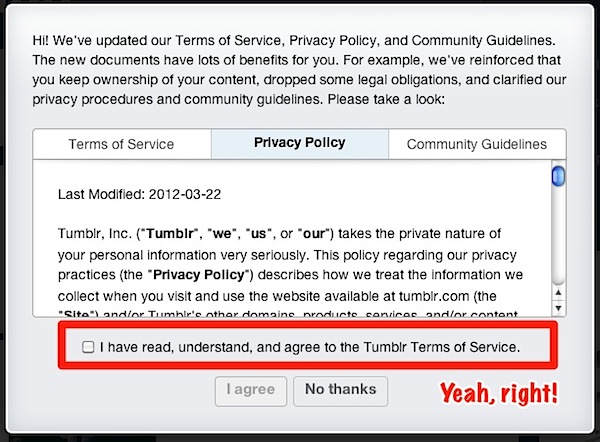
Today I popped over to have a look and saw this, which made me laugh:

Oh yes? Agree, sure ... but Read? Understood? ... seems unlikely

Is it cynical of me to suggest there’s no way the majority of tumblr’s teenage clients will have read the approaching ten thousand words(!) updated Terms of Service.

No way.

How many will read this amount of words? (To quote Scribe - "Not many, if any.")

Funny.
– P

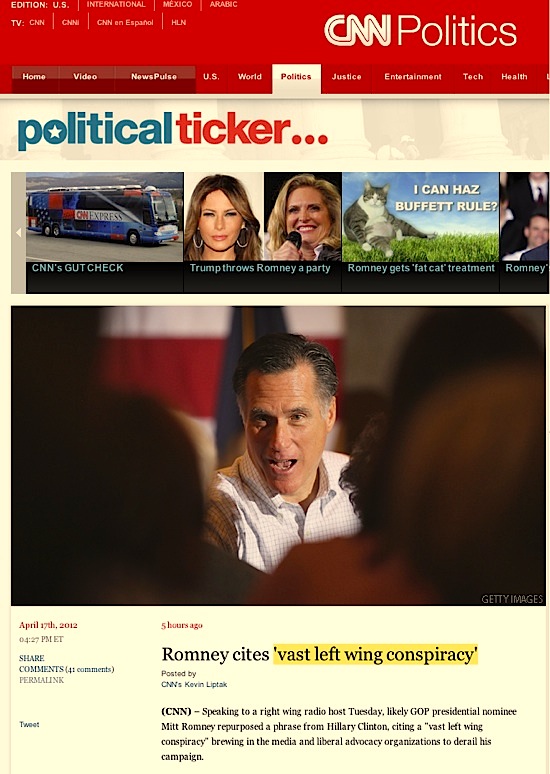
Romney faces a ‘Vast Left Wing Conspiracy’. OMG!

"...Mitt Romney repurposed a phrase from Hillary Clinton, citing a "vast left wing conspiracy" brewing in the media and liberal advocacy organizations to derail his campaign." What if he's right? (click to visit CNN)

Highlights from Kevin Liptak’s CNN post: Romney cites ‘vast left wing conspiracy’

Romney was making an appearance on Breitbart TV [Comment: surprise!] and was asked by host Larry O’Connor whether he was ready to take on “the media and these nonprofits groups that are working together.”

“There will be an effort by the quote vast left wing conspiracy to work together to put out their message and to attack me,” Romney said in response. “They’re going to do everything they can to divert from the message people care about, which is a growing economy that creates more jobs and rising incomes. That’s what people care about.”

Romney’s choice of words echoes Clinton’s assertion in 1998 that a “vast right wing conspiracy” was behind the sexual harassment charges her husband, former President Bill Clinton, was facing at the time.

… Romney said dealing with journalists, many of whom he said were biased, was a perpetual problem for Republicans.

“Many in the media are inclined to do the president’s bidding and I know that’s an uphill battle we fight with the media generally,” Romney said, before praising O’Connor for offering a conservative voice.

The candidate said he was unfazed by the prospect of doing battle with the left’s vast operation.

Oh boy. This US election is definitely going feed my addiction again.

– P

PS That line about ‘biased’ journalists trying to “divert from the message people care about” reminds me of something … what was it? Oh yes. ‘public interest’ vs ‘the issues that matter’

NY Times smears former collaborator Assange: ‘a nut job’

What a sleazy smear. But just the latest in a long line.

His reputation has taken a deep plunge since he shook the world in 2010 by releasing, in cooperation with The New York Times and several other news organizations, masses of secret government documents, including battlefield reports from Iraq and Afghanistan. Most news organizations edited and redacted the papers to protect lives. Mr. Assange put everything on his Web site. To some he was a hero, to others a spy, but nowadays he is most often portrayed as a nut job.

from The Prisoner as Talk Show Host

Shabby work NY Times. The very same article credits Assange as an interviewer …

On his talk show Mr. Assange was a little stiff but sounded rational, didn’t talk much about himself and asked Mr. Nasrallah some tough questions about Hezbollah’s support for President Bashar al-Assad of Syria. He even cited reports, found by WikiLeaks, that suggested corruption and high living among some members of Hezbollah. (Mr. Assange cited S.U.V.’s, silk robes and “take-away food” as signs of decadence.)

…but really what the hell does “Mr. Assange was a little stiff but sounded rational” imply?

Nasty.

– P

Oops. What? He wants us to LISTEN to the murderous ultra-right nut job? Er, well, gee. OK.

In my experience, sometimes when one is interviewing someone in the news, particularly a LIVE interview, things can take an unexpected turn. Your subject says things that you didn’t expect.

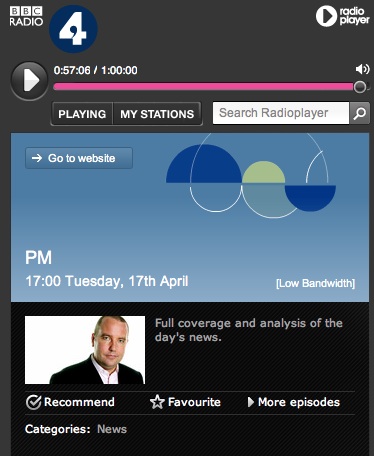
This morning, roused very early by an insistently affectionate cat (still getting over her spell in the cattery while we were at the beach last week) I tuned into BBC Radio 4’s PM programme and heard Eddie Mair’s interview with a Norwegian clinical psychologist Dr Roderick Orner about the 30 page ‘manifesto’ Anders Behring Breivik, the ‘ultra-right wing Nationalist’ who has admitted killing 77 people, presented to his trial.

Eddie, I think, had been expecting a ‘How is this guy insane? Let me count the ways’ track from the psychologist, but listen as he’s given a short course in the need to engage in debate with even those we characterize as ‘hateful extremists’ as part of our commitment to democracy. (This was the very same point I tried to make to Martyn Bradbury here: ‘On a collision course‘.)


MP3 file

Here’s a link to the 4 min 18 sec 4.1MB MP3 file for non-flash users (like moi).

Highlights:

“We should be very cautious about labeling things. We should be listen very carefully to what he says and not think of it as a man who is mentally ill who speaks. This is a man who is now the voice of the extreme right, of extreme ultra-Nationalism and of fundamentalism. And he speaks on behalf of forces that are loose in Europe and in other places in the world. If we just write this off as the statements of a madman we will suffer for this in the long term because we will not have listened to what he said. He’s warning us.”

“I think [to fail to listen to him because he is ‘a mad man trying to justify horrific actions’] would be something we would come to regret very much indeed.”

“One of the key points that we learned from Breivik last year was that here is a man who has refused to engage in debate. Part of his counter accusations now is that nobody has given him, and his body of opinion, a platform in which to have discussions.”

“What is so [is to] important to engage fundamentalism is to have open debate. This is not [to] justify his actions in any way but debate is a crucial aspect of democracy — all opinions should be represented.”

There are all sorts of justifications for refusing to engage in debate. Most of them, in my view, pretty weak.

– P

‘New media’ absorption — another signal

Sorry to bang on about it, but the ‘blogosphere’ is more and more entering and becoming part of what some self-described ‘True Bloggers’ appear to think of as their mortal enemy, the ‘Mainstream Media’ (boo hiss) 🙂

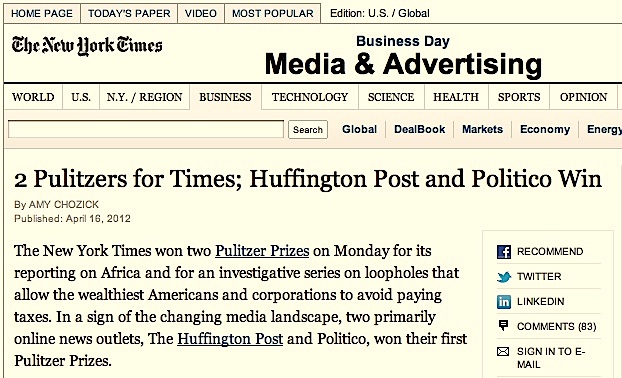
Today’s exhibit:

Oops, now the barbarians at the gate are wining Pulitzer Prizes — how 'maverick' of them!

Congratulations to the Huffington Post and Politico — both of which I read (often through their excellent iPad apps) along with the BBC, the multiple-award-winning NY Times, Washington Post, Guardian

– P

Be of good cheer

Spotted this encouraging message on the way to town…

20120417-152140.jpg

Um … OK.

– P

Of bloggers, dogs and fleas. The Ports of Auckland’s ‘ethical and legal breaches’

Getting too close to the 'product' of certain organisms can lead to infestation. It's the same in politics and the media, as the Ports of Auckland company MIGHT be learning. (pic: http://healthtips-sastha.blogspot.co.nz/)

Now that the Ports of Auckland has admitted it, I haven’t got much to add to my earlier ‘Lie down with dogs get up with fleas’ comment in ‘Garner: “@whaleoil lies again.” Surprise me‘ about the Ports company leaking their personnel records to a sympathetic (at best case) blogger.

Today’s Yesterday’s NZ Herald editorial: Port’s misuse of private files lamentable is worth a read — although it focuses solely on the Port company’s actions, and not on the advocacy-verging-on-hate-speech and odious denigration tactics used by website operator/attention-seeker Cameron Slater — whom the NZ Herald so elegantly describes as ‘a pro-company blogger’.

Yes. Cameron is very ‘pro-company’, it seems — or is he simply anti-Union? Whatever he is, it is purely as a hobby, apparently. (‘I have not accepted or received any money from Ports of Auckland, not 1 cent let alone $10,000,’ he asserted in response to scrutiny at The Standard). Or perhaps he’s acting from conviction. (Not that kind of conviction!) Or it could be like his promotion of Simon Lusk‘s discreet, behind-the-scenes political ‘campaign strategy’ services — for ‘a mate’ … d’ya think? Continue reading →

Weaponising the web? Or just trolling?

David Carr wrote an interesting — and pretty balanced — retrospective on America’s recently-deceased right wing internet attack dog Andrew Brietbart, published in The New York Times over the weekend.
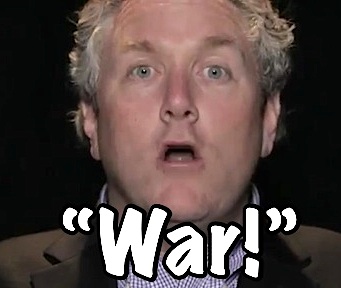
Andrew Breitbart — defining himself by who he opposed, then taking it too far. It's a risk.

Brietbart, perhaps more than anyone besides Matt Drudge, seems to me to have understood the practical weaponising of information-misinformation-disinformation-propaganda (call it what you will) using the internet.

“Mr. Breitbart, as much as anyone, turned the Web into an assault rifle…”

Also, as we discussed in ‘Poisonous Andrew Breitbart – the attack was everything, the details nothing‘ Breitbart (to me) appeared to subscribe to the idea that those on the right wing in US politics are constantly being ground under the heel of a widespread conspiracy by a monolithic mainstream left wing media made up of liberal elites activated and inspired by contempt and loathing for ‘traditional’ values and constitutional rights & freedoms — such treasonous media stooges actively and corruptly demonising the patriotic Tea Party and suppressing and robbing the heroic right wing of their voice.

It’s ironic that his driven personality and dedication* to his ‘war against the left’ and his campaign against whatever he imagined the mainstream media is may have shortened his life …

“If Twitter ever killed anyone, it was Andrew,” said [Matt] Labash of The Weekly Standard. “Andrew was a magnet for hatred, and he used Twitter for a full frontal assault, a tool of combat,”

Friends and colleagues described Mr. Breitbart as both jester and provocateur, one who enjoyed soy lattes (a family friend sprinkled coffee grounds from Starbucks onto his grave) almost as much as waging war on what he saw as Democratic hypocrisy.

“Andrew was a kind of human pinball, always doing something while doing something else, but he never took himself all that seriously,” said Greg Gutfeld, the host of “Red Eye” on Fox News, who frequently booked Mr. Breitbart as a guest. “He was the least serious, serious person I ever met.”

A student of the tactics of the leftist organizer Saul Alinsky (if not his politics), Mr. Breitbart played defense by giving offense, subscribing to Alinsky’s theorem that “the real action is in the enemy’s reaction.” He wielded a network of conservative sources, including a number of members of Congress, four of whom spoke at his Washington memorial, to sow mayhem opportunistically.

As is often the case, there is no more ferocious advocate than a convert.

“He rejected the culture that produced him, and once that process began, it could not be reversed,” said Tucker Carlson, the founder of the Daily Caller, a conservative Web site. “My strong sense was that he loved the performance aspect, the drama of it all, and lived for those moments of provocation.”

Watching him, I never knew how serious he was. Impassioned, sure, but that’s an easy act to put on. It’s ‘performance’, to quote Carlson. Political animals act aggrieved all the time. Marshalling resentment, fuelling the embers of outrage — these are old political ploys.

But did he actually mean some of the things he said? Was he really so offended by how he imagined the ‘liberal elite media’ regarded people who lived in middle America? Did anyone on ‘the left’, really, tell him to shut up in a way that people on ‘the right’ don’t? Hello?

I came to see Breitbart as a professional liar, distorting facts to make them sharper arrows, calling for ‘War!’ against ‘the media’ … and hatefully shouting down and intimidating others.

His world was less about discourse between opposing ideologies — thesis, antithesis, synthesis … 0r finding a centre way — and more about lurid mud wrestling.
Keep your 'friends' close but your enemies closer? Pic: Cactus Kate

Matt Labash’s comment about using “Twitter for a full frontal assault, a tool of combat” put me in mind of other low-rent Perez Hiltons of mock-outrage, who troll & stalk through Twitter and Facebook slobbering bile on those they imagine are their enemies but whom they follow as ‘friends’ (see right) like Captain Ahab cursing his whale.

Social media is a playground, complete with childish bully-boys, cliques and snotty dribblers. It’s striking how some people revert to type, and how often those who dish out criticism, just can’t take it.

– P

The business of selling words

So, does all-encompassing MEDIA find an audience, or does the audience find what they ‘re interested in knowing more about? What do you think?

From a new article ‘How to Blog’ by Rob Beschizza at Boing Boing with some good stuff to say about writing, including the ‘so yesterday’ thought that maverick bloggers were always gunna be ‘outside’ MEDIA … instead of, as I say, absorbed into the borg.

It’s about what readers want but also, where writers see themselves going, career-wise.

SERIOUSLY, WHAT IS BLOGGING?
It’s a funny word for writing online. This question persists because getting noticed in “blogging” is widely perceived as the gateway to a career in writing and journalism. And for all its challenges, journalism is fun if you pick the right subject. It’s a cool job.
A few years ago, blogging was a new, controversial and even disreputable form. Established, credentialled, school-indebted journalists faced barbarians at the gate: barbarians in pajamas. Writers with their own websites, no boundaries, and only a fleeting interest in the trade’s ethical traditions. The readers wanted a less mediated connection to the news, something more personal than the AP style guide offered, and bloggers delivered it.
As time went by, though, the business of selling words accommodated itself to it. Journalists became bloggers, and bloggers got hired by magazines and newspapers. And here we all are. …

For me, as we discussed briefly here re Andrew Sullivan’s view of ‘Loyalty, engagement and criticism’ … the ‘ethical’ stuff (telling the truth) remains an important distinction, so it’s good to see Rob mention it.
Liars have written their lies on clay tablets, goat skins, papyrus, parchment … and WordPress, Tumblr and Twitter. Same old, same old.

Read Rob’s article How to blog at Boing Boing for an interesting viewpoint, and some stuff to consider — as he says: ‘I present to you the fourth-best article about blogging published this week.’

Nice.

– P

via Cam Slater

Update: On related thoughts, if you care, read this: It’s Time to Stop Talking About the Death of Big Media by Hamish McKenzie Pando Daily

Didn’t we evolve beyond the “Internet vs big media” dichotomy a few years ago? Isn’t it clear that “the Internet,” despite the magical quality applied to it by some denizens of the Valley, is nothing more than a network, which can be used as a channel and a platform, and that it is just as accessible to “big media” as it is to a bunch of comp-sci grads who have rented space in Palo Alto?

The idea that “the Internet” will defeat a clueless “big media” at its own game is romantic at best, naive at least, and actually, in a way, kind of cute…

Yes, the digital disruption of the media industry has been massive and real. It pried open some cracks in which some excellent excellent new media properties have been able to thrive – Slate, Salon, The Awl, just to name a few. New platforms have emerged to challenge big media’s hegemony, but as they mature and as big media catches up, those platforms – Facebook, YouTube, Twitter, Spotify – are proving fertile territory for the major media brands. CNN, for example, is one of the most followed brands on social media. Its central Twitter presence counts more than 4 million followers. The Huffington Post has 1.8 million. …

The trajectory of property spruiker Dean Letfus

Spruiker Dean Letfus is a personable chap who used his communication skills to get people to take his advice, and buy whatever he was selling. It didn't always work out well for them. But nobody's perfect, right?

I hadn’t seen this until today — a remarkably positive article about investment ‘lessons’ spruiker Dean Letfus has learned from the collapse of his ‘property empire’ in April’s New Zealand Property Investor magazine.

A few other bankrupt investors are mentioned to leaven the loaf, but in the main it reads like an article about cover boy Dean Letfus, the former (and current) property spruiker and internet guru talking about what he did right and his ‘innate ability to negotiate’ before the wheels came off.

It quotes him in such gems as:

Letfus knows that his success could have continued unabated if the market had stayed buoyant: ‘Everything I did worked, I just did too much high-risk stuff at the beginning of an unprecedented recession.’

and some of the events and people documented on The Paepae (use the tags below if you want to know more) are also mentioned, tangentially:

“As an educator and professional investor [comment: never stop promoting, huh?] I have always taken my business very seriously,” Letfus says. “When the world started imploding I started looking for cashflow solutions outside my own skill set. I felt like I had to fix not just myself, but hundreds of clients as well. So in my enthusiasm/desperation I connected with people that I shouldn’t have and got involved in businesses I didn’t know enough about. In my case this culminated in … a business partner who took advantage of me, my clients and then vanished overseas … Huge damage was done to me and my friends, including the destruction of my New Zealand business.” (ellipses and punctuation in original — interviewed by email?)

Oh dear me. For those of who observed the methods Dean Leftus and his accomplices used operating his New Zealand businesses, selling get-rich-quick schemes like ‘Conquer Australia’, and his mate Matthew Gilligan’s subdivision sites, not to mention his local and overseas selling trips as, first a property guru, then suddenly an internet marketing expert, perhaps the cessation of those activities wasn’t a totally bad thing?

I’ve had correspondence from people who now put Dean firmly in the same category that he’s now apparently classing his former business partner Shaun Stenning: ‘I connected with people that I shouldn’t have’. Oh yes, that’s how some people feel about Dean, believe me.

If you’re interested, scope out the April 2012 issue of the magazine.

– P

Politicians and the media

Richard Nixon on “outrageous, vicious, distorted reporting” from Oct. 26, 1973 Press Conference (days after the Saturday Night Massacre)

… reminds me of something. But I can’t quite put my finger on it.

-P

Always try to be the one to write the contract

20120413-200626.jpg

Those in the news media undertaking scrutiny of the New Zealand coalition government’s unpopular* state-owned asset sales/partial privatisation (your choice) programme will, naturally, look for ‘fish hooks and broken glass’ and clauses like this … and write headlines like Vernon Small’s Loophole allows sale of over 49pc

A democracy depends on it.

*I say ‘unpopular’ based on opinion polls like this which shows 60% plus opposition to the proposed asset sales, although that may be falling.

One can only speculate what the effect on public opinion might be if the much-vaunted 49% ‘private ownership’ cap were to … slide … or appear to, as today’s Dominion Post front page story seems to suggest.

This sort of development can be seen as more grist to an electorate (partisan elements aside) which is being provoked, surely, to wonder if all may not be quite as it seems with their current crop of politicians.

On this issue, so far we’ve had the Finance Minister admit to a ‘guess’ of proceeds of sale, the ‘We’ll put it into schools and hospitals’ justification, we’ve had the hurriedly painted-back-in Treaty of Waitangi SOE clauses, the PM’s ‘Trust me’ response to questions about limiting ownership to Kiwi mum and dad investors, and the 10% cap on ownership … now today’s ‘loopholes’ story on the front page of the capital’s newspaper.

At what point does National’s partial privatisation policy stand naked and exposed as ideologically-driven — a lurch to the right … as opposed to centrist, mainstream, sensible-fiscal-management-by-blokes-you-wouldn’t-mind-having-a-beer-with’?

Any day now?

-P

Danger of dogma

Following our protracted discussion on conservatism and liberalism (for want of better labels)— and differing levels of willingness by adherents to validate the values of ‘The Other’ … by coincidence, here’s William F Buckley on what Andrew Sullivan calls ‘the Danger of Political Dogma’. From a brilliant article What William F. Buckley Would Think of Today’s GOP

In his later years, Buck­ley believed that the Repub­li­can fail­ures in Iraq stemmed from a … ten­den­cy to engage in ide­o­log­i­cal wish­ful think­ing instead of hard analy­sis. He also cau­tioned against the ten­den­cy of con­ser­v­a­tives to trans­form the cau­tious insights of supply-side eco­nom­ics, for exam­ple, into the­o­log­i­cal cer­tain­ties, and to move toward ever more nar­row and rigid def­i­n­i­tions of doc­tri­nal accept­abil­i­ty.

Fanati­cism and obses­sion, he believed, ulti­mate­ly rep­re­sent­ed a sur­ren­der of indi­vid­ual free­dom. As the high priest of the con­ser­v­a­tive move­ment, Buck­ley had lat­i­tude to advance unortho­dox pro­pos­als such as the legal­iza­tion of mar­i­jua­na with­out being con­demned for apos­ta­sy, but he also sought sim­i­lar indul­gence for other con­ser­v­a­tive thinkers.

Above all, Buck­ley want­ed con­ser­vatism to be a respon­si­ble and effec­tive gov­ern­ing philosophy. He rec­og­nized that a move­ment that dele­git­imizes its oppo­nents as Com­mu­nists and trai­tors is doomed to be irre­spon­si­ble and inef­fec­tive. He warned against con­ser­v­a­tive tri­umphal­ism and refusal to com­pro­mise. He had been men­tored by Whit­tak­er Cham­bers on the need to bal­ance the ideal with the prac­ti­cal, and to strive for con­ser­v­a­tive advances that inevitably would fall short of utopia. To live, Buck­ley remind­ed con­ser­v­a­tives, is to maneu­ver.

I recently saw someone refer to the ‘Dead Marxists’ game, where an historical figure’s ideology and philosophy are revised and either lauded or condemned (usually with extra cheese).

It’s easy to fall into the trap of lining up our historical ducks in a row to ‘support’ whatever POV one has of the historical figure. ‘Confirmation bias’ afflicts us all, making it difficult if not impossible to elude ‘what you see depends on where you stand’.

This is assuming we’re not talking about deliberate propaganda like Oliver Stone’s JFK, which poormastery referred to recently in our discussion about Watergate/Nixon.

Then there’s this (which I don’t subscribe to);

“History is bunk”

“History is more or less bunk. It’s tradition. We don’t want tradition. We want to live in the present and the only history that is worth a tinker’s dam is the history we made today.”
— Henry Ford, Interview in Chicago Tribune, May 25th, 1916
US automobile industrialist (1863 – 1947)

Personally, I’m intuitively more with;

Those who cannot remember the past are doomed to repeat it. – George Santayana

… but interpretation can be everything including the ‘What’s it all about Alfie?’ question.

I’ve tried to learn from history, but what it often teaches is that — at best — the decision makers are imperfect people working with imperfect information. Do they know their history? Well in Winston Churchill’s case, yes, in John F Kennedy’s case, yes. Two perfect examples of imperfect people.

A lot of history is the battle of ideology and resisting the trap of dogma that Buckley describes.

Some of us are looking for a way through — perhaps a way to co-operate … Jon Stewart’s Rally image of traffic merging like a zip – “You go, then I’ll go” resonated with me.

I am willing to acknowledge other people have values that don’t necessarily align with mine, and, like so-called ‘consensual crimes’ where there’s no victim, that’s a matter of ‘ain’t nobody’s business if they do’.

I know others don’t see it that way. Especially some good friends who see society disintegrating or spiritual warfare or ‘a battle of principalities and powers’ being waged and ‘moral standards’ as the battlefield. I don’t despise that point of view, it’s legitimate. But seeking to dominate and persecute or oppress someone else or a class of people because of dogma — religious, political, racial, sexual — seems to me to be futile, wrong and dangerous.

That’s what history teaches me.

– P

Update: What can be conceived of as Buckley’s yardstick (‘Does this reduce individual freedom?’) is very useful.

The web: almighty humbler of power, or useful tool?

"The ballroom, though, was mostly misty with nostalgia." - Ouch!

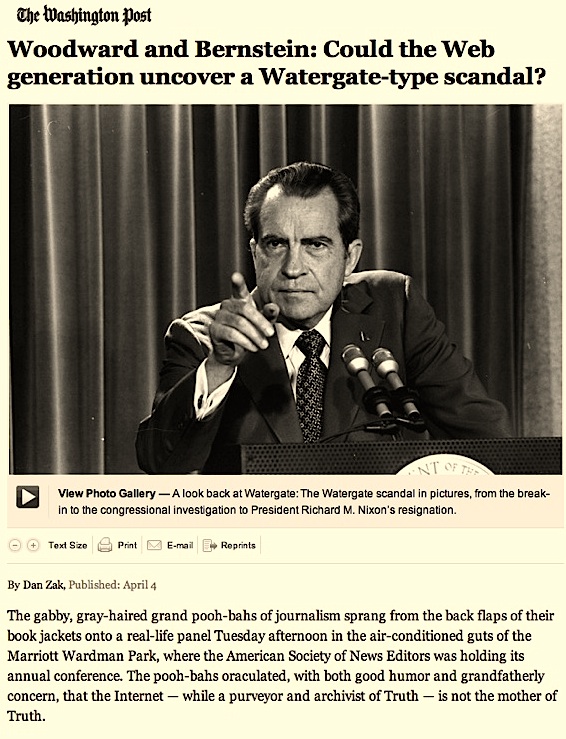
Worth a read: this brief article by Dan Zak at The Washington Post Woodward and Bernstein: Could the Web generation uncover a Watergate-type scandal? discussing how a ubiquitous internet has so seized the world-view of even bright people that they think journalistic ‘sleuthing’ can be done online and that no corrupt power can but kneel before the web.

“The truth of what goes on is not on the Internet. [The Internet] can supplement. It can help advance. But the truth resides with people. Human sources.”

Human sources — indeed. And, as the Watergate scandal and revelations about ‘Deep Throat’ Mark Felt proved, those human sources can have their own agenda too.

Dan Zak’s article is drenched in, if not contempt, what sounds like generation-gap-esque disdain for the “gabby, gray-haired grand pooh-bahs of journalism” but he makes a good point:

If Watergate happened today, it would probably involve a hacking, not a burglary.

He’s right about that. Or a LEAK.

Consider Manning/Assange/Wikileaks — today’s version of Daniel Elsberg and associated news publishers of the time. Same formula, different scale and methodology.

The power of the web and ease of ‘data’ copying and transmission are two-edged swords in the hands of the reporters and the reported … and whistle-blowers.

Lamenting the budget-constrained loss of investigative reporting doesn’t change the fact that ‘stories’ have always been about people, and power, and how they interact. From Plutarch to Pilger.

Our ‘connected world’ and the fact that anyone can call up your credit-rating, criminal history, satellite pictures of your home, etc hasn’t changed that.

– P

Bank sugar coats price-fixing penalty as ‘rebate’

‘Spin’ (bending reality), is not a phenomenon just confined to politics.

At the risk of being accused of ‘looking a gift horse in the mouth’, here’s a fine example:
Yesterday I saw this letter which looks like a kind gesture from the BNZ — telling ‘small business owners’ who are credit card merchants about the bank’s ‘support’ for them, and sharing news of a $125 ‘rebate’ …

Wow, THANKS BNZ for giving us back some of the money you gouged from us when forced to by High Court action.

Best line: ‘This rebate is yours to invest back into your business.’
Translation: ‘Because it was your money that we over-charged you in the first place.’

‘Rebate’, BNZ? Riiiight. But, funny, when I read the October 2009 detail of the ‘agreement’ the BNZ has reached with the Commerce Commission referred to in the postscript, I see it was the result of High Court action against financial institutions … which seven settled: ANZ National, ASB, Westpac New Zealand Ltd, Bank of New Zealand, Kiwibank/New Zealand Post, TSB Bank, and The Warehouse Financial Services Limited.

The Commission claimed in High Court proceedings that the parties breached the Commerce Act by agreeing and implementing the Visa and MasterCard credit card scheme rules in New Zealand which, among other things, provided for the payment of multilateral interchange fees. The Commission alleged that these rules substantially lessened competition by artificially inflating the cost to retailers of accepting credit cards and ultimately raising prices paid by all consumers.

Relevant sections of the Commerce Act. The proceedings are brought under sections 27 and 30 of the Commerce Act 1986. Section 27 prohibits contracts, arrangements or understandings that substantially lessen competition. Section 30 prohibits price fixing, which is when people or businesses that are in competition with each other agree to control, fix or maintain the prices for the goods or services that they supply. Price fixing is deemed to substantially lessen competition under section 27 of the Commerce Act.

Thanks for the support BNZ.

– P