On narrow social focus and moral taste buds

20120325-084404.jpg

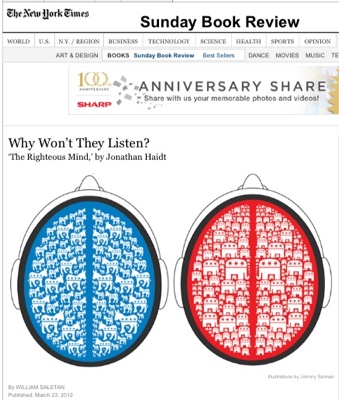
A wonderful book review in the NY TimesWhy Won’t They Listen?’ sheds some light on the ‘my tribe is better than yours’ bias we discuss here from time to time.

Reviewing The Righteous Mind by Jonathan Haidt, William Saletan describes how we acquire preferences for social values (liberal v conservative) over time, based on our upbringing and environment.

We may attempt to write off other people’s values as bigoted and reactionary, but really, it’s worth taking a step back and trying to see the ‘good’ they’re based on. (‘Empathy’, as I keep harping on about, although the word doesn’t appear in Saletan’s review.) As he explains, a predisposition to espouse support for morality, authority, sanctity as values can start with a ‘taste’ as we’re brought up.

The worldviews Haidt discusses may differ from yours. They don’t start with the individual. They start with the group or the cosmic order. They exalt families, armies and communities. They assume that people should be treated differently according to social role or status — elders should be honored, subordinates should be protected. They suppress forms of self-expression that might weaken the social fabric. They assume interdependence, not autonomy. They prize order, not equality.

These moral systems aren’t ignorant or backward. Haidt argues that they’re common in history and across the globe because they fit human nature. He compares them to cuisines. We acquire morality the same way we acquire food preferences: we start with what we’re given. If it tastes good, we stick with it. If it doesn’t, we reject it. People accept God, authority and karma because these ideas suit their moral taste buds. Haidt points to research showing that people punish cheaters, accept many hierarchies and don’t support equal distribution of benefits when contributions are unequal.

You don’t have to go abroad to see these ideas. You can find them in the Republican Party. Social conservatives see welfare and feminism as threats to responsibility and family stability. The Tea Party hates redistribution because it interferes with letting people reap what they earn. Faith, patriotism, valor, chastity, law and order — these Republican themes touch all six moral foundations, whereas Democrats, in Haidt’s analysis, focus almost entirely on care and fighting oppression. This is Haidt’s startling message to the left: When it comes to morality, conservatives are more broad-minded than liberals. They serve a more varied diet.

OK, yeah, much as I don’t like being put in a monolithic pigeon hole (‘the left’) he has a point.

It’s more than that. We all (liberals and conservatives) each tend to defend our positions by arguing with an often quickly rendered cliché version of ‘the other side’. We look for, perceive and remember data which we interpret as ‘evidence’ (‘proof’ even) that our existing ideas and values are the ‘correct’ ones. It’s the problem with paradigms, in other words, as we have discussed here before.

I’ve always said no ‘side’ is better or worse than the other at getting off their point of view. We’re equally quick to judge each other as inferior. Haidt disagrees:

The hardest part, Haidt finds, is getting liberals to open their minds. Anecdotally, he reports that when he talks about authority, loyalty and sanctity, many people in the audience spurn these ideas as the seeds of racism, sexism and homophobia. And in a survey of 2,000 Americans, Haidt found that self-described liberals, especially those who called themselves “very liberal,” were worse at predicting the moral judgments of moderates and conservatives than moderates and conservatives were at predicting the moral judgments of liberals. Liberals don’t understand conservative values. And they can’t recognize this failing, because they’re so convinced of their rationality, open-mindedness and enlightenment.

Haidt isn’t just scolding liberals, however. He sees the left and right as yin and yang, each contributing insights to which the other should listen. In his view, for instance, liberals can teach conservatives to recognize and constrain predation by entrenched interests. Haidt believes in the power of reason, but the reasoning has to be interactive. It has to be other people’s reason engaging yours. We’re lousy at challenging our own beliefs, but we’re good at challenging each other’s. Haidt compares us to neurons in a giant brain, capable of “producing good reasoning as an emergent property of the social system.”

That, “We’re lousy at challenging our own beliefs, but we’re good at challenging each other’s” is a key statement. (Which is only to say it reinforces my already-held model of the world!)

In my experience, despite the [alleged] broadmindedness of conservatives, an attempted discussion about policy or morality, even a questioning of some assertions, can very quickly lead some personality types to retreat to their mental bunker, spewing.

I haven’t read Haidt’s book yet but I will.

In the meantime, read the illuminating review here at NY Times.

– P

What do you think?

Sign on the ferry back from camp yesterday. When I read ‘body parts’ I think ‘dismembered’. Am I wrong?

– P

20120324-202619.jpg

Update: You know, like chicken pieces.

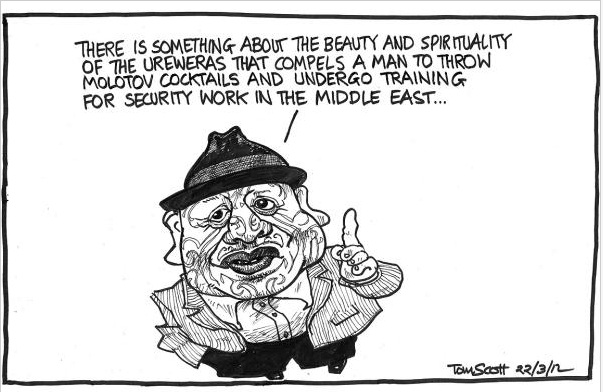
This is a very good cartoon

Tom Scott — as sharp as ever …

Yeah, it does sound implausible. But has the prosecution actually PROVED anything else? Because that's the test, y'all.

It’s a funny thing, the justice system. I worked at the Supreme Court when Arthur Allan Thomas was going through an ill-fated appeal of his 1971 wrongful convictions for murder. A scientist named Jim Sprott conclusively discredited the police ‘evidence’ that a shell casing they said they miraculously ‘found’ in a flower bed linked Thomas to the Crewe murders.

Sprott showed the shell casing had never been manufactured with slugs of the type found in Harvey & Jeanette’s bodies. So the police, Thomas’s defence implied, must have manufactured their evidence. (I could have said ‘planted it in the garden’, but that would be a terrible pun.) Nevertheless, Thomas’s appeal was still dismissed and he and his family had to wait until a Royal Commission exonerated him and he was released in 1979. How’s that for justice?

I don’t know what the hell was going on in the Ureweras, but to make it a crime, you have to prove it was.

– P

(Thanks to Jacqueline Sperling for highlighting Tom’s cartoon.)

Bryan Gould’s must-read on the changing face of John Key

Wow. I’m still catching up on things that popped up while I was away and largely offline this week.

Read this analysis from the nothing-if-not-polarising Bryan Gould in the NZ Herald: Tougher approach hints this term is Key’s last

What is now clear is that the goal of the first term was simply to win the 2011 election. The key to achieving that goal was to be the Prime Minister’s personal popularity – particularly with the politically uncommitted.

That goal having been achieved, a quite different goal has now been identified. A Prime Minister who was criticised in his first term for being lightweight and not making a difference seems now to have set himself the task of making his mark and leaving a political legacy.

The second term, it seems, will be used to push through an agenda of change which may commend itself less – or not at all – to the uncommitted, but which will deliver to the Prime Minister’s own closest supporters much of what they elected him to do.

That’s been my impression too. What I earlier called ‘The Punch and Judy Show‘ of the Key/Joyce (Joyce/Key?) government had been characterized by, for the most part, deft political management (i.e. extreme sensitivity to public opinion and maintaining Key’s likability quotient) in the first term — with the odd slip.

But that was then, this is now. Things are different, majority of one notwithstanding.

Gould correctly (in my view) fingers the driver: rewards for the ruling party’s supporting constituency. Many of National’s more hard core supporters tolerated the ‘incrementalism’ of the first term for just the reasons Bill English and Lockwood Smith spelt out on the clandestine recordings at a National Party conference: So as not to alarm the populace/frighten the horses … while they prepared to gently, then not so gently ease in the ‘reforms’ with or without public support.

Political parties, whether tories or socialists, exist for the purpose of benefitting their constituencies … by whatever means are at their disposal. That’s democracy folks.

– P

Simon Power is putting it all behind him. Whaaat?

This caught my eye in today’s NZ Herald piece Govt turns its back on terror law about the woeful state (sarcasm) of our country’s botched me-too Terrorism Suppression Act.

pic: u-s-history.com (click)

[Former justice minister] Mr Power, now a banker, said yesterday he could not recall why he allowed the review of the act to be dropped. He had made a decision when he left politics last November not to comment about events that occurred while he was in Government.

The most significant ‘I can’t recall’ why I acted/didn’t act as I did was in my view Ronald Reagan on the Iran-Contra scandal. A ‘patriot’ by the name of Oliver North working for Reagan secretly arranged illegal US arms sales (i.e. in defiance of an arms embargo) to ‘sworn enemy’ Iran — now being described by hawks in the US as ‘America’s Number One Enemy’ — then funneled funds to Contra rebels in Nicaragua to oppose the ‘Marxist’ Sandanista regime.

Reagan repeatedly testified he ‘didn’t recall’, ‘didn’t know’ and ‘couldn’t recollect’ details of these extraordinary events. (See NY Times: Excerpts From Reagan’s Testimony on the Iran-Contra Affair)

He was probably in the early stages of Alzheimer’s disease.

What’s Simon Power’s excuse?

– P

Heads must roll: Minister for Marmite

While I was away I heard the Marmite crisis predicted last year has actually bitten — hard. I didn’t know Nick Smith was the Minister responsible for Marmite, but, well, yeah, I can see he really had to go. Accountability.

Marmite stocks exhausted. Minister resigns. Fair enough too. (pics: thedailywh.at and Fairfax)

On a serious note, Smith’s cronyism has added more weight to those suggesting an image of sleaze has attached to the National Government. Stephen McElrea, Wayne Mapp, …

– P

Fishing for suckers

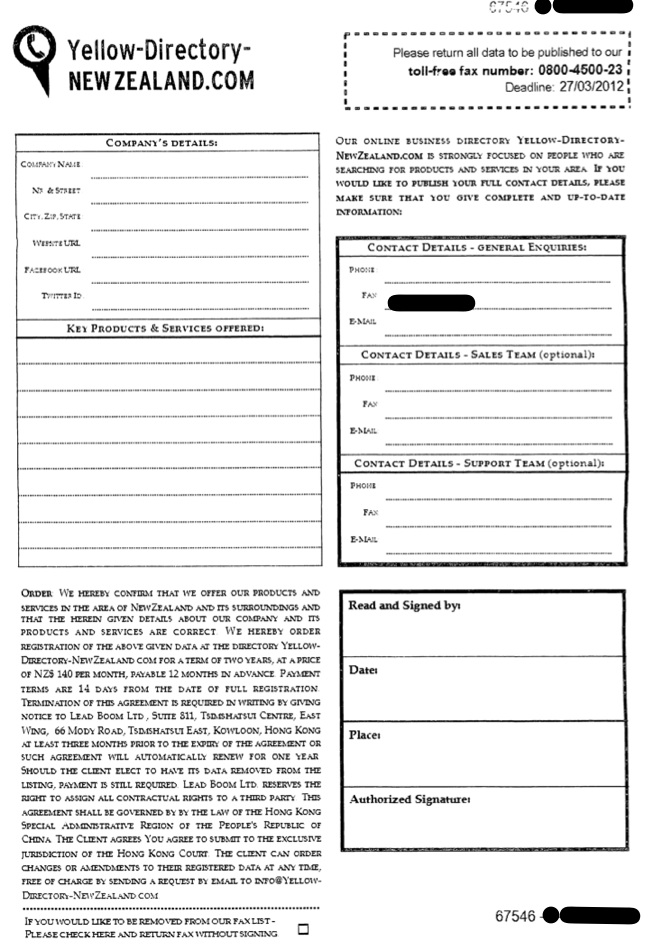
Just back from my school camp/tropical island holiday (ha!) and look what was on the fax machine: A new scam looking for victims…

Fishy? Yup.

Yellow Pages Group is warning its small business customers not to be sucked in by a scam that asks for their details so that they can be listed online.
The faxed request from a company called Yellow-Directory-NEWZEALAND has been identified as a scam by the Department of Internal Affairs.
It asks customers to sign up for a listing period of two years at $140 per month.
Yellow Pages says people should ”exercise extreme care” when engaging with the company. … stuff.co.nz

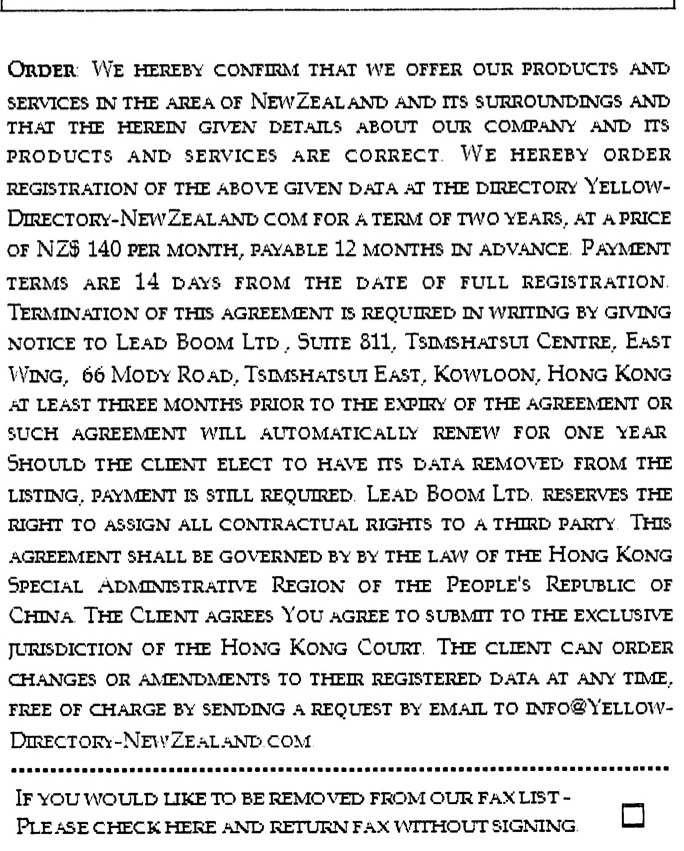
Here’s the fine print they probably don’t want you to read … “Should the client elect to have its data removed from the listing payment is still required.” [At $140 per month!]

Fishhooks and broken glass. Or 'fine print' as it's known. (click to enlarge)

Dorks. But (shockingly) it must work!

Oh dear.

– P

Tropical holiday

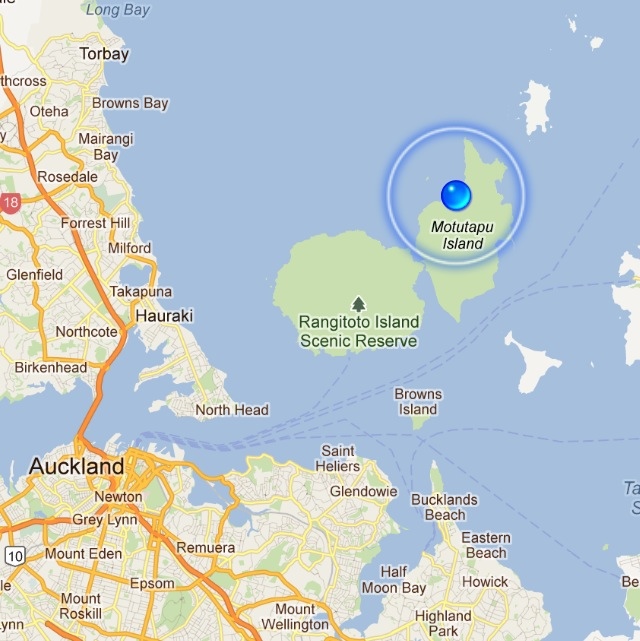
I’m a parent helper on my son’s school camp on Motutapu Island this week … so things will be quiet from me.

Go well in the meantime. – P

20120320-223447.jpg

Read the logo. What do you see?

Designer Erik Spiekermann: Standing on the shoulders of giants? Or appropriating existing symbology and harvesting its legacy?

Thought provoking.

– P

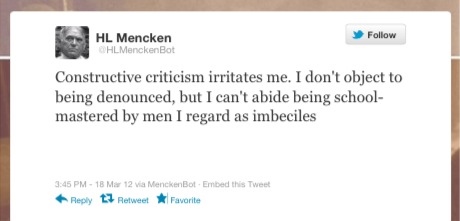
Denounced

I’m writing a post about denunciation and related matters … and look what popped up in my twitter stream:

20120318-183406.jpg

Ha!

-P

Hidden liability in a dotcom domain name

I did not know this:

… having a .com domain name for [your] website is sufficient for [you] to be subject to US jurisdiction – which allows for nasty stuff like the US government seizing [your] website or extradition to USA to stand trial over there based on allegations alone.
The bottom line: If you have a .com domain name, or other at-risk domain names like .net, you are subject to US domestic laws and jurisdiction.

Food for thought from Have a .com web address? Know the legal risks by Vikram Kumar | National Business Review.

Reality check?

Worth a look. The war of the US election campaign videos is going to get intense.

The Road We’ve Traveled
Published on Mar 15, 2012 by BarackObamadotcom

Remember how far we’ve come. From Academy Award®-winning director Davis Guggenheim: “The Road We’ve Traveled”.
This film gives an inside look at some of the tough calls President Obama made to get our country back on track. Featuring interviews from President Bill Clinton, Mayor Rahm Emanuel, Elizabeth Warren, David Axelrod, Austan Goolsbee, and more. It’s a film everyone should see.

A dark, cynical, political thrill

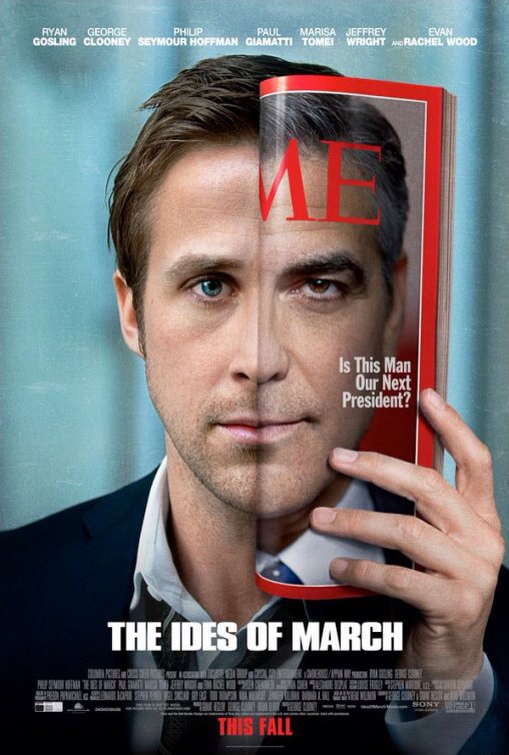
I saw this film ‘The Ides of March’ with a pal on Friday night and it was brilliant. Dark, sinister, awful, and brilliant.

What is it about politics that provokes acts of treachery and intrigue? Why does it so often descend into the arena of personal destruction?

Plutarch records the intrigue surrounding Brutus’ assassination of Julius Caesar. What’s changed? Nuttin’.

When I hear someone say they were brought up in an intensely political family, I know more often than not that means they heard schemes and plots to cut the ground out from under political rivals.

Look at the language of the dark side of politics: knee-cap, knobble, cripple, crush, destroy. They mean business. These words, used as verbs (‘doing words’) describe actions aimed at neutralizing (at best) the ‘opposition’. It matters not, of course, whether that opposition is, for the time being, within one’s own party or not. Ambitious political animals will savage each other and climb over each other’s still warm body (figuratively speaking) for political advantage.

The binary choice: ‘You’re either for us or agin us’ applies. Intimidation and threat is, distastefully, very common.

If it is possible to undercut one’s enemies and destroy their confidence to the extent that a battle or actual showdown is avoided, well, so much the better, seems to be the approach. Truth is secondary. Consider the political leaders you know about who, presented with information (true or false) chose to resign rather than wait for an axe to fall. Don Brash has been on all sides of those equations — the shafter, the shaftee, etc. Beneficiary and victim of the process.

Hang out with political animals, as I have done, and you’ll find they are, by nature, schemers. (Even worse than journalists! Actually, in my experience most journos are intensely interested in the whole wheels-within-wheels, story-behind-the-story aspects of life. We’re curious to know the ‘real story’. Oh, and we’re gossips.)

Arch schemers like National’s Michelle Boag and Labour’s Mike Williams, now both relatively mellow (or so they would have you suppose), still benignly spin and machinate when they can. They have been in many a brutal campaign.

By the time a polished political figure (like, say Barack Obama) appears in any meaningful public profile, they’ve in most cases experienced the private, behind the scenes deal crunching, trade-offs, arm wrestles, alliances of convenience, neutralizing of opponents, dealing with political scandals real and manufactured, and ugly, cynical compromises … which is what the movie ‘The Ides of March’ is all about,

Chess, they say, resembles war — it’s a strategy game with bursts of ‘killing’ and planned sacrifice. So it is with politics.

– P

Fabrications, lies, errors – and ‘dramatic licence’

A huge embarrassment for ‘This American Life’ …

RETRACTING “MR. DAISEY AND THE APPLE FACTORY”
16 March 2012
Ira [Glass, Executive Producer and Host of This American Life] writes:

I have difficult news. We’ve learned that Mike Daisey’s story about Apple in China – which we broadcast in January – contained significant fabrications. We’re retracting the story because we can’t vouch for its truth. This is not a story we commissioned. It was an excerpt of Mike Daisey’s acclaimed one-man show “The Agony and the Ecstasy of Steve Jobs,” in which he talks about visiting a factory in China that makes iPhones and other Apple products.

The China correspondent for the public radio show Marketplace tracked down the interpreter that Daisey hired when he visited Shenzhen China. The interpreter disputed much of what Daisey has been saying on stage and on our show. On this week’s episode of This American Life, we will devote the entire hour to detailing the errors in “Mr. Daisey Goes to the Apple Factory.”

Daisey lied to me and to This American Life producer Brian Reed during the fact checking we did on the story, before it was broadcast. That doesn’t excuse the fact that we never should’ve put this on the air. In the end, this was our mistake.

We’re horrified to have let something like this onto public radio. Many dedicated reporters and editors – our friends and colleagues – have worked for years to build the reputation for accuracy and integrity that the journalism on public radio enjoys. It’s trusted by so many people for good reason. Our program adheres to the same journalistic standards as the other national shows, and in this case, we did not live up to those standards.

A press release with more details about all this is below. We’ll be posting the audio of the program and the transcript on Friday night this week, instead of waiting till Sunday.

Read press release here

Mike Daisy’s response:

I stand by my work. My show is a theatrical piece whose goal is to create a human connection between our gorgeous devices and the brutal circumstances from which they emerge. It uses a combination of fact, memoir, and dramatic license to tell its story, and I believe it does so with integrity. Certainly, the comprehensive investigations undertaken by The New York Times and a number of labor rights groups to document conditions in electronics manufacturing would seem to bear this out.

What I do is not journalism. The tools of the theater are not the same as the tools of journalism. For this reason, I regret that I allowed THIS AMERICAN LIFE to air an excerpt from my monologue. THIS AMERICAN LIFE is essentially a journalistic ­- not a theatrical ­- enterprise, and as such it operates under a different set of rules and expectations. But this is my only regret. I am proud that my work seems to have sparked a growing storm of attention and concern over the often appalling conditions under which many of the high-tech products we love so much are assembled in China. [emphasis added]

For the second time this week, I say: this reminds me of some bloggers.

It’s just not good enough nor credible to pose as someone who appears to abide by journalistic values of truth and accuracy, purporting to ‘report’ ‘facts’ … but inserting lies, distortions and partisan disinformation … then, when shown to be a liar, trotting out a ‘but I’m not a journalist‘ routine.

Unconvincing.

– P

Update: Here’s Rob Schmitz’s more detailed account of uncovering Mike Daisy’s ‘dramatic licence’ (read: deceit) An acclaimed Apple critic made up the details (marketplace.org)

51% of web site traffic is ‘non-human’

image: jeffbots.com (click)

“Report: 51% of web site traffic is ‘non-human’ and mostly malicious

By Tom Foremski | March 13, 2012, ZD Net

Summary: Web site analytics packages record what real people do on a site but most web site traffic comes from other computers often with nefarious intent.

Incapsula, a provider of cloud-based security for web sites, released a study today showing that 51% of web site traffic is automated software programs, and the majority is potentially damaging, — automated exploits from hackers, spies, scrapers, and spammers.

The company says that typically, only 49% of a web site’s visitors are actual humans and that the non-human traffic is mostly invisible because it is not shown by analytics software.

This means that web sites are carrying a large hidden cost burden in terms of bandwidth, increased risk of business disruption, and worse.

Here’s a breakdown of an average web site’s traffic:

– 5% is hacking tools searching for an unpatched or new vulnerability in a web site.
– 5% is scrapers.
– 2% is automated comment spammers.
– 19% is from “spies” collecting competitive intelligence.
– 20% is from search engines – which is non-human traffic but benign.
– 49% is from people browsing the Internet.

The data was collected from a sample of 1,000 websites that are enrolled in the Incapsula service. …”

(Via Report: 51% of web site traffic is ‘non-human’ and mostly malicious | ZDNet)

Now THAT’S worth knowing when considering puffed-up claims of ‘follower’ figures on, say, blogs, doncha think?

– P