Ironic, Mr Zuckerberg. Ironic.

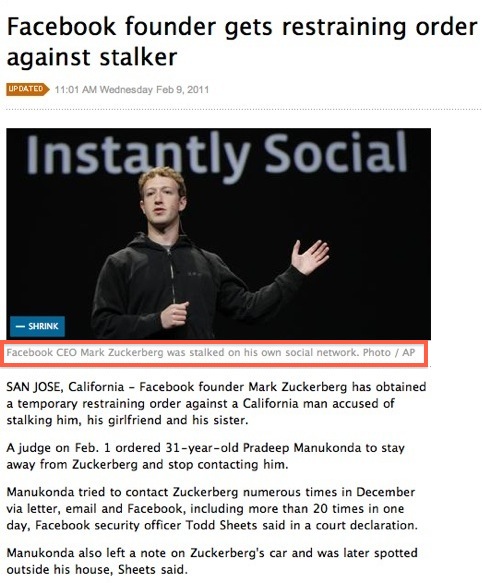
Facebook founder Mark Zuckerberg has obtained a temporary restraining order against a California man accused of stalking him, his girlfriend and his sister.

… [Alleged stalker] Manukonda tried to contact Zuckerberg numerous times in December via letter, email and Facebook, including more than 20 times in one day, Facebook security officer Todd Sheets said in a court declaration…

Click to read the story at NZHerald.co.nz

Do I need to say anything, Mr ‘Instantly Social’?

No, I didn’t think so.  (More like ‘Insanely Social’.)

Uncovering the Scientology cult and its practices

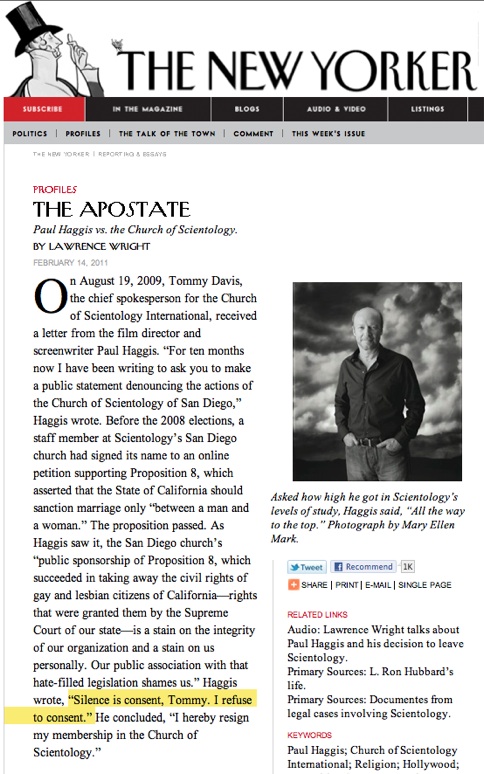
Writing in The New Yorker, Lawrence Wright gives a comprehensive and illuminating account of the cult known as the Church of Scientology. His article is a follow-up the controversy surrounding writer/film director Paul Haggis’s public defection after 35 years as a Scientologist.

Click to to read at The New Yorker.

I quoted Haggis’s resignation letter with its core message: ‘Silence is consent … I refuse to consent‘ in an early post here on thePaepae.com.

It’s one of my themes — the need to speak up about wrongdoing… which Hubbard’s very own philosophy expounds (see below).

Wright’s carefully written article (as you do) is REALLY worth reading … it’s long, so if you can’t make the time now, archive it for later when you do. It’s a must-read. Some highlights:

‘Hubbard says that there is a relationship between knowledge, responsibility, and control, and as soon as you know something you have a responsibility to act. And, if you don’t, shame on you.’ [Comment: See?]

In October, 2009, Marty Rathbun called Haggis and asked if he could publish the resignation letter on his blog. Rathbun had become an informal spokesperson for defectors who believed that the church had broken away from Hubbard’s original teachings. Haggis was in Pittsburgh, shooting his picture. “You’re a journalist, you don’t need my permission,” Haggis said….

When Haggis first turned to Scientology, he considered himself an atheist. Scientology seemed to him less a religion than a set of useful principles for living. He mentioned the ARC Triangle; “ARC” stands for “Affinity, Reality, and Communication.” Affinity, in this formulation, means the emotional response that partners have toward each other; reality is the area of common agreement. Together, these contribute to the flow of communication. “The three parts together equal understanding,” Haggis said. “If you’re having a disagreement with someone, your affinity drops quickly. Your mutual reality is shattered. Your communication becomes more halted. You begin to talk over each other. There’s less and less understanding. But all you need to do is to raise one part of the triangle and you increase the others as well. I still use that.” [Comment: Yes, so do I, but fortunately, I didn’t have to join a cult to learn it!]

I once asked Haggis about the future of his relationship with Scientology. “These people have long memories,” he told me. “My bet is that, within two years, you’re going to read something about me in a scandal that looks like it has nothing to do with the church.” He thought for a moment, then said, “I was in a cult for thirty-four years. Everyone else could see it. I don’t know why I couldn’t.

Wright’s article exposes what I can only interpret as corrupt and bullying practices within the ‘Church’ (hardly a novelty for an organised religion, I’m sorry to say). The [alleged] forgeries and misuse of legal process (sworn statements etc) are eye-opening.

Personally, I found the hectoring and threatening tactics the Scientologists use reminiscent of Matthew Gilligan’s response to online discussion about the marketing methods used to sell his Sponge Bay and Perriam Cove subdivisions … discussion since expunged (ex-Sponged?) from the internet.

Seriously, read it at The New Yorker. Fine work.

Heady assumptions, a get-rich-quick climate, wishful thinking …

Boom-bust, not not so much good, bad. (Wilson Quarterly - click)

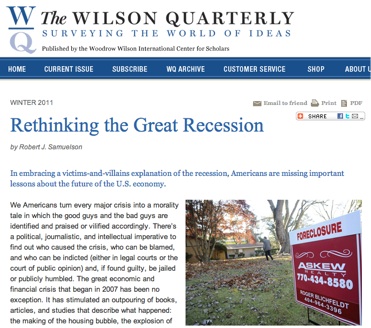
I’ve just read a fantastic article Rethinking the Great Recession by Robert J. Samuelson in the The Wilson Quarterly. Wow.

Instead of hand-wringing and wailing about ‘What’s happening to us?’ Samuelson’s plausible analysis points to a widespread forgetting of the boom-bust lessons of history…

The great economic and financial crisis that began in 2007 … has stimulated an outpouring of books, articles, and studies that describe what happened: the making of the housing bubble, the explosion of complex mortgage-backed securities, the ethical and legal shortcuts used to justify dubious but profitable behavior. This extended inquest has produced a long list of possible villains: greedy mortgage brokers and investment bankers, inept government regulators, naive economists, self-serving politicians. What it hasn’t done is explain why all this happened.

The story has been all about crime and punishment when it should have been about boom and bust. The boom did not begin with the rise of home prices, as is usually asserted. It began instead with the suppression of double-digit inflation in the early 1980s, an event that unleashed a quarter-century of what seemed to be steady and dependable prosperity. …. As inflation fell, interest rates followed. The stock market soared. From 1979 to 1999, stock values rose 14-fold.

Housing prices climbed, though less spectacularly. Enriched, Americans borrowed and spent more. But what started as a justifiable response to good economic news—lower inflation—slowly evolved into corrupting overconfidence, the catalyst for the reckless borrowing, overspending, financial speculation, and regulatory lapses that caused the bust.

In some ways, the boom-bust story is both more innocent and more disturbing than the standard explanations of blundering and wrongdoing. It does not excuse the financial excesses, policy mistakes, economic miscalculations, deceits, and crimes that contributed to the collapse. But it does provide a broader explanation and a context.

People were conditioned by a quarter-century of good economic times to believe that we had moved into a new era of reliable economic growth. Homeowners, investors, bankers, and economists all suspended disbelief. Their heady assumptions fostered a get-rich-quick climate in which wishful thinking, exploitation, and illegality flourished. People took shortcuts and thought they would get away with them. In this sense, the story is more understandable and innocent than the standard tale of calculated greed and dishonesty. Continue reading →

Oh.

315 million reasons to build an internet following … Well done to the crew at Huffington Post. I guess.

Huffington Post Gets Bought by AOL for $315 Million

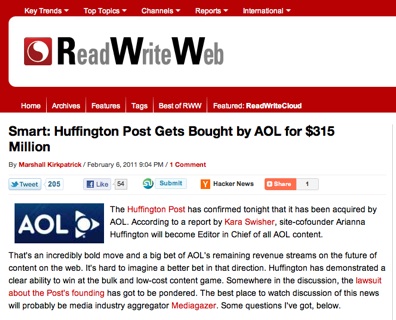
The Huffington Post has confirmed tonight that it has been acquired by AOL. According to a report by Kara Swisher, site-cofounder Arianna Huffington will become Editor in Chief of all AOL content.

That’s an incredibly bold move and a big bet of AOL’s remaining revenue streams on the future of content on the web. It’s hard to imagine a better bet in that direction. Huffington has demonstrated a clear ability to win at the bulk and low-cost content game. Somewhere in the discussion, the lawsuit about the Post’s founding has got to be pondered. The best place to watch discussion of this news will probably be media industry aggregator Mediagazer.

But, but, but … well, bravo!

I hate to be a nag about Facebook, but this is the sort of thing that makes my blood run cold. Good on these guys for exposing what can happen …

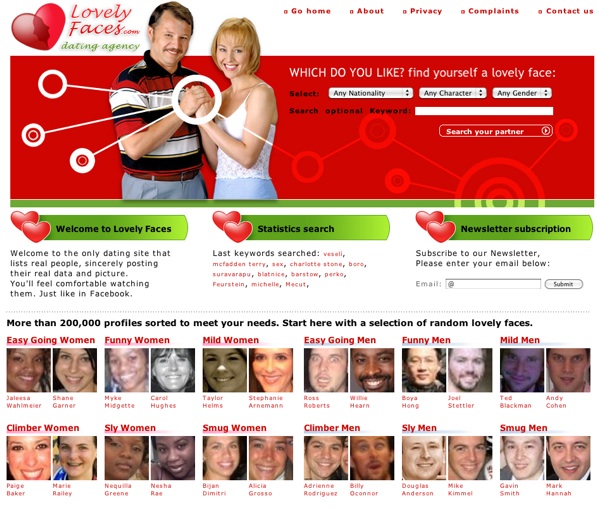
What they did was set up a fake ‘Dating’ website called Lovely Faces .. and populated it with REAL names, locations and photos — all scraped from publicly accessible Facebook pages.

(Ugh! Try explaining THAT to your spouse who somehow heard that you’re ‘back on the market, looking for love’ … I know a guy who irredeemably fractured a relationship by posting his profile on a singles site.)

As Wired reports:

The site categorizes these unwitting volunteers into personality types, using a facial recognition algorithm, so you can search for someone in your general area who is “easy going,” “smug” or “sly.” Or you can just search on people’s real names.

Now, as it turns out, the site is an awareness-raising stunt to get people to THINK ABOUT WHAT YOU PUT ON FACEBOOK … and how ‘trustworthy’ a for-profit corporation will be with YOUR private data.

Stealing 1 million Facebook profiles, filtering them with face-recognition software, and then, posting them on a custom-made dating website, sorted by their facial expressions characteristics.

The founders of the experimental website explain in a detailed post:

“Facebook, an endlessly cool place for so many people, becomes at the same time a goldmine for identity theft and dating — unfortunately, without the user’s control,” …. “But that’s the very nature of Facebook and social media in general. If we start to play with the concepts of identity theft and dating, we should be able to unveil how fragile a virtual identity given to a proprietary platform can be.”

Nice one.

Quite a lot of wannabe Hemingway

Oh zing!

From Ed Vulliamy’s The Observer piece about WikiLeaks publishing US State Department cables re the background of the Egyptian — gee, what do we call it? Uprising? Revolution? Riots?

Julian Assange: ‘How do you attack an organisation? You attack its leadership’

Julian Assange … has been up all night disseminating, on his WikiLeaks site, American State Department cables and documents relevant to the events unfolding in Egypt, and they make remarkable reading.

The United States diplomats writing the cables leaked to Assange report many of the reasons for the Egyptian uprising: torture of political dissidents, even common criminals, to obtain confessions; widespread repression and fear; and the increasingly important role of internet activism, opposition blogging and communication with democratic movements via the web.

As ever with the diplomatic memorandums published by WikiLeaks – which has made Assange public enemy number one in the US – the cables are, ironically, testimony to the professionalism and straight-talking of the US State Department. Assange concedes that the cables contain “a relative honesty and directness, and quite a lot of wannabe Hemingway”.

Read the article here at The Observer … and not just for the bitch slaps. This is a fascinating time to be alive and the insights the WikiLeaks HEROES (yes!) are revealing are, on the whole, illuminating.

The ‘rising tide of hostility’ Julian Assange (reportedly) faces smacks of the same smear and ‘decapitation attacks’ that I guess the CIA and its equivalents will be waging against him as head of WikiLeaks.

As for The Guardian reporters who’ve written a book about him, following their collaboration to originally publish the WikiLeaks material (a scoop any way you look at it), well, that’s to be expected. Seeking their 15 minutes of fame. We live in a culture of celebrity. Look how The Guardian demeaned its primary source in these matters:
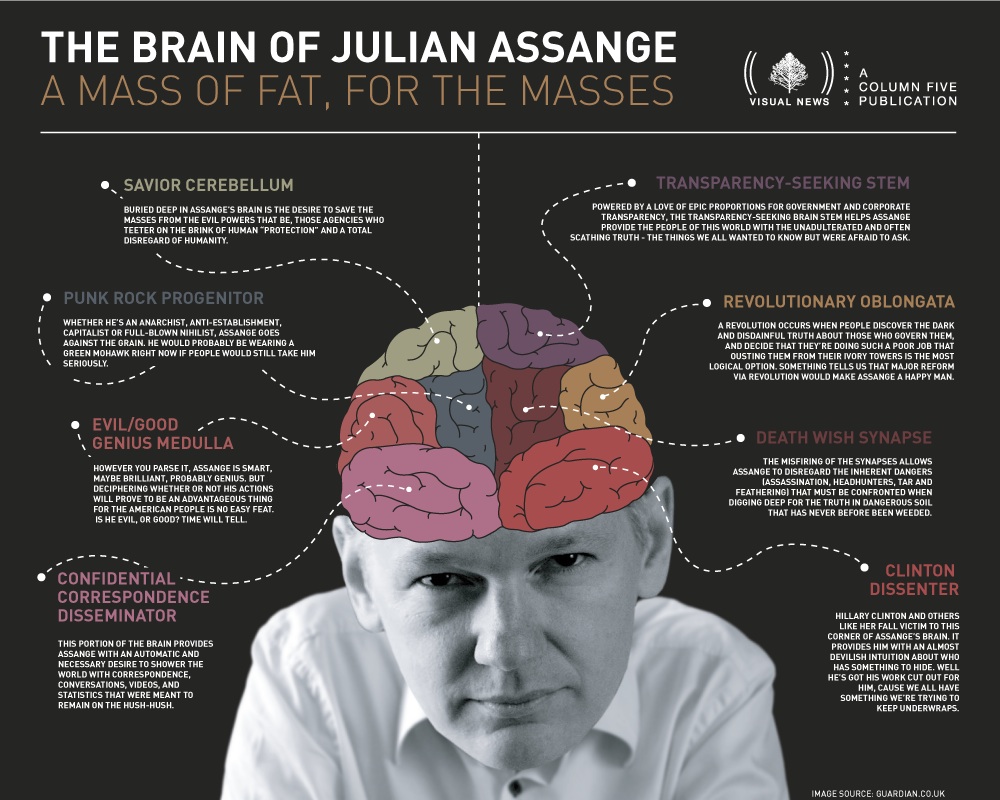
Biting the hand that feeds you. This kind of gutless schizophrenic hero/devil treatment of Julian Assange by his media collaborators annoys me. Cheap shots from weasels trying to prove their independence credentials, in my opinion. (Source: Guardian.co.uk click to enlarge)

According to Vulliamy, Assange sees the book and the Bill Keller piece as attacks. He’s sensitive. I would be too. There’s a nauseating ‘see-we’re-not-in-love-with-WikiLeaks’ stageshow being promulgated by some in the media which stinks to me. A little fishy. It smacks a little too much of FUD. And we know who is good at that, don’t we?
+
UPDATE: Interesting headline on this very same article in the NZ Herald:

Public enemy No 1 faces his accusers

Ooooh. I wonder who tacked that on? It may be syndication…?

+
UPDATE 2: from the Huffington Post
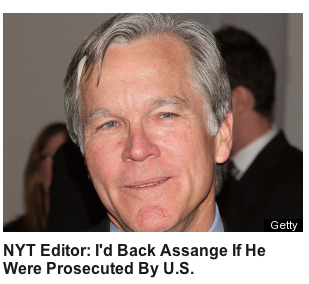
Bill Keller: 'Whatever one thinks of Julian Assange...journalists should feel a sense of alarm at any legal action that intends to punish Assange for doing what journalists do.'— report from the Huffington Post (click)

The editors of The Guardian and the New York Times both said they would back WikiLeaks chief Julian Assange if he were ever prosecuted by the U.S. government. They also said they are thinking of launching WikiLeaks-style operations at their own papers.

The comments from Alan Rusbridger, editor of The Guardian, and Bill Keller, editor of the Times, came at a panel about WikiLeaks on Thursday night. The panel was held at Columbia University. The two discussed their fractious relationship with Assange and the effect that WikiLeaks has had on journalism. Jack Goldsmith, the former Bush administration official, was also on the panel.

Both papers worked with Assange on a series of explosive scoops throughout 2010–until a series of arguments and decisions by the two news outlets led to the severing of their ties with Assange. But they both said they would firmly side with Assange if he were prosecuted. The Justice Department has acknowledged that it is seeking to charge him with violating the Espionage Act of 1917 for publishing secret documents and soliciting them from Bradley Manning, the alleged leaker who is now in jail.

“If, God forbid, ever this came to court, I’d…stand completely shoulder to shoulder with him,” Rusbridger said. “I have great admiration for him [and] respect for a lot of the stuff that he’s done.”

Keller said that he was “not a lawyer,” but that it would be “hard to conceive of a prosecution of Julian Assange that wouldn’t stretch the law to be applicable to us. Whatever one thinks of Julian Assange…journalists should feel a sense of alarm at any legal action that intends to punish Assange for doing what journalists do.”… Read on …

Amen

Bad scene in Egypt — round up the usual suspects

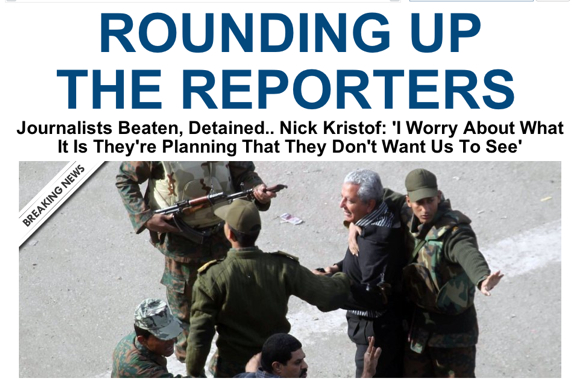
A crackdown on the truth often starts with rounding up the journalists…

images from Huffington Post.

+
UPDATE 5/2/11

Bugger!

JP Morgan execs: Useless as [insert expletive here]

In today’s NY Times

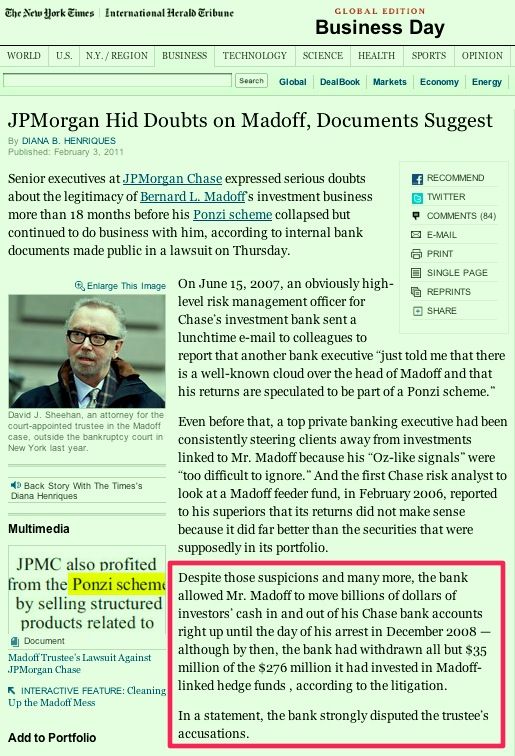
Senior executives at JPMorgan Chase expressed serious doubts about the legitimacy of Bernard L. Madoff’s investment business more than 18 months before his Ponzi scheme collapsed but continued to do business with him, according to internal bank documents made public in a lawsuit on Thursday.

Pretty hard to swallow if you lost money in the Madoff scam. (click to read at NYTimes.com)

Oh. My. God.

If this is true (and that’s a big ‘if’ — and it’s being denied, see box) … then whatever the opposite of a whistle-blower is, those useless schmucks are it!

If you prick us, do we not bleed?

I had the opportunity for a long face-to-face discussion with Dean Letfus yesterday, as earlier forecast.

For those of you who haven’t met him, let me say first off I find Dean an intelligent, personable chap, with good communication skills and a sense of humour. (I’ve never subscribed to the ‘Say no good thing about your political opponents’ philosophy held by many politicians.) Nah, I’ve said it before: Dean can be good company.

EMPATHY makes the world go around (image: princetonprofs.blogspot.com - click)

We discussed a wide range of topics, some of which we disagreed about including, naturally, the fact that I have referred to some of his marketing statements and activities here on thePaepae.com from time to time … and I also comment on various of his partners and business alliances past and present (i.e. his track record) … and sometimes my comments can seem pretty negative.

I have, apparently (and understandably) cut or bruised Dean’s feelings at times by expressing my views as I have done and also with some juxtapositions. (I don’t want to overstate the ‘injury’. He seems OK.)

Reflecting on our conversation, which involved some to and fro over several hours but could never be described by an observer as ‘confrontational’, (Jeez, I’ve had Kieran Trass shouting at me in a café … a little awkward!) I want to say this, using my word of 2011 again: It’s good to empathise with others. We are all human, we all have emotional responses to the events that occur in our lives, and to our interactions with one another.

Shakespeare expressed it so wonderfully in The Merchant of Venice (Act 3, Scene I): Continue reading →

Shock! Horror! Scandal! Microsoft COPIES!

O hardy-har-har-har. Here’s a turn up for the books (NOT!)… via Danny Sullivan at Search Engine Land

Google: Bing Is Cheating, Copying Our Search Results

Here’s the slightly novel bit:

Bing Admits Using Customer Search Data, Says Google Pulled ‘Spy-Novelesque Stunt’

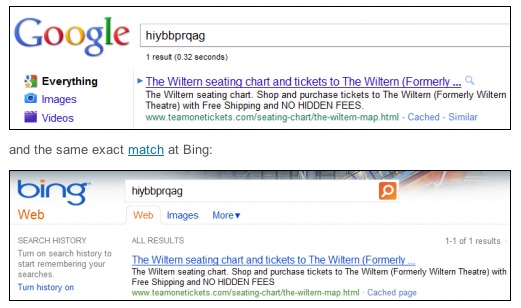
The details of the sting, which Danny Sullivan lays out, are interesting. Google artificially assigned nonsense words to unrelated search results then, searched for the ‘fake’ results (on Google) using Internet Explorer repeatedly.  What d’y’know? It wasn’t long before Microsoft Bing made the same nonsensical link! Several times. Oops.

An example. (Click to see more at SearchEngineLand.com)

But, for the p-p-p-paranoid, THIS is the bit that gets creepy

Google thought Microsoft’s Internet Explorer browser was part of the equation. Somehow, IE users might have been sending back data of what they were doing on Google to Bing. In particular, Google told me it suspected either the Suggested Sites feature in IE or the Bing toolbar might be doing this.

…Do Internet Explorer users know that they might be helping Bing in the way Google alleges? Technically, yes — as best I can tell. Explicitly, absolutely not.
Internet Explorer makes clear (to those who bother to read its privacy policy) that by default, it’s going to capture some of your browsing data, unless you switch certain features off. It may also gather more data if you enable some features.

Yechh!

Check Google dashboard out some time — but at least you can! (click)

All I can say is, if I was a Microsoft Internet Explorer user (shudder) I would have turned that setting OFF. Unlike some people, I don’t even stay logged into Google or iGoogle or Gmail … nor do I value their offer to record my web history. (In fact, drop over to google.com/dashboard some time and take a wee looksie at what they already know about YOU.)

Zing! Well, it's undeniable, isn't it?

Apple famously ran a poster campaign poking fun at Microsoft’s legendary, um,… lack of innovation with a slogan directed to Microsoft’s Redmond, Washington base:

Redmond, start your photocopiers.

That was Mac OS 10.4 Tiger. We’re currently at 10.6.6 Snow Leopard. Sigh. Don’t mention the iPhone and the iPad. (Oops.)

More cheap laughs from the same campaign here at Gizmodo.

Looks to me like Microsoft Bing is just doing business-as-usual.

How do you see it? (Craig: I already told you I was a one-eyed Apple fanboy, but seriously… what?)

Now, if both search engines can just put some energy into ridding the internet of spam pages and low-quality content MFA (rubbish) sites dressed up as ‘internet goldmines’ … please.

Get your own little piece of the subprime crisis

In my in-box today* from the UK-based property spruiker hawking Memphis distressed real estate … a chance to buy mortgage bonds … at 40% discount! Oh boy!

I wonder if this is how they offer “amazing finance packages” (no-questions-asked??) to the offshore suckers … sorry, investors buying up Memphis distressed real estate … um, er, ‘bargains’?

Wow! A 40% discount! (Puh-leeze) I love that last line: 'You won't find these investments anywhere else.' (Investments. Yeah, right. Oh dear.)

The more I read about these offers the more I think Neil Jenman is probably right:

AMERICAN WARNING

A deadly trap for Aussie investors.
by Neil Jenman

Here’s a confident prediction: Hundreds (probably thousands) of Australian investors are going to lose millions of dollars in the American property market.

Right now, it seems to be all the rage, the latest fad. Buy real estate in the United States. It’s easy. Prices for American homes are so low and our dollar is so high that an investment in ‘the home of the brave and the land of the free’ seems like a really good idea.

Unfortunately, it’s not a good idea. For the average mum-and-dad Australian investor, buying real estate in America is a very bad idea. Never mind what the Aussie spruikers tell you, never mind how good it sounds, it really is too good to be true. …

Why would you think they are looking offshore for ‘investors’ to fund mortgage bonds at a 40% discount? Can’t they sell them in the USA at that bargain price?

Could that ‘discount’ indicate something about the reliability of the so-called valuations (appraisals) of the properties for sale breathlessly proffered in the promotional materials? e.g. “Buy at 60% or 70% of valuation — that’s a very very ordinary deal”. Look …

An example of a local spruiker's supposed 'very very ordinary deal'. Note the projected 'Purchase Price' of $50k as a proportion of the 'Valuation' of $80k = 63%. Wonderful. (But hang on, what effect could a bunch of sales at that discount have on values?)

Hmm. And then consider the issues enforcing mortgage defaults, for instance — from another country.

Good grief. It may not be a scam, but my antennae are twitching.

* I have never requested information from these spruikers by the way. I do not know how they got my address to SPAM me this way … but it’s an interesting coincidence.
– P

SPAM as an indicator of the economy?

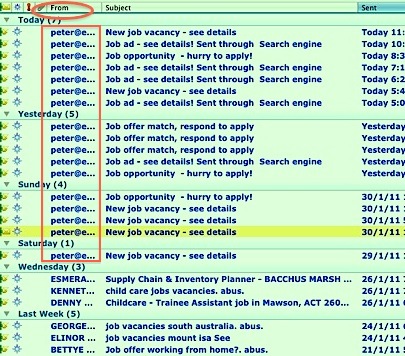
In the SPAM folder — sleazy marketers gaming job seekers (...and spoofing my address to do it!)

Among all the SPAM touting for anatomy-enlargement and performance-enhancing pills and replica watches (for replica people?) and, oh boy, online casino gambling (!) …. I’ve noticed a recent apparent increase in SPAM messages targeting job seekers

Subject: Job offer match, respond to apply

Subject: Job opportunity – hurry to apply!

Subject: Employment you’ve been searching!

Subject: Position opening in your area

Subject: Job ad – see details! Sent through Search engine

Subject: New job vacancy – see details

Subject: Position opening in your area

Subject: Employment you’ve been searching!

Subject: Start earning the salary you deserve by obtaining the proper credentials! business canada government loan small

Sometimes the mail uses spoofed sender addresses — including my own! (grump) Naturally, I know I won’t be the only one being impersonated.

Looks like the world’s cynical ‘internet marketing experts’ and their ‘students’ are trying to exploit an apparent upsurge in keyword traffic. Sleazy.

Is this for real?

Does anyone know if this works?

I got a spammy-looking ‘link exchange request’ with this as the last line:

IF YOU’D LIKE TO MAKE SURE WE DON’T CONTACT YOU AGAIN, PLEASE FILL IN THE FOLLOWING FORM: emailsnomore(dot)com ; PLEASE ACCEPT OUR APOLOGIES FOR CONTACTING YOU.

… which redirects to what looks like a different website (but the name in the page logo — nomoremails.com — doesn’t work):

Believe it ... or not?

What do you think?  Would YOU fill it in? – P

PS Take a look at the form here. It does say, reassuringly and in red: Your details will not be added to any lists or provided to any third parties.

Oops. False pretences?

Nothing to do with spruikers!

Wall St Journal: CCTV Tries to Pass Off ‘Top Gun’ Clip as Military Drill?

Chinese netizens are accusing China state broadcaster CCTV of repurposing footage from the movie “Top Gun” for use in a news story about an air force training exercise. Take a look:

Lowest form of life?

Not a bad column from Michael Laws in the Sunday Star Times today. He’s worth reading when he writes about things he knows about… and there’s no question he knows about political ambition.

Not that the game isn’t intoxicating. We both know that it is. Parliament and politics is its own world. And the only people who truly understand that are those that are there.
Not the press gallery nor even the staffers. Not the party functionaries nor the luminary apparatchiks. Just the elected. [Comment: As a former member of the Parliamentary press gallery (actually while Laws was there), I have to strongly agree with him on this point. And the next.] I was only ever a government backbench MP. There is no lesser life form. You’re either a plodder with ambition or a plonker with ambition. Either way, you are going nowhere fast. People can smell the ambition like it’s a bad Lady Gaga scent. Maybe that’s why you are going nowhere.

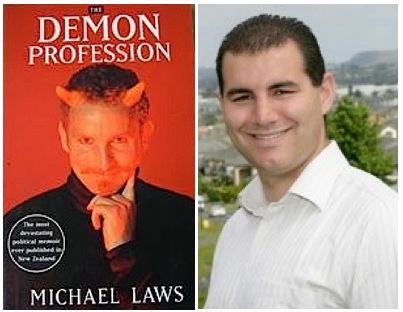
Government backbench MPs past and future — Michael Laws, Jami-Lee Ross (Ross pic: NZ Herald)

Laws’ book The Demon Profession is absolutely fascinating … and essential reading for every neophyte politician, including the newly-annointed Jami-Lee Ross virtual MP-in-waiting for Botany. (God save his soul.)

This passage from The Demon Profession (p 296) resonated when I first read it. Referring to machinations in 1996 around joining what he called the ‘psychic morass’ of Winston Peters’ NZ First Party, Laws recounted:

My corruption was now complete. I had become as opportunistic, as expedient, as politically vain as the system I loathed and publicly condemned. This profession had subtly but inexorably exposed my own ethical inadequacies — I equated the public good with my personal good; compromised my own beliefs for the promise of post-election power and influence; and had proven unwilling to test my own beliefs in the public arena, instead choosing to hide behind the skirts of more established personalities.
My fall was complete. It was just a case of waiting to hit the ground.

Tragic waste of human talent, huh?

Good luck, Jami-Lee. I mean it. – P