Let’s make it an even 5-million views … Leonard Cohen


When I watched this, it was sitting at 4,956,083 views on YouTube.

I’ve seen Leonard Cohen perform this song LIVE twice: Montreal, Canada and Wellington New Zealand. What a legend. (Yeah, I’m a fan.)

Apparently there’s a new collection coming out: The Complete Albums Collection while we’re waiting for a new album.

– P

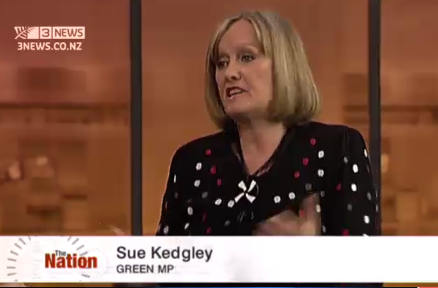
Sue Kedgley on trench warfare and the value of MMP

A worthwhile interview between Sean Plunket and retiring Green MP Sue Kedgley was broadcast on The Nation today. I’d seen reports of her valedictory statement with ‘parting shots’ about Parliamentary ‘trench warfare’ and nodded in agreement.

Much of the time it’s trench warfare in here,” she told Parliament. “The aim is to do battle, to defeat the enemy on the other side, not to debate or to listen. The heavy hitters, the point scorers and the alpha males lead the charge, and hurl abuse and insults at the other side.
Question time, which ought to be a showcase of our democracy, routinely degenerates into a pointless slanging match.” — Sue Kedgley, quoted in NZ Herald

'Accidental' MP Sue Kedgely brought a public-awareness sensibility to politics. (click to watch video at 3news.co.nz)

Watch video of today’s The Nation interview at 3news.co.nz

Quotes:

Is parliament all about point scoring? Or is it actually about holding the government to account? Is it about tribal warfare? — Sue Kedgley on ‘The Nation’

One of MMP’s great benefits … is that it has made Parliament more democratic and more accountable. — Sue Kedgley on ‘The Nation’

I found it interesting that she talked about ‘tribal warfare’ and the (pointless?) point-scoring behaviour of MPs. I see reflexive and ritual political partisanship and tribalism as the cause of so much energy-wasting conflict — not aiming at better solutions but merely demeaning, knee-capping and displacing one’s ‘opposition’.

I wish Kedgley well in this next chapter of her life.

– P

Newly political Peter Leitch – timing is everything

There’s been a dose of opprobrium directed towards a Labour MP Darien Fenton for her Facebook comments (yawn) in reaction to ‘The Mad Butcher’ businessman/philanthropist Sir Peter Leitch publicly endorsing the National Party in the lead up to the General Election.

Mad Butcher businessman and philanthropist Sir Peter Leitch (image from nzrl.co.nz - click)

Some of Labour’s political enemies have sought to make it a litmus test, describing criticism of Saint Sir Peter and his effusive endorsement of National and implied public criticism of Labour as ‘class warfare’.


Even the NZ Herald editorial today implied Ms Fenton’s comments were a ‘cringeworthy and callous’ political clanger and her statement (on Facebook!) that she would choose ‘not to buy stuff from those who support Tories’ as ‘petulance’ against ‘a working man selling his meat in working-class areas for more than a generation’, someone, the anonymous Herald writer said, who ‘despite his own wealth … has stronger blue-collar credentials than Ms Fenton and her Opposition backbenchers combined.’ (Purple, huh?)

For Ms Fenton, though, his [Leitch’s] broadcast utterances were political treason. That any member of the country’s working class could speak well of a “Tory” leader is anathema. Unthinkable. Unforgivable. [Comment: Note these are the NZ Herald’s word’s, not Ms Fenton’s.]
The Mad Butcher was shocked by her withering personal rejection and the attempt to denounce him for saying what he thinks. His former butchery business was also stunned by an inference some had taken that a Labour MP was calling for a boycott of the Mad Butcher stores, many of them in rock-solid Labour seats.
The Fenton comments would have been politically dumb and personally reprehensible at any time, given Sir Peter’s record for serving the communities the MP purports to represent.
But her timing, amid Sir Peter’s well-publicised but tentative recovery from cancer and the joy of all league fans at the Warriors’ late season success, was particularly damaging. The general election is in less than two months. Her party is at historic lows, Mr Key’s National Party at historic highs in the opinion polls.

Now, there’s a part of comments from the nameless editorial writer at the NZ Herald that I completely agree with: ‘The general election is in less than two months.’

Yes indeed. And in that context, ‘working class hero’ Peter Leitch’s highly-charged political comments (or merely ‘saying what he thinks’ according to the faceless Herald writer) must, surely, amount to election campaigning. Do they?

I’m a fan of Mr Leitch’s and actually heard the radio interview when it was broadcast on 19 September. I recalled Mr Leitch’s comments going considerably further that the unnamed NZ Herald writer’s vapid and anemic characterisation: ‘…saying on Radio New Zealand that he liked and backed National’s John Key.’

Listen to what Mr Leitch ACTUALLY said for yourself … and see what you think. Here are four brief extracts (total 3:45) from the full 31 minute Eight months to Mars interview between Radio NZ National’s Jim Mora and Sir Peter Leitch.

Audio clip: Adobe Flash Player (version 9 or above) is required to play this audio clip. Download the latest version here. You also need to have JavaScript enabled in your browser.

Here’s a link directly to the extract MP3 file. (You can listen to the full interview here at Radio NZ’s website.)

Click to listen to the full 31 minute interview at radionz.co.nz

And here’s a transcript of the key extract — the fulsome/damning (depending on whether you’re a National/Labour supporter) ‘public endorsement’:

Peter Leitch: Jim, can I say this to you and your listeners: I’ve never been involved in politics in my life. Never. This year, I’ve become very focussed on this election because I think the election will be the biggest election of our life — in my time. And I’m a great supporter of John Key’s. I’m a great supporter and I’m publicly supporting him now and I’ve never done that in my life.
Helen Clark was a very good friend of mine but I never come out and endorsed her. But I think this election is so important that people like me need to make a stand. You know? Because I think it’s — Christchurch, Pike River. You know, my father was from the West Coast so you know I know about mining. It’s really set us — it’s set the country back Jim, big time.
Jim Mora: Some of those Christchurch Labour MPs have done a good job though.
Peter Leitch: I’m not questioning that. I’m talking about running the country, Jim.

National Party agony aunt Cameron Slater ‘reports‘ that Sir Peter telephoned him and expressed ‘deep hurt’ that he’d been criticised for these comments, even saying he felt he’d been ‘stabbed in the back’.

But just for a moment put yourself in Labour’s shoes. Working class hero and former ‘good friend’ of Labour PM Helen Clark goes on National radio and publicly takes a dump on them, just before an election. Ask yourself: Who is stabbing whom in the back?

Peter Leitch says he’s ‘surprised and hurt’. But please read the transcript: During a 30 minute appearance on radio, he announced that he was now taking a step he’d never taken before: to become involved in politics and endorse a political party in the lead up to an election. The Mad Butcher (everybody’s mate) did this against type, you could say — in a context where he and his interviewer were making much of his working class ‘little people’ roots and influence. Come on.

Now I’m NOT saying Peter Leitch who has a long history of good works and sporting & charitable contributions, has become some sort of ‘class traitor’. Like all of us, he’s entitled to his opinions, to change his mind, and to express his views. (But the same freedom goes to Darien Fenton, too, surely? Or is that an inconvenient question?)

By golly customers, Peter Leitch HAD to expect his highly political public statements would spark a reaction. At the very least he had to expect people would express surprise at the Mad Butcher’s deliberate (or naive?) foray into party politics … and his blatant attempt to use his reputation and prestige to influence an election just two months away.

– P

Lawyers (and lab rats) have their uses

Despite all the jokes about lawyers (some of them very funny, like Q: Why do some experiments use lawyers instead of lab rats? A: Because there are more of them, there are some things even rats won’t do, and the experimenters prove less likely to become emotionally attached to lawyers than rats) there are times when you can count on them (er, lawyers) to raise points worth considering.

You can learn a lot by observing others' reactions. (image: http://animalphotos.info - click)

The draft Video Camera Surveillance (Temporary Measures) Bill being fast-tracked through the NZ Parliament in the last few days of this session is a case in point.

The New Zealand Law Society submission is worth reading, or just read the summary of objections and the assertion that the current law (Section 30) is good enough if the alleged crimes/charges are serious.

This executive summary makes pretty poor reading if you were the Attorney-General trying to squeeze the rushed amendment through (“It is inconsistent with the rule of law and the principles upon which the rule of law is based“), and touches on my concerns about the Bill of Rights being messed with. These are issues to be dealt with carefully, soberly.

2. The Law Society finds the proposed law objectionable because:

(a) It misrepresents the legal position, both as it existed before the decision of the Supreme Court in the recent Hamed case and as it was determined to be in that case.

(b) It would effectively amend the New Zealand Bill of Rights Act 1990 (both retrospectively and prospectively) by over-riding and attenuating a fundamental human right, and would do so in a way that appears disproportionate to any demonstrable need.

(c) If enacted under urgency, as is intended, it would lack both the degree of consultation within the community and the level of careful deliberation by Parliament that is appropriate for a significant constitutional amendment.

(d) A pressing and demonstrable need for such a serious departure from constitutional principle has not been demonstrated.

(e) It would comprise legislative interference in the judicial process in respect of cases that are currently before the courts or which are about to come before the courts.

(f) It is inconsistent with the rule of law and the principles upon which the rule of law is based.

Lawyers are sometimes good at looking for alternative ways to achieve your goals. viz:

…. As noted above, the Law Society recommends the following as a preferred alternative to enacting the proposed law:

(a) Section 30 provides a more principled means of addressing the concerns that have been raised in the current debate than does the proposed law as set out in the draft Bill.

(b) If urgent legislative intervention is considered necessary, and if section 30 in its current form is thought to provide an insufficient answer to the problem, it would be more appropriate to amend section 30 than to over-ride section 21 of the New Zealand Bill of Rights Act.

(c) If the government were to accept this position, the Law Society would be willing to address the question of an amendment to section 30 on an urgent basis.

Lab rat Lawyer Scott Yorke, on his blog Imperator Fish, has a fuller summary and makes some good points of this own: Law Society Slams Police Spying Bill

– P


Coincidence

I swear every word of this is true.

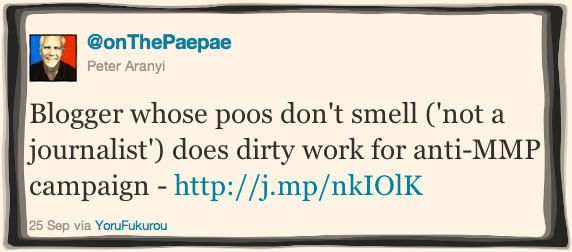
A couple of days ago I tweeted a link about a ‘Blogger whose poos don’t smell …’

… referring to my post that day about [update:] recent tactics of the VFC anti-MMP campaign …

Luna, our new kitten.

Well, today after I picked him up from school, my son and I dropped into our local Veterinarian to get some supplies for our new kitten Luna (right) and got talking about different options for cat food. Did you know Vets recommend you feed cats the complete nutrient biscuits like, for their whole life?

Sure, the lady at the clinic told me, we could feed our kitten things like meat and chicken … if we wanted to … eventually. But then how would we know she was getting a balanced set of vitamins, minerals and anti-oxidents? Better to stick with the ‘science’ biscuits. (Between you and me, I thought I detected a sales pitch.)

Then, almost as an afterthought, she added: ‘Oh, and the other good thing about those biscuits is  … it makes their poos less smelly.

And I laughed.  😉

Honest. – P

Another good graphic

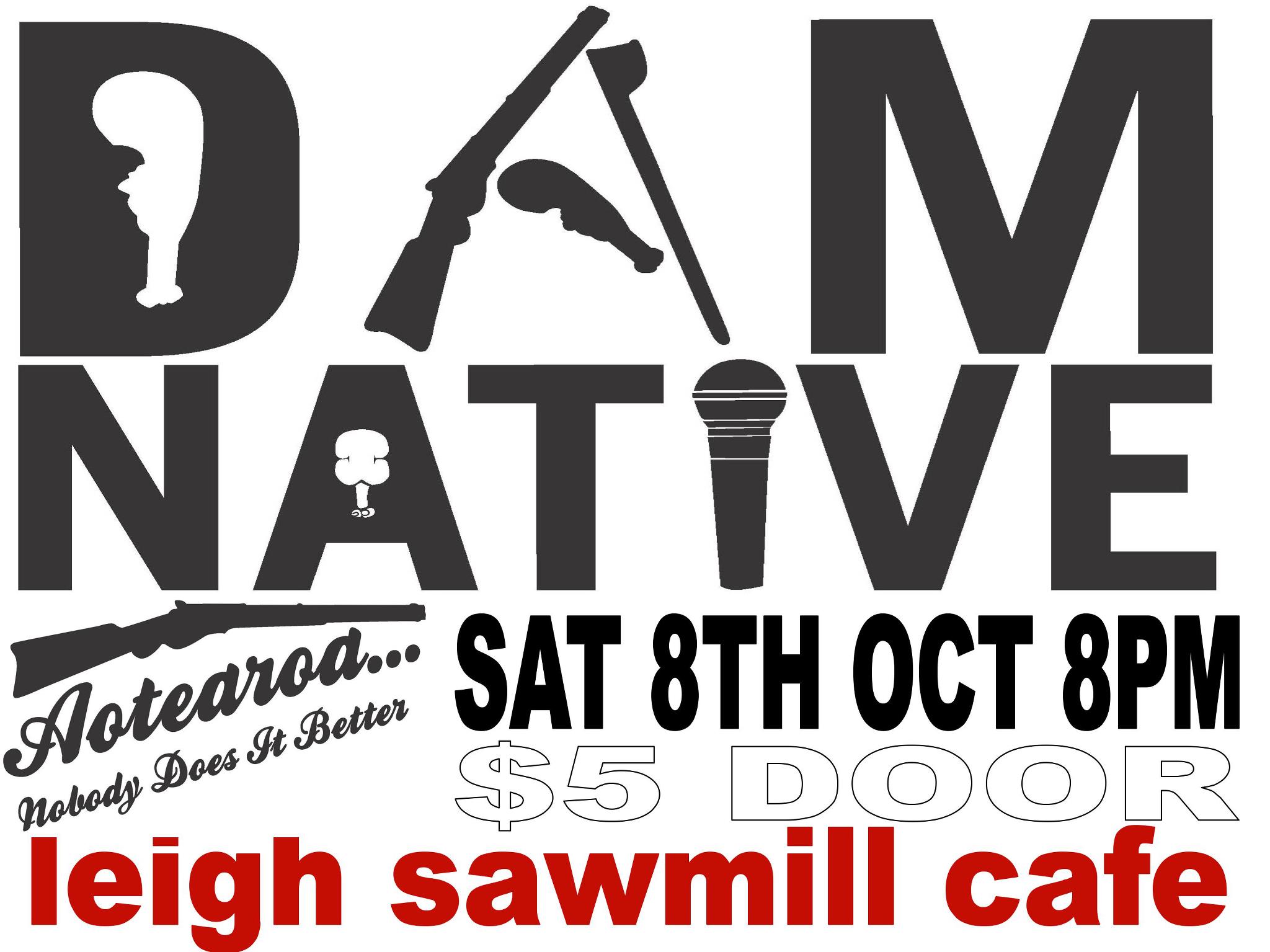
Another in my series of ‘graphics that communicate‘ … this poster design for an upcoming event in Leigh next month really appeals to me:

Dam Native poster (click to enlarge)

Now the funny things is, I found the poster because this morning Facebook recommended I ‘friend’ Tame Iti (since we have four friends in common) and I wandered over to his FB wall to see he’d been tagged in a photo = this Dam Native poster. Voila.

So if the new proactive Facebook sharing was enabled, my other Facebook friends might have seen I’d viewed Tame’s wall … without my deliberately sharing that … and what business is it of theirs?

Actually, the few times I’ve met Tame he was very good company. He’s a thoughtful and articulate person. I bought my son a beautiful pounamu (greenstone) pendant from him which we still treasure like the taonga it is.

– P

Facebook. Brought to you by the letters ‘F’ and ‘O’.

Read it and weep (or adjust your behaviour?)

I first ‘made’ and used the graphic to the right (FACEBOOK MEANS NO PRIVACY) for a post called Facebook — leaks like a sieve in April 2010, and we’ve discussed the treacherous descent of the social media behemoth down the slippery slope several more times since.
Lesson: treat whatever you put there as PUBLIC.

But it gets worse. Recent changes to Facebook can give them (and their partners) a proactive spin on ‘sharing’ … Dave Winer says in Facebook is scaring me:

They [Facebook] are seeking out information to report about you. That’s different from showing people a picture that you posted yourself.

Further, according to Nik Cubrilovic, even logging out of Facebook won’t stop it tracking you …

Dave Winer wrote a timely piece this morning about how Facebook is scaring him [Comment: Dave’s article is worth reading] since the new API allows applications to post status items to your Facebook timeline without a user’s intervention. It is an extension of Facebook Instant and they call it frictionless sharing. The privacy concern here is that because you no longer have to explicitly opt-in to share an item, you may accidentally share a page or an event that you did not intend others to see.

The advice is to log out of Facebook. But logging out of Facebook only de-authorizes your browser from the web application, a number of cookies (including your account number) are still sent along to all requests to facebook.com. Even if you are logged out, Facebook still knows and can track every page you visit. The only solution is to delete every Facebook cookie in your browser, or to use a separate browser for Facebook interactions.

Bleurgh!

As I said in my comment about Facebook posts now featuring in legal agreements around matrimonial splits Facebook’s tentacles now part of divorce settlements! and court injunctions Welcome to the mainstream, social media (like, again) … Don’t let anybody tell you Facebook doesn’t matter.

– P

How to piss off an All Blacks supporter

Crikey!

20110926-081134.jpg

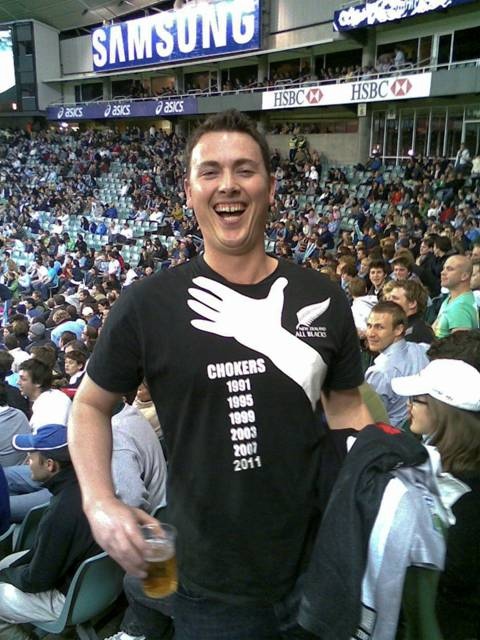
My expat Kiwi friend on the Gold Coast emailed me this charming little number. It certainly lessens my sympathy for the rarking up Aussie supporters have copped in New Zealand.

UPDATE: Apparently the Queenslanders are buying them from a South African T-shirt maker:

I made this one off t-shirt for a rugby union mad friend as laugh for his day out with his kiwi mates to the rugby just after the 2007 RWC. To my surprise, four years later, his photo has gone viral across the interweb. After a few days and some amazing detective work using Facebook recognition software and Google image search I was tracked down by some very clever Queenslanders and ordered to print more choker t-shirts. After 10 phone calls from customers around the world we have decided to do a limited edition print of the famous All Black choker t-shirts.
My Kiwi mates are spewing but hey after all the choker digs I get about the Proteas choking in the cricket WC its only fair to return the vollley. Sorry Kiwidave but until the monkey is off your back you have to kop it sweet mate.
— Kevin Rack.

Saffers! Even worse!

– P

New media – it’s not about being impartial

There’s a sad, kid-with-his-nose-pressed-up-against-the-glass yearning in much of the whiny ‘commentary’ about how social media has ‘attacked’ mainstream media, and how MSM ‘hates’ or doesn’t ‘get’ social media. Bloggers from Cameron Slater to Martyn Bradbury agree on the sad state of MSM compared to … er, … their blogs.

A lot of it is, as I see it, just a Generation gap style adolescent longing to be regarded as significant and different. People who see themselves as a ‘new generation’ of media pine and hanker to be acknowledged for their talent, (in some cases) hard work and dedication to their social media spinning jenny, and express frustration at a lack of doors swiftly opening for them.

As part of discussion on such matters over at Cameron Slater’s WhaleOil blog, I mentioned

I know plenty of bloggers who itch and yearn to be part of the MSM. Gawd, Martyn Bradbury even apparently advocates forced retirement of baby boomers in his latest frustrated effort to get them out of senior media jobs so dipwits like him can pleeeeeeeeeeeeesse get a proper job/enter the palace. (Groan.)

Blogs, Facebook, Twitter whatever’s next are simply part of the ever-expanding, ever-adaptive MEDIA — in the widest sense.

But like an individuating teenager, some with ‘I’m a blogger not a journalist’ intrinsically wound into their self-image seem to try to make themselves as repellant as possible to show they’re not their parents. (This ‘defining yourself by non-membership of other groups’ schtick is as old as the hills.)

Strategies include spraying about bilious slander, abuse and untruths — possessed by the seemingly ardent belief that these are ‘opinions’ and they’re entitled to free expression on the internet without accountability.

They seek to be untrammeled by laws and conventions concerning silly, fussy things like defamation, privacy and name suppression legislation … or, indeed, by the ‘journalistic’ (hoik!) standards of fact-checking, accuracy and truthfulness that apply to broadcasters and publishers. (Oh yeah, we’re bad! We’re mavericks! We’re rebels. Roar! … Puh-lease.)

In my experience, a moderating voice pointing to ‘old’ media values that might be useful is accused of ‘not getting it’. Blogs are different to journalism, the ‘teenager’ snivels, dodging the issues while name-calling their critics or characterising them as stupid.

Cam says

Witness now the large number of stories that the MSM picks up off Twitter or blogs.

So what does that prove? Not much. Witness instead the ongoing large number of blog posts that reactively refer or quote from MSM articles and broadcast programmes. Virtually every post on his website, on mine, and on many others. Parasitic, I call it. Own it.

In comments like Cam’s “The MSM hated blogs, and in New Zealand they have tried to slag blog gers off…” I detect the bitter taste of rejection laced with a hint of inferiority. According to the ‘I’m a blogger not a journalist’ psyche, the MSM is ‘wrong’ whatever it does … whether ignoring social media or embracing it … simply because they’re not you. It reminds me of Mark Twain’s wisdom.

An unpleasant, reactive ‘us and them’ partisanship permeates a lot of the so-called commentary about media e.g. Cam’s fact-free assertion that the Press Gallery is bound by some cosy set of rules to prevent them criticising parliamentarians. That might sound good in a blog post but it’s pure fantasy. (I worked there, so I feel I can comment. Does that make me ‘pompous’? Who cares?) Now, seriously, is bias and ‘provider capture’ present in the media? Do ‘access’ issues concern or constrain some journalists? Yeah, sure, sometimes. But it’s not a monolithic conspiracy — ‘old’ versus ‘new’ media.

Absorbing the ‘revolution’ — honey, it’s what we do

The media, like language, is adept at incorporating new expressions of media (outliers, if you like) into the ‘broad church’. The best and most insightful writers in the blogosphere will, I predict, find an audience in MSM. As writers always have. Ideas are powerful and attract the audience they deserve, eventually. No free lunches.

The MSM will welcome or include passionate expression by ‘reasonable’ people … as I discussed in David Farrar showing WhaleOil how it’s done … but concerns about audience reaction to those whose personas are written off as monochrome, sometimes deceptive (sorry, Cam) militant attack dogs may see them have to wait a bit longer.

– P

Objectivity vs Fairness

I quoted this, from Voice of San Diego, which journalism/media critic Jay Rosen describes as ‘one of the best born-on-the-web news sites to have emerged in the last few years’.

It’s from that news organisation‘s no-doubt-about-it aspirational primer for journalists…

There is no such thing as objectivity.
• There is such a thing as fairness.
• But everyone sees everything through their own filter. Acknowledge that, let it liberate you. Let it regulate you.
• We are not guided by political identification, by ideology or dogma. But every decision we make, from what to cover to how to cover it, is made through our own subjective judgments.
• We are guided by an ability to be transparent and independent, to clearly assess what’s going on in our community and have the courage to plainly state the truth.
Tell the truth.
• This means not being mealy mouthed and not being bias-bullied.
• Stand up to bias bullies. Tell them why you did something. Let them challenge you on it.
• If someone calls you biased, don’t be scared. Don’t dismiss it either. Reflect on it and answer with conviction.
• Don’t go quote-hunting for something you know to be true and can say yourself. Don’t hide your opinion in the last quote of a story.
• Take a stand when you know something to be true or wrong.

Authentic use of a following …

Brooke Fraser - great use of a popular following by a role model. She has my respect.

Brooke Fraser gets the value of using her ‘brand’ … and putting her body in the space to support good causes. Here’s what she says about the poverty of Africa, on her way to Ethiopia:

“This is my eighth visit to the continent but my first to Ethiopia and I’m expecting it to be a pretty weighty experience, especially in light of what is unfolding in east Africa.
“Yet at the same time you often find that people with the least in material terms, often have this deep and infectious joy which is sorely lacking in so many ‘wealthy’ cultures. I always leave inspired and challenged.”

via stuff.co.nz

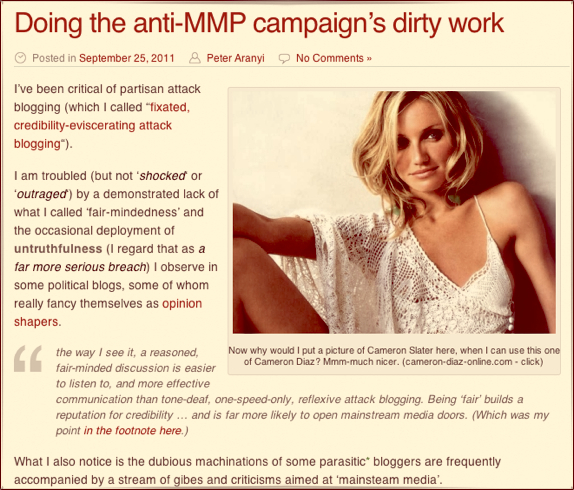
Doing the anti-MMP campaign’s dirty work

Now why would I put a picture of Cameron Slater here, when I can use this one of Cameron Diaz? Mmm-much nicer. (cameron-diaz-online.com – click)

I’ve been critical of partisan attack blogging (which I called “fixated, credibility-eviscerating attack blogging“).

I am troubled (but not ‘shocked‘ or ‘outraged‘) by a demonstrated lack of what I called ‘fair-mindedness’ and the occasional deployment of untruthfulness (I regard that as a far more serious breach) I observe in some political blogs, some of whom really fancy themselves as opinion shapers.

the way I see it, a reasoned, fair-minded discussion is easier to listen to, and more effective communication than tone-deaf, one-speed-only, reflexive attack blogging. Being ‘fair’ builds a reputation for credibility … and is far more likely to open mainstream media doors. (Which was my point in the footnote here.)

What I also notice is the dubious machinations of some parasitic* bloggers are frequently accompanied by a stream of gibes and criticisms aimed at ‘mainsteam media’.
Those working in MSM make an easy target because the professional journalism model — with its adherence to professional standards, its coverage demands, priority setting, editorial process and legal obligation to be truthful — is inevitably slower than some dork in his or her pyjamas spraying bilious vitriol at those on their ‘enemies list’.
[*Parasitic bloggers (and that’s most of us) take far more content and ‘inspiration’ from MSM than the reverse, in my observation. Some of us have the grace to admit our debts, some don’t.]

The doctrine of fairness is an important one, despite the overt disavowal by enraged ‘partisan bloggers’.
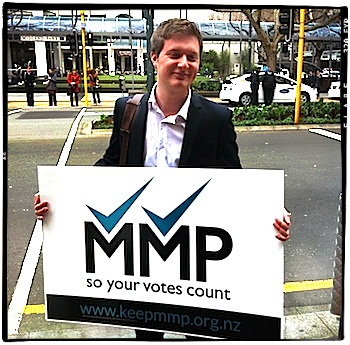
Are state employees entitled to ‘campaign’ for an upcoming referendum on their own time? Photo of Jordan King with placard in Wellington – adapted from an image made by anti-MMP activist Jordan Williams and secretly supplied to right wing proxy and attack blogger Cameron Slater for use in his ongoing smear campaign against supporters of KeepMMP.org.nz (click)

One of my ‘targets’ (in the nicest possible way) right wing proxy and attack blogger ‘WhaleOil’ Cameron Slater denies being a journalist — preferring to run barefoot and naked through the lush grass of the social media jungle as a ‘partisan blogger’.

Here’s Cam’s response to my challenging him about selectively omitting relevant facts from a seedy little smear on a public servant waving a placard around in Wellington [allegedly] in his lunch hour.

Peter, FFS, I’m not a jour­nal­ist, I’m a par­ti­san blog­ger, when will you fuck­ing under­stand that?

Well, sorry, but that seems like bullshit when Cameron, in fine Armchair Quarterback style, frequently deigns to criticize and castigate MSM (mainstream media) for [allegedly] ‘following’ bloggers and generally doing a poorer job of covering news that he cares about than he does, questioning their ethics(!), intelligence and competence…

I’ve lost count of the num­ber of times that I have bro­ken sto­ries and the repeaters ahve (sic) foll­woed (sic) along one, two (sic) or even a week later. It would be nice of them to insert a line acknowl­edg­ing where they heard about it from.
The thing is I know they heard about it from me first, because they all fol­low my Twit­ter account and read my Face­book wall. I’m sure as hell not fol­low­ing them on Twitter.
When blog­gers use news sto­ries to high­light their opin­ion they politely pro­vide a link to the source story, it would nice if chur­nal­ists and repeaters did the same.
I might have to start billing I think. Either that or the various schools of churnalism start teaching these chumps about ethics, [Comment: See?] how to google, how to link to sources and other useful topics instead of them sit­ting on Face­book and Twit­ter hop­ing a story will land in their lap.)

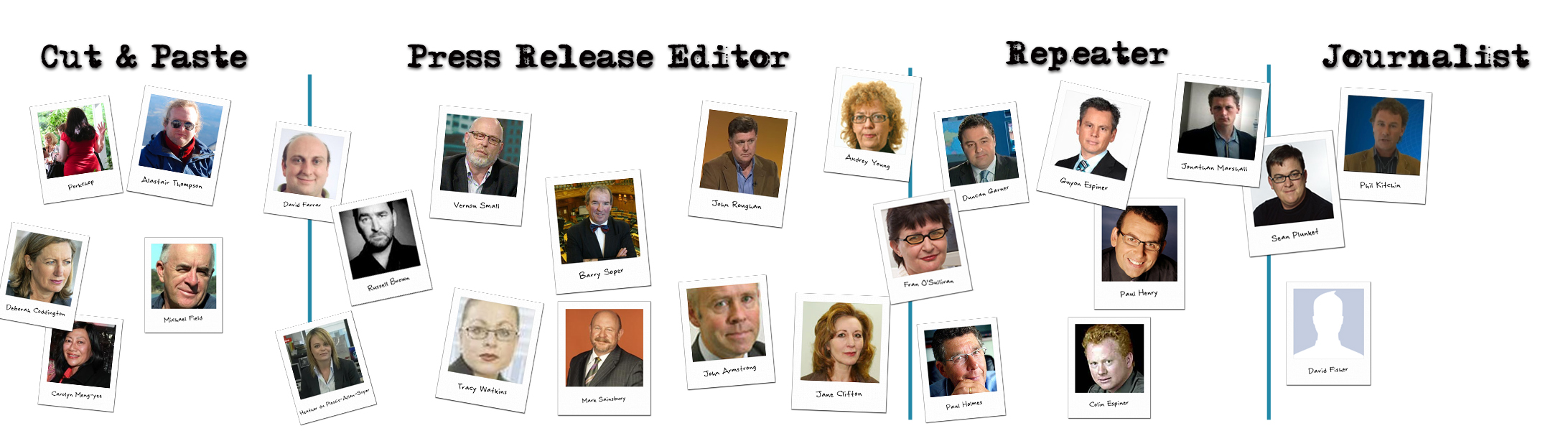
Good grief. Cam I’m-not-a-journalist Slater has even (FFS) developed his own rating system for journalists. I’m not kidding. See:
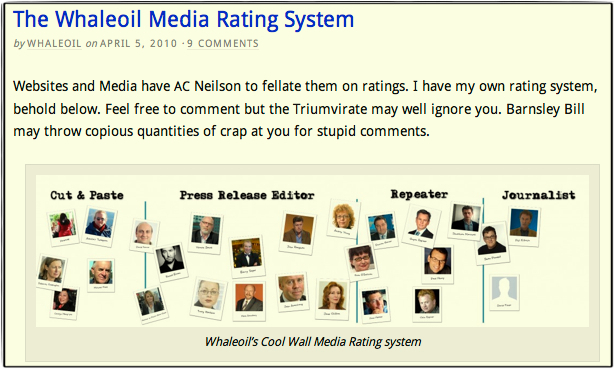
Click to enlarge

So what we’re dealing with is a bloke who sees the standards of ‘ethics’ and ‘truthfulness’ don’t apply to his online alter ego because he’s ‘not a journalist’, he’s a ‘partisan blogger’ … but he’ll happily judge them on some twisted model of his own design about their ethics and competence. Yes. Inconsistent to say the least. Or fruitcake levels of self-deception.

Towards a Code of Ethics for bloggers

So, what about these guidelines developed earlier this year among middle eastern bloggers and others? This Code of Ethics for Citizen Journalists was created by bloggers operating in the blood-soaked crucibles of the Arab Spring and elsewhere, fighting bigger battles than ours.
I’ve reproduced them in full because I think they’re worthwhile.

Guidelines for Good Citizen Journalistic Practices:

  • Be accurate.
  • Be transparent about who you are/your role in the story, your methodology, any conflicts of interest.
  • Be fair.
  • Disclose any funding.
  • Be careful posting developments that have not been confirmed or that you have not witnessed yourself.
  • Do not distribute copyrighted material or plagiarize.
  • Always link to original sources.
  • Do not post anything that will endanger someone’s life.
  • Do not sell information about your subscribers or followers’ list.
  • Do not fabricate stories, or digitally alter pictures or video.
  • Avoid profanity.
  • Put a disclaimer before especially disturbing post.

This code was established by young citizen journalists from the MENA region and Iran, with the help of traditional journalists namely Kelli Arena, Magda Abu-Fadil, and Digital Strategy Consultant Ayman Itani, during the last session of a workshop on “Citizen Journalism, Professionalism, and Ethics”. The workshop was organized by the National Democratic Institute and ASWAT in Beirut from July, 25, 2011 to 27.
It is highly recommended for this code to be shared in order to “increase the professional standards of journalistic reporting for citizen journalists”.

Perhaps bloggers in less contentious parts of the world, dealing with far less contentious issues (like, gee, our upcoming referendum on our Mixed Member Proportional Representation electoral system — which the Egyptians, Libyans, Syrians, Iranians, Yemenis, etc would die for) might benefit from adopting some of these ethical standards? What do you think?

Why would a propagandist use a slogan like ‘Keeping the buggers honest’ then dissemble and mislead about his and his friends’ enemies? Whacky.

Taking the high ground

It’s ludicrous for Cameron Slater to try to hold himself out as some sort of political-moral-media monitor and enforcer, castigating his enemies and even using a slogan like ‘Keeping the buggers honest’ … and then act in an unfair, dodgy way.

For instance, like not revealing that he’s doing anti-MMP Vote For Change spokesman Jordan Williams’ dirty work, then, when confronted about it, saying ‘journalistic’ standards of ethics and honesty don’t apply to him — nor is he bound to Vote For Change‘s pledges to act with ‘integrity in the campaign’ (cough), ‘Play the ball not the man’ (hack) and refrain from negative personal attacks. (splutter) because he’s not formally a member. (No, he’s just a PR conduit.)

Unlike some of Cameron’s critics such as Andrew Geddis (‘Cameron Slater’s slighty wonky jihad‘), I have had the pleasure of his company and find him interesting, informed and insightful. I look forward to our next meeting. Cameron is entitled to his political opinions, of course, about MMP and any other matters like our name suppression laws & legal conventions, and, if he so chooses, to attempt to persuade and proselytize on behalf of the sleazy Vote For Change propagandists seeking to reduce representation in our electoral system. I guess. (See what I did there? Irony.)

But it would be better if he was honest about it.

– P

Sad saga of co-operation breaking down

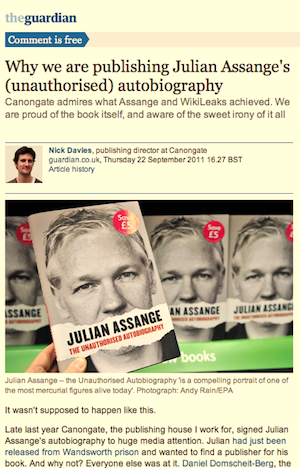
Oh boy. Nick Davies (not that Nick Davies) explains a relationship breakdown (The Guardian - click)

Best line:

Julian’s ghostwriter delivered a brilliant first draft of the book, bang on schedule, at the end of March. We read it and loved it. Julian didn’t. He didn’t love it. We’re not even sure how much he actually read. It was an extraordinary reaction to a manuscript he should have been grateful for and immensely proud of.

Says it all for me.

The publishers say they ran out of time and the ‘author’ ran out of … well, not sure.
Looks like a cash-in to me.

– P

Formative experiences

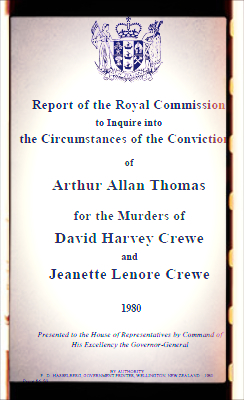
Reflecting on why I oppose the National government’s proposed rushed legislation to retrospectively sanctify unlawful police surveillance actions, I found myself remembering back to when I was a sixth-former in Wellington and got a holiday job at the Supreme Court — coincidentally just as an appeal was being heard against the double murder conviction of Arthur Allan Thomas.

The unjust trials of Arthur Allan Thomas produced a loss of innocence for us as a country and enraged my 16 year old sense of ‘right’.

The New Zealand public were confronted with the grotesque, unpalatable but inescapable realisation that it appeared the investigating police officers had planted evidence — and lied — to gain Thomas’s conviction of the murders of Harvey and Jeanette Crewe.

Defence lawyers have always known cops and prosecutors can bend the facts and ‘selectively’ present evidence to build their case. (They’re only human after all, and ours is an adversarial justice system.)

But the manufacture of evidence against a defendant is, most fair people would agree, a step too far, even if we at times accept the police contention, “He’s a bad bugger that one.”

So in that context, I am uneasy with another Supreme Court decision being sidestepped with rushed legislation, crammed through under urgency in the final few days of a parliamentary term.

I just don’t buy the “50 investigations and 40 court cases in jeopardy” rationale — not without more and substantial evidence … more than a glib PM stand up media statement. Sorry, too important. That’s probably what the Opposition parties being asked to support the fast-track legislation are asking for too.

I think any change to the Bill of Rights Act should require the full democratic process including public submissions … rather than a half-baked fast-track push through the House.

Labour, surely, must oppose it. We’ll see.

Meanwhile, more reasoned public pleadings from goodfella Greg O’Conner, Police union boss, as he continues to spin. I heard him offering a homily in justification this afternoon to NewstalkZB’s Danny Watson involving trout licences and whitebait licences Hint: there’s nowhere you can go to get a whitebait license — you’re just allowed to catch them in the season. Geddit?

Sorry Greg, I’m not soothed by your homespun don’t you worry your pretty little head about that whitebait fritter entrée with the “We’ve got to crack down on the P-labs and criminal gangs” cheeseboard and cigars.

As I see it, the covert cameras weren’t authorised. Change the law by all means, but do it properly, Mr Key.

-P

Coming up: My experience photographing the Wellington Team Policing Unit in action at Flanagan’s Hotel.

The gods will offer you chances … for inspiration

OK, I can see I’m the three-million, thirty-seven thousandth (plus) viewer of this Levis ad on Youtube, and sure, it’s corporate propaganda/advertising dressed up in a call to self-expression, inspiration (and, if you’re a paranoid conservative Glenn Beck, a message ‘glorifying revolution’) … but, hey, it works for me.

Reminds me of Apple’s ‘Here’s to the crazy ones …‘ ads.

The Levis ad narration is from a poem The Laughing Heart by Charles Bukowski

your life is your life
don’t let it be clubbed into dank submission.
be on the watch.
there are ways out.
there is a light somewhere.
it may not be much light but
it beats the darkness.
be on the watch.
the gods will offer you chances.
know them.
take them.
you can’t beat death but
you can beat death in life, sometimes.
and the more often you learn to do it,
the more light there will be.
your life is your life.
know it while you have it.
you are marvelous
the gods wait to delight
in you.

@Charles Bukowski

Laura Norder a surprise election issue?

The Supreme Court’s decision last Friday to declare covert police surveillance videos unlawful unless properly authorized by a court had big implications. Under this country’s Bill of Rights Act, citizens have a right to be free of unreasonable search and seizure by the forces of the state. It seems some aspects of the police’s search warrant applications for covert video surveillance were dodgy with a capital D. The Chief Justice stated:

In circumstances where the police officer in charge of the inquiry knew that there was no authority to be obtained for such filmed surveillance, the deliberate unlawfulness of the police conduct in the covert filming, maintained over many entries and over a period of some 10 months, is destructive of an effective and credible system of justice.

Clearly, according to the Supreme Court, the NZ Police have routinely breached that citzens’ right to freedom from unreasonable surveillance. They acted unlawfully, and probably deliberately so, according to Justice Tipping:

I do not consider there is any escape from the view that the police deliberately breached the appellants’ rights. Detective Sergeant Pascoe acknowledged that he knew there was no legislative authority to install surveillance cameras. This, no doubt, is why he did not seek a warrant to do so. The Detective Sergeant did not profess to have authority from any other source. … If the breach was not deliberate it was undoubtedly reckless because, at best, the position in law was decidedly unclear and, in the very difficult and unusual circumstances facing them, the police, extraordinary as it may seem, did not obtain any legal advice. It is difficult to resist the inference that formal legal advice was not sought because the police knew or strongly suspected what the advice would be and that it would make it more difficult for them to proceed as they intended.

I saw Police Association (Union) boss Greg O’Connor’s press statement on Friday and parsed it down to a news story: ‘Police response to Supreme Court finding they acted unlawfully = Change the law!’

Now, it seems our prime minister has bought the ‘change the law’ programme, judging by this (forgive me) shallowly expressed alarmist spin:

“I think New Zealanders would be horrified if a large number of criminals weren’t made to pay their debt to society because some political parties don’t recognise the law needs to be clarified.” [Comment: Further, he credulously peddles somebody’s claim  (the Police’s?): ‘The ruling in the Urewera case jeopardises 50 investigations currently underway and 40 cases before the courts.’ [Comment: Oh really?]

I heard barrister Grant Ilingworth in National Radio this morning, plausibly describing the ’50 investigations’ spin as an exaggeration (cough): “Does that mean that police are going onto private property on a routine basis, installing cameras on private property and taking photos there? I don’t think so.”

Like the ‘right to silence’ which the National Justice minister Simon Power earlier proposed to do away with by a majority of one or two, any [retrospective] changes to the effects of the Bill of Rights should be taken with full Parliamentary procedure — not passed in Urgency in the last six sitting days before a General Election and using clichéd rhetoric like John Keys’ above.

Better minds than mine (and er, John Key’s, if you ask me) have considered the government’s proposal to use Urgency to rush through retrospective legislation (ding ding ding — alarm bells) to undo the effect of the Supreme Court’s judgement.

Here’s Andrew Geddis, writing at pundit: Once upon a time in te Urewera …

[The Government] seems to be proposing to set just aside the Supreme Court’s view that gathering such evidence in and of itself constitutes an unreasonable search and thus is unlawful under the New Zealand Bill of Rights Act. And if it is not unlawful, then there’s nothing to stop the Police from gathering evidence in this manner … whenever and however they want.

So this isn’t really about giving specific legal power to the Police to conduct video and photo surveillance under set legal limits. It rather is about removing a bar on the Police carrying out these actions … and then leaving it up to the Police to decide when it is appropriate or necessary to do so.

Second, even if the ability to gather this form of evidence is believed to be necessary in the modern world – a point the Police seem very strong on, so I guess I’ll believe them – it isn’t clear why the Government is proposing to retrospectively validate the use of video and photo surveillance. The argument is, I guess, that the Police have used this technique in good faith to gather evidence against a bunch of criminals, and they shouldn’t walk free just because the Supreme Court now has changed the rules.

Putting to one side whether the Supreme Court really has changed the rules here, the fact that such evidence may have been unlawfully obtained does not mean that it cannot be used in court. Remember the Evidence Act 2006, s. 30? That allows the courts to decide on a case-by-case basis whether or not to let such evidence in. And if the affected cases really are as serious as the Prime Minister suggests, you can be pretty sure the courts will allow it in.

So what the Government really seems to want to do here is short-circuit the courts’ role in deciding if the Police’s unauthorised (and, according to the Supreme Court, unlawful) use of video and photo surveillance should be allowed to stand as evidence. Instead, it will require such evidence to be let in – irrespective of whether or not it was obtained unlawfully in breach of the New Zealand Bill of Rights Act 1990 (which it wasn’t … because Parliament will deem that it wasn’t).

Me? I’m all for considered, democratically debated changes to the law, if it makes sense. I’m against knee-jerk reactions leading to half-cocked legislative change being crammed through Parliament using Urgency — especially to our Bill of Rights Act! — without a proper debate and submissions.

I know Greg O’Connor and I like him. He does speak for the police force and represents their interests with ability. He is also an able and effective spin doctor, in my view. I’ll never forget then PM David Lange being asked in sober terms about an historic mass assembly of police officers — in uniform — on the forecourt of Parliament Buildings as part of some industrial protest. Ex-defence lawyer Lange chuckled and said, ‘These people twist arms for a living!

Indeed they do.

– P

See also Victoria University Law lecturer Dean Knight’s thorough examination of the issues: Covert video surveillance and the (c)overt erosion of the Rule of Law (Quotes from the Supreme Court judgement above were lifted from him.)