Does anyone else have a bad feeling about this? It reminds me of ‘Joe Wilson’s War’ in Afghanistan, Ronald (‘I don’t recall’) Reagan/Oliver North’s Iran-Contra deal … and, WikiLeaks or not, how is THIS supposed to stay ‘secret’? Huh?
Tread softly because you tread on my dreams
from Aedh Wishes for the Cloths of Heaven
by William Butler Yeats
Had I the heavens’ embroidered cloths,
Enwrought with golden and silver light,
The blue and the dim and the dark cloths
Of night and light and the half light,
I would spread the cloths under your feet:
But I, being poor, have only my dreams;
I have spread my dreams under your feet;
Tread softly because you tread on my dreams.
Timeless.
– P
Overcome the past by FACING it

This article (below) from The Guardian‘s ‘Comment is free’ site reminded me of the wonderful, uplifting movie The Lives of Others which featured the late Ulrich Mühe in the role of a world-worn East German secret policeman whose job it was to bug a playwright’s apartment and report on the goings on. I won’t spoil the plot for you in case you’ve yet to see the movie but it’s surprising and heartwarming. I recommend it.
Sparked by the recent overthrow of dictatorial leadership in several Arab countries, writer Timothy Garton Ash makes a cogent case for the ‘truth and reconciliation commission’ or ‘overcome the past by fully examining it’ approach to dealing with past crimes against humanity … paying tribute to Germany’s hard-won expertise … as opposed to the ‘Pact of forgetting‘ that was for so long the Spanish response to their terrible Civil War and Fascist General Franco period … but even that shell-shocked stoicism is crumbling, thank god.
I found his ideas and his writing gripping from his opening paragraph:
Like it or not, Germany still provides the global benchmark for political evil. Hitler is the devil of a secularised Europe. Nazism and the Holocaust are comparisons people reach for everywhere.
Godwin’s Law, named after the American free speech lawyer Mike Godwin, famously states that “as an online discussion continues, the probability of a reference or comparison to Hitler or to Nazis approaches 1”
That is something today’s Germans have to live with. But there is a brighter side to this coin. For out of the experience of dealing with two dictatorships – one fascist, one communist – contemporary Germany offers the gold standard for dealing with a difficult past.
Read on at guardian.co.uk
Personally, I think the approach Timothy Garton Ash spells out for nations also works for businesses and (gasp) families. Crimes and grubby little secrets disempower us …
‘Sunlight is the best disinfectant’ the saying goes.
If we can bear it, huh?
– P
Honest opinion
A brief extract from Bevan Marten’s thesis ‘A FAIRLY GENUINE COMMENT ON HONEST OPINION IN NEW ZEALAND’ … (Victoria University) [PDF 400k]
III UNDERLYING PRINCIPLES
Common to all such jurisdictions is the major tension in the law of defamation between freedom of expression and the individual’s right to reputation. The defence of honest opinion holds a key position within this tension, and is based on a set of principles that have remained more or less intact throughout both its common law development and later statutory enactments. The key concept of the defence, which protects statements of opinion as opposed to fact, is not difficult to grasp. It is essentially that people should be able to express their own opinions on the facts before them, even when those opinions are critical of others.Whose Honest Opinion and Why?
As a result, honest opinion is aimed at a broad range of defendants, and is certainly not limited to those expressing reasonable or orthodox views. The defence enshrines “the right of the crank to say what he likes”, and is open to commentators with exaggerated, obstinate or prejudiced opinions.
In practice the defence is especially useful to media defendants, journalists and others who frequently evaluate and comment on the actions of others. However, with the rapid growth of the internet and other readily accessible means of masscommunication, the likelihood is that a growing number of people from all walks of life will be publishing opinions and relying on the defence. Continue reading →

Harvesting the ‘wisdom of the crowd’
I know I knock Wikipedia a little bit … but it is inescapable, whether it is completely ‘trustworthy’ or not. I go there all the time — and reference it. (It’s also top-of-the-pops in search results.)
I listened to this fascinating BBC documentary ‘Wikipedia at 10‘ when it first came out earlier this year, and again this morning … you might be interested in it.
Wikipedia founder Jimmy Wales tells how his first version of the free online encyclopaedia utilised ‘a very old-fashioned, top down, very controlled model’ which ‘failed in no small part because it wasn’t much fun for the volunteers’ … before they adopted a wiki model where anyone (gulp) can create or edit a page … and suddenly productivity took off. Interesting.
I like what this ‘Wikipedian’ says …
…. the personal relationships can be scratchy, the end product isn’t always what you’d want, but the direction, the momentum, the trend is so good it really is a very interesting idea ….
Which I found encouraging. ‘Scratchy’ — good word. I know some people can get cranky with me (and vice-versa, I guess) … that’s a challenge for collaboration.
Question: Now, how can we work with, work through our differences in other cyber-communities? I’m open.
There’s also some good discussion about the non-soapbox aspect of Wikipedia and their goal of ‘neutrality’. Worth listening if you have an interest in these things. Let me have your thoughts, please …
Listen here if you have Flash installed:
Audio clip: Adobe Flash Player (version 9 or above) is required to play this audio clip. Download the latest version here. You also need to have JavaScript enabled in your browser.
Or, here’s a link to the MP3 file for the rest of us.
– P
Nice logo, nice sentiment
This design appeals to me. Simple. Unified. Consistent. Good. I like it.
And here’s their associated tagline which I like too … although I probably read something else into ‘media freedom‘ given my background — more John Pilger/Amnesty International/WikiLeaks than TV shows over wifi, huh?
– P
The sort of spruiker who gives spruikers a bad name
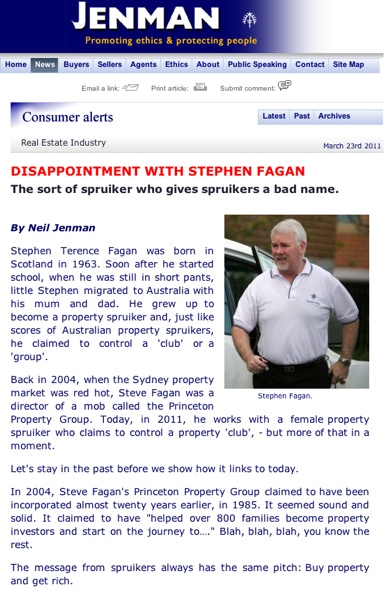
My hero Neil Jenman shares his experience with an Australian spruiker …
Interesting about the tie-up between Steven Fagan, his book ‘Accidental Millionaire’ and Carly Crutchfield. Have a read:
Nick and Wendy are a delightful young couple. In 2004, after advice from Fagan’s property group, they purchased an apartment in the western Sydney suburb of Blacktown. They paid $325,000.
Three years later, in 2007, Nick and Wendy were buckling under the strain of their investment property. It was costing around $1,300 a month to hold the property. When they made enquiries about selling, they were told that the apartment was worth around $230,000, almost a hundred thousand dollars less than they paid for it three years earlier.
Nick and Wendy contacted me, Neil Jenman, and asked for my help. I contacted Steve Fagan and asked him to discuss Nick and Wendy’s case with me. When I met Steve, he told me that he was most “concerned” to hear that some of his customers were not happy. We also discussed his book and I pointed out the many errors in it. Fagan said he was shocked that his information was so wrong but he agreed to never make such claims again. That was a decent and proper thing to do.
As for Nick and Wendy, well, Fagan had a simple solution: he would buy the property back from them for the price they paid for it ($325,000). He would also refund all their expenses. What a good man. At last, I thought, maybe I have met a decent spruiker. …
Read the full ‘disappointing’ article here at www.jenman.com.au
Other references to Neil Jenman on thePaepae.com
– P
PropertyTalk, public criticism and the public good

The challenge of hosting contentious discussion on the interwebs — when some people want to shut you up ... and shut you down (click)
An interesting discussion has started about discussion forum PropertyTalk in the comments thread of my post about Linking to sources and the Sean Wood case study.
Two of my favourite PropertyTalk (ex) posters poormastery and exnzpat kicked it off last night in response to comments from Perry … with some pretty strong opinions… PT moderator Quentin/cube climbed in, and so did I … then this morning, a follow-up comment from poormastery is, I think, worthy of promotion to a post (I’ve left it out of ‘blockquote’ for legibility):
–START–
poormastery says:
March 23, 2011 at 1:31 am
Hi Peter,
I will accept that the propertytalk.com owners and monitors collaborated with the spruikers because they felt that they had no choice.
This plot reminds me of one of my favourite novels – La Peste (The Plague) by Albert Camus. I recommend it to you.
Although the book is superficially about a plague in Algeria, it is also at an allegorical level about French collaboration and resistance to Nazi occupation during World War II. Camus himself was an important member of the French resistance.
http://en.wikipedia.org/wiki/The_Plague
“The plague comes unannounced and may strike down anyone at any time. It is arbitrary and capricious, and it leaves humans in a state of fear and uncertainty, which ends only in death. In the face of this metaphysical reality, what must be the response of individuals? Should they resign themselves to it, accept it as inevitable, and seek what solace they can as individuals, or should they join with others and fight back, even though they must live with the certainty that they cannot win? Camus’s answer is clearly the latter… Rieux argues that one would have to be a madman to submit willingly to the plague. Rather than accepting the natural order of things — the presence of sickness and death — he believes one must fight against them. He is aware of the needs of the community; he does not live for himself alone. When Tarrou points out that “[his] victories will never be lasting,” Rieux admits that he is involved in a “never ending defeat,” but this does not stop him from engaging in the struggle.”
Although Camus considers revolt to be the ideal, he is quite forgiving of the allegorical Vichy collaborators in his book. Indeed, Jean Paul Satre, Camus’ philosopher friend, barely spoke to him again after reading the book, so enraged was he by this treatment.
In my view, Camus was correct on both counts.
One should engage in the struggle and fight back rather than surrender, even in the face of overwhelming odds. Nonetheless, towards those that fail to engage in the struggle, or even join the oppressors, one should show forgiveness.
“Forgiveness is divine.”
Finally, I am willing to accept your point that propertytalk.com probably did some good work before the subsequent surrender and complete capitulation.
Appeasement is seldom the optimal policy.
Kind Regards,
*p*
–END–
Here’s my response …
One should engage in the struggle and fight back rather than surrender, even in the face of overwhelming odds. Nonetheless, towards those that fail to engage in the struggle, or even join the oppressors, one should show forgiveness.
Very nicely said, poormastery.
I conceptualise what you label ‘forgiveness’ in this case as empathy (my word for 2011) or understanding … the very same thought. It doesn’t ease the disappointment at times.
And of course, there’s a terrible ‘meat in the sandwich’ dilemma for PropertyTalk owners and Moderators. I saw this when I observed the high pressure campaign the United Federation of Property Spruikers commenced last year to convince PT it needed to ‘clean up its act’ and censor ‘certain posters’ and threads even more aggressively (leading to the sad denouement: “Why are we making these changes….because we have to – to avoid litigation”). Continue reading →

Linking to sources — why it’s vital for credibility (Case study: property spruiker Sean Wood)
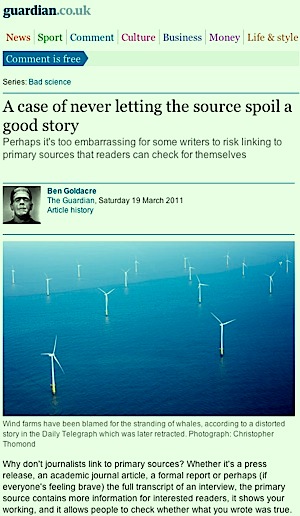
I read a really interesting article I read this morning on The Guardian’s Comment is free website:
‘A case of never letting the source spoil a good story’
subtitle: Perhaps it’s too embarrassing for some writers to risk linking to primary sources that readers can check for themselves
Wherein Ben Goldacre concludes:
But more than anything, because linking to sources is such an easy thing to do and the motivations for avoiding links are so dubious, I’ve detected myself using a new rule of thumb: if you don’t link to primary sources, I just don’t trust you.
Good on him!
Providing original sources to back up assertions seems unfashionable for some bloggers and many internet commenters. I guess my background in journalism, and particularly political journalism where claims of ‘I was misquoted’ or other cavils are deployed in the heat of political rivalry, makes me careful to be able to substantiate claims, or to choose language to phrase such claims to properly reflect any ambiguity that exists.
I know I’ve annoyed some people with my ‘cross-threading’ and linking to original sources or background material. (I know because they complain about it.) But quoting sources really is a professional way to extend an argument, in my view, as we’ve discussed.
Just last night I saw some speculation online about a property spruiker by the name of Sean Wood — and a question about whether he’d actually been connected with a questionable scheme called ‘Blue Peak Wealth Management’, to sell ‘licences’ to property finders … and also to sell apartment developments and other property ‘investments’ to people seeking ‘property education’.
PropertyTalk forum Moderator ‘Perry’ asked the question of another poster ‘Sharpie’:
Can you substantiate your assertion about Sean Wood being
associated with Blue Peak? Wasn’t Blue peak a Phil Jones and
Steve Goodey run/owned/operated/fronted outfit?
Such is the apparent stigma attached to the Blue Peak fiasco that some people, including Perry, were questioning the claim of Sean Wood’s involvement in Blue Peak Wealth Management. (BP ended in tears, by the way, according to this article in the Sunday Star Times: Blue Peak faces angry backlash.)
I recall that Sean Wood was a promotional face of the business. He was also one of three directors of Blue Peak and the sole shareholder/director of one-third Blue Peak shareholder Citylink Property Masters Ltd. At the same time, it seems, he was acting as property spruiker Richmastery’s ‘Property Mentoring Manager’.
This is easily demonstrated with a link to one of his sales letters … in this case for the ‘Saffron’ apartment development offered to the public as ‘Auckland’s second highest building’ in 2007 — without a building consent — and a quick search of the Companies Office records. The Sunday Star Times reported on Wood’s sales techniques, and directorship of Blue Peak, in these terms:
At a seminar organised by Richmastery last week, the units were being offered for sale through a company called Blue Peak Wealth Management, which is one-third owned by Richmastery founder Phil Jones.
… At last week’s seminar, Blue Peak director Sean Wood encouraged potential investors to sign sale and purchase agreements for the units on the spot, [Comment: On the spot!] saying that their price would be increased by 10% the following day, and if investors signed up on the night they would make an immediate capital gain. — SST on Saffron launch 24June2007
So, no controversy there, if one links to sources. Hard-selling Sean Wood was clearly associated with the Richmastery and Blue Peak enterprises selling ‘investments’ to property education ‘students’. [Disclosure: I was party to a copyright lawsuit against Richmastery — details here.] Continue reading →

Bernard Whimp – another suck of the saveloy. No shame?
You may recall the general disregard in which low-ball share buyer Bernard Whimp is held by members of the local business community.
My post earlier this year Low-ball share buyer Bernard Whimp in action was provoked by his [arguably] misleading offer to buy shares in big companies at a significant, some say unconscionable discount to their market value. This, having dredged a list of shareholders names and addresses from the public register.
Well, the burglar (I mean it) is at it again, according to the NZ Herald:
Too bad. Nice to have a photo – from TVNZ apparently.
Even the Shareholders Association is warning against Bernard Whimp and his Carrington Securities LP. Here’s a clip from Radio NZ’s Checkpoint tonight:
Audio clip: Adobe Flash Player (version 9 or above) is required to play this audio clip. Download the latest version here. You also need to have JavaScript enabled in your browser.
Download or listen to the MP3 file (provided for those without Flash installed. Like me.)
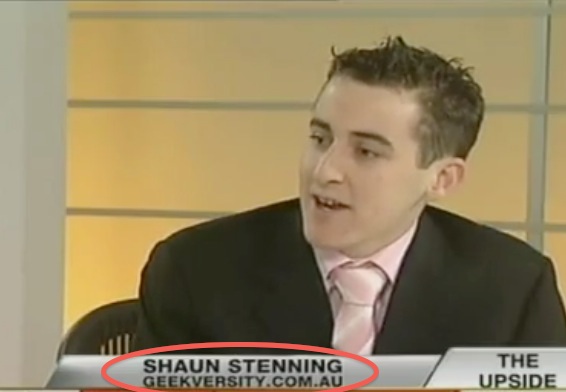
Exasperated Shaun Stenning Twa.lk and Sni.pr customers speak out about his ‘refund’ offer
The contentious matter of the ‘refund movement’ targeting ‘get-rich-through-internet-marketing’ salesman Shaun Stenning … and revealing how he and his associates deal with dissatisfied clients … is unfolding.
The by-all-reports persuasive Australian spruiker Shaun Stenning and various members of his family and colleagues (including ‘Mr X’ Dean Letfus and Shaun Stenning’s former Geekversity confederate Ian Naylor) apparently spent 2009-2010 hyperbolically pitching internet marketing ‘products’, ‘platforms’ and ‘education’ as a pathway to rapid wealth for ordinary people.
A series of live events was held throughout Asia and Australasia, with local promoters including Success Resources (Singapore and Malaysia) and TWD (Indonesia) and other operators portraying Shaun Stenning as a successful internet marketing ‘expert’. Promotions were run also targeting Taiwan, Hong Kong, Thailand and Viet Nam as well as Australia and New Zealand, apparently.
All this despite the fairly-public implosion of Geekversity in Australia and NZ (at a AUD$5.5m loss) following a virtual stampede of dissatisfied customers (and their lawyers) demanding refunds for the non-delivery-of-promised-benefits Geekversity ‘product’. Things don’t appear to have worked out any better for those persuaded by Shaun Stenning’s enthusiastic and inspiring spiel this time around, judging by the latest ‘refund movement’.
Here’s one disappointed client’s story (from Jen Huei who blogs at www.guizai.com):
More reasons to research ‘investments’
Con artists taking advantage of Facebook
… “With any startup company, early-stage investors that are putting their capital and their belief and trust into the company are exposing themselves to a great deal of loss,” said Walsh.
“The workers who often get stock options should the company ever go public, are putting in their sweat equity, so why would a stranger approach you, give you an opportunity to get in on this ground-floor investment — you need to ask, ‘why me?'”
She said con artists commonly manage to persuade investors to take part in their scams by dangling “phantom riches” –– the promise of huge guaranteed returns for getting in on the ground floor.
FINRA recommends a few things investors can do to avoid cons: verify that the person touting the investment is licensed; look the person up on the Federal Bureau of Prisons Inmate Locator, Google them; and get a second opinion from a licensed investment professional or an attorney.
Good advice from Reuters via stuff.co.nz … and, if you will forgive my immodesty, echoing my own post here at thePaepae.com last May: ‘Good advice: Google the salesmen and their get-rich-quick scheme‘.
We’re all leaving a trail in cyberspace.