Rights, rights, everywhere, but not a drop to drink

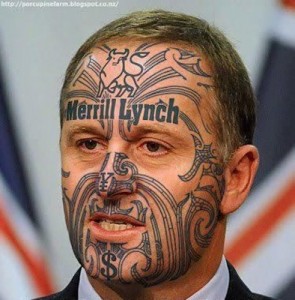
John Key with Merrill Lynch moko - pic: RadioLIVE (click)

From this morning’s NZ Herald editorial about the National-led government’s political machinations around heading off court action by Maori against its flagship asset sales policy*:

‘Too clever’ risk in Govt shares plan

Crown lawyers have acknowledged that pre-colonial iwi and hapu had customary control of rivers and streams in their area and those rights were preserved by the Treaty.

And that statement, about rights, is at the heart of the matter.

That’s despite  the outcry … and the foaming repulsive hate speech and posturing of racists who call for the Key government to ‘show some spine’ (i.e. oppress indigenous rights) and seek to decry Maori — as a race! — as ‘greedy’.

John Key is never more personally-maligned by his constituency than when he is perceived as protecting indigenous rights. Remember this nasty demonisation (feather cloak, Tino Rangatiratanga/’Maori independence’ flag) courtesy of the Coastal Coalition and the ACT Party’s Muriel Newman?:
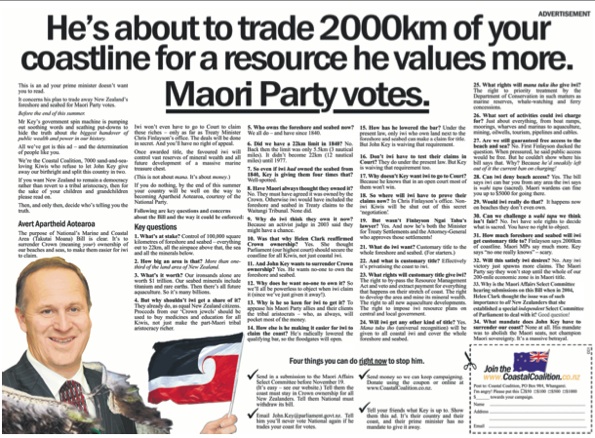
It’s inescapable that some rights were preserved by the Treaty of Waitangi — which has been upheld by the courts time and time again as a founding document of this country. For decades the Treaty was more marked by rapacious and dishonest breach than observance … and ‘elegant solutions’ of the day to get around government and local authority promises of reservation. Maori Native Lands Act, anyone? Maori Lands Administration Act? Public Works Act? Leases in perpetuity? Groan.

Today, the Treaty of Waitangi is at the heart of New Zealanders’ self-image as more enlightened settlers/occupiers than the state-orchestrated genocides of Australia, the USA and South America. For most of us, ‘By right of conquest’ doesn’t wash anymore. That seems like a ‘stone-age’ concept. But some some hate-mongers seem to be wish for a new round of Land Wars and revising history demonstrating their own insatiable greed.

– P

* A nice line elsewhere from Bryce Edwards’ political round up reminded me of the John Key moko image. “Fifty-fifty odds on the Government’s flagship policy getting off the ground? Merrill-Lynch would never gamble on those sorts of odds and their ex-trader wasn’t about to either.”

Dragon imagery and hanging on to past Mac OS functionality


Apparently this cool design is like a mascot/logo for LLVM compiler software

The LLVM logo is a stylized wyvern (a kind of dragon). Dragons have connotations of power, speed and intelligence, and can also be sleek, elegant, and modular (err, maybe not). In addition, there is a series of influential compiler books going back to 1977 which featured dragons on the cover. — source

I spotted the image at Jack Overfull’s website. Jack says he used LLVM to write a useful bit of Mac software called multiXFinder. I use multiXFinder every day now that the venerable Frank Vercruesse’s ASM doesn’t work any more … Mac diehards like me previously used ASM to give us a System 7-esque application switcher menu (ASM, geddit?) in the top right of our screens, a feature dropped in OSX.

Like, a decade ago.

Yeah, I resist change, sometimes.

– P

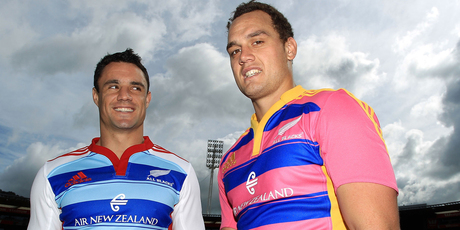
Pink! I knew this would happen while Rob Fyfe was Air NZ’s CEO and an All Blacks sponsor. I just knew it.

Look at this:

All Blacks Dan Carter and Israel Dagg. Oh my god. (pic: NZ Herald - click)

So what part of ‘ALL BLACKS’ wasn’t clear?

Read the background in Daniel Richardson’s article at the NZ Herald and you’ll see Israel Dagg’s wounds are self-inflicted.

I still blame Rob Fyfe.

– P

The D-word. Name-calling in place of intellectual debate

100 percent degradableA nice line from Stanley Fish’s New York Times review of right wing polemicist Dinesh D’Souza’s ninety minute anti-Obama campaign ad masquerading as a feature film …

… While a viewer could certainly disagree with D’Souza’s analysis of the genesis and emergence of Obama’s views, it is nevertheless an analysis to which one could respond in the usual spirit of intellectual debate by saying things like “you’ve left something out” or “you draw your conclusion too quickly.” But as the movie picks up polemical speed, philosophy, political theory and psychology are left behind and replaced by name-calling, and by a name-calling that brings D’Souza close to positions he rejects.

For instance, he rejects birtherism, the contention that Obama was born in Kenya and is hence not an American citizen; but he replaces it with a back-door, or metaphorical, birtherism when he characterizes Obama as an alien being, as a fifth-column party of one who has pretended to be an American, and technically is one, but really is something else.
The argument founders on the fallacy of assuming that the adjective “American” has a fixed meaning with which everyone, or everyone who is right-thinking and patriotic, agrees. But the meaning of America is continually contested in essays, books, backyard conversations, talk shows and, most of all, in elections. It is often said, and it is true, that the opposing parties in an election have “different visions for America.” There are many ways of describing the alternative visions offered to us in a year like this; but describing one of them as un-American and its proponent as a foreign intruder is not to further discussion but to foreclose it and to replace the contest of ideas with the rhetoric of demonization.

The D word again. Demonisation.

I see the same approach in certain other right wingers’ statements of hatred and contempt towards trade unionists and others they perceive as their class enemies. Teachers, the media, Maori, welfare beneficiaries, or intellectuals — not to mention left wing politicians or activists — are derided in terms ranging from the vaguely amusing (‘painty-waists’, ‘pinkos’) to the wannabe obscene (‘sanctimonious twats’ ‘lefty c***ts’) to the downright bigoted (‘greedy Maori’, ‘brown-mail’). It marks the abusers out as belligerent, and worse: lazy thinkers.

They are, some of these reptiles (irony), apparently far more interested in denigrating The Other Side or preaching to their braying like-minded, party faithful audience, and fuelling a toxic blend of hate speech, class warfare and bigotry. They seem more fond of ‘sledging’ the opposition than issues analysis, policy debate — squeezing out ‘opinions’ without subjecting themselves to what John F Kennedy referred to as ‘the discomfort of thought’.

A very subtle political statement from The Daily Show. Clever! (click)

I don’t care whether the propagandist is of the left or the right, HOW the argument is conducted matters to me.

Dishonest, deceitful arguments, hate-mongering and lies might just be an ‘acceptable’ strategy in a military campaign (‘All’s fair in love and war’), but in a democracy? As political discourse? Nope. And even more so where the attack dogs routinely question/criticise ‘The Other Side’s integrity/truthfulness/fitness to govern as a matter of course, mudslinging their way to an illusionary claim to the moral high ground. (cough)

While I believe in a vote for every citizen, in my view it *is* possible to lose your ‘right’ to be taken seriously as a participant by being proven to be a deliberate, outright liar … just as it is if you’re seen as a wild-eyed lunatic. (It’s called the lunatic fringe for a reason.)

Which struck me when I heard the Romney campaign’s declaration
We’re not going to let our campaign be dictated by fact checkers and lyin’ Paul Ryan’s grossly misleading Republication Convention speech, so pilloried by critics from the left and the right. See Paul Ryan’s breathtakingly dishonest speech. Very shabby stuff.

When someone lies like that, it seems to me they’ve lost.* You can decide what they’ve lost for yourself.

– P

*It also demonstrates a lack of creativity. I know that sounds counter-intuitive, because people ‘make up’ lies.

Satiric comment on Apple patents

Of course it’s exaggerated but … a wee bit funny …

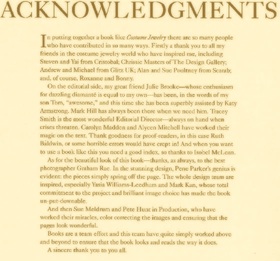
Acknowledgements page as self-promotion and commercial message. Ha!

For my author friends … a description of the ‘undercurrent of faux-modest self-promotion [which] runs like a viral strain throughout every acknowledgments page’. (We refer to them as ‘Ackowledgements’ — an inside joke after an unfortunate and undetected-until-too-late typographical error.)

A lively, little-bit-snarky, enjoyable read: Against Acknowledgments by Sam Sacks at the New Yorker magazine. Funny.

Acknowledgments typically open with a statement to the effect that, although writing is lonely work, the author could never have completed his book without help and support. “This is my fourteenth novel and I am as dependent as ever on the wisdom of others,” begins one, and another, plucked at random from a Barnes & Noble new-arrival shelf: “The creation of this book has removed any notion I may have had of it being a solo endeavor.” …

Read Sam Sacks’s insights (harsh but true) at The New Yorker.

– P

Old school

20120829-083026.jpg

I’m visiting my mum.

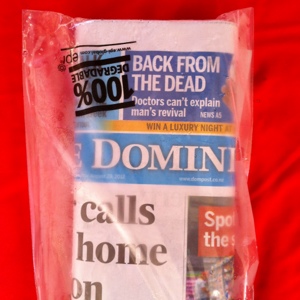
Spring might be around the corner but judging by the state of lawns (and Midland Park) there’s been a bit of rain here in Wellington …

Nice to see The Dominion Post delivery team knows how to deal with it. To be fair: That’s just dew on the newspaper delivery bag — “100% Degradable” (aren’t we all darlink?)

– P

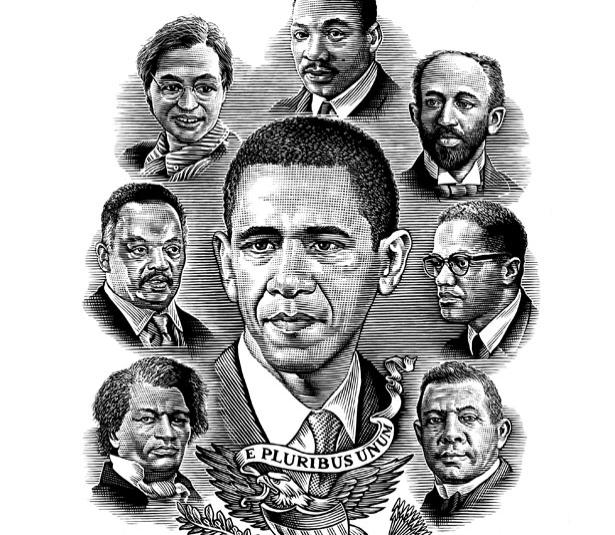
Fear of ‘the other’ exemplified

via Andrew Sullivan, read this huge read at The Atlantic. Wow.

image: Bill Sanderson via The Atlantic

Fear of a Black President

by Ta-Nehisi Coates

As a candidate, Barack Obama said we needed to reckon with race and with America’s original sin, slavery. But as our first black president, he has avoided mention of race almost entirely. In having to be “twice as good” and “half as black,” Obama reveals the false promise and double standard of integration.

The whole article is powerful, but this got me:

Racism is not merely a simplistic hatred. It is, more often, broad sympathy toward some and broader skepticism toward others. Black America ever lives under that skeptical eye. Hence the old admonishments to be “twice as good.”

… Obama’s first term has coincided with a strategy of massive resistance on the part of his Republican opposition in the House, and a record number of filibuster threats in the Senate. It would be nice if this were merely a reaction to Obama’s politics or his policies—if this resistance truly were, as it is generally described, merely one more sign of our growing “polarization” as a nation. But the greatest abiding challenge to Obama’s national political standing has always rested on the existential fact that if he had a son, he’d look like Trayvon Martin. As a candidate, Barack Obama understood this.

“The thing is, a black man can’t be president in America, given the racial aversion and history that’s still out there,” Cornell Belcher, a pollster for Obama, told the journalist Gwen Ifill after the 2008 election. “However, an extraordinary, gifted, and talented young man who happens to be black can be president.”

Belcher’s formulation grants the power of anti-black racism, and proposes to defeat it by not acknowledging it. His is the perfect statement of the Obama era, a time marked by a revolution that must never announce itself, by a democracy that must never acknowledge the weight of race, even while being shaped by it. Barack Obama governs a nation enlightened enough to send an African American to the White House, but not enlightened enough to accept a black man as its president.

And this …

While Beck and Limbaugh have chosen direct racial assault, others choose simply to deny that a black president actually exists. One in four Americans (and more than half of all Republicans) believe Obama was not born in this country, and thus is an illegitimate president. More than a dozen state legislatures have introduced “birther bills” demanding proof of Obama’s citizenship as a condition for putting him on the 2012 ballot. Eighteen percent of Republicans believe Obama to be a Muslim. The goal of all this is to delegitimize Obama’s presidency. If Obama is not truly American, then America has still never had a black president.

Read this brilliant article (it’s worth your time) at The Atlantic

– P

PS I see this thought: “Racism is not merely a simplistic hatred. It is, more often, broad sympathy toward some and broader skepticism toward others” applied in politics in this country all the time. I call it ‘sectarianism’ or ‘extreme partisanship’ in other contexts, and refer to it here from time to time. It’s just as much bigotry as racism … which we also indulge in New Zealand.

Media contempt for #Assange. Useful idiots?

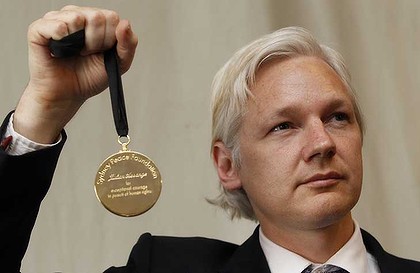
Julian Assange with the Sydney Peace Prize he received in May 2011. Photo: Reuters

I’m completing the design for a book by a friend of mine at present, Slouching Towards Bethlehem. It’s a fascinating study of the rise of the antichrists — note the plural. Graeme’s definition of ‘antichrist’ differs considerably from The Omen/Damien/666 stuff of the 1970s movies, and encompasses the repeated incidences of elevation of heads of state as ‘deities’ throughout human history. And the problems that causes.

As we worked on the book yesterday afternoon, I was struck again by how intelligent observers in the past have ignored or justified evil or repression in the name of an ideology they support — only later (in some cases) realising their beliefs and wishful thinking led them to be duped, played for fools and used in deadly propaganda. Here’s an extract …

“Useful Idiots”

Understanding this demonic seduction to emperor-worship helps explain the phenomenon of what Lenin and Stalin were said to have called their “useful idiots”: prominent aristocrats, writers, intellectuals, philosophers and artists who would willingly justify the regime’s murderous activities. In a BBC radio documentary of this name broadcast in July 2010, Doris Lessing, winner of the Nobel Prize for Literature in 2007, admitted her role as such, along with George Bernard Shaw, H.G. Wells, Jean-Paul Sartre, André Malraux, famed black singer Paul Robeson, and Pulitzer Prize winning journalist, Walter Duranty. Duranty was the Moscow correspondent for The New York Times from 1922 to 1936 and publicly denounced fellow correspondents Gareth Jones and Malcolm Muggeridge of the Manchester Guardian for daring to write of the Soviet government’s causing the Ukrainian famine. Muggeridge had become disillusioned as a socialist during his time in Russia and, as incredible as this may seem, he became an outcast among English intellectuals and journalists for his dispatches and books about what he had seen.

It struck me because I had a (very mild) disagreement on Twitter with three people I respect over the treatment of Julian Assange. I’d pointed to an article by Glenn Greenwald The bizarre, unhealthy, blinding media contempt for Julian Assange which sums up and addresses the unease I’ve long felt about the way the establishment media — including Assange’s ertswhile collaborators at the New York Times and The Guardian — have smeared and pilloried him. They’ve portrayed him as a paranoid oddball and a nutcase … and as if allegations of sexual violence had been already proved. (We’ve discussed that here at The Paepae before — see the Assange tag.)

I’m NOT calling my Twitter buddies idiots. Just the opposite. I like and respect them. But I was struck, and said so, by their potent sense that Assange was somehow already guilty … of being ‘an awful person’ … based on his resistance to turning himself over to what looks like a compromised ‘justice’ system investigating (in my view dodgy) allegations of sexual violence.

Today in The Guardian, there’s an article by Katrin Axelsson and Lisa Longstaff We are Women Against Rape but we do not want Julian Assange extradited in which they say ‘For decades we have campaigned to get rapists caught, charged and convicted. But the pursuit of Assange is political.’

When Julian Assange was first arrested, we were struck by the unusual zeal with which he was being pursued for rape allegations.
It seems even clearer now, that the allegations against him are a smokescreen behind which a number of governments are trying to clamp down on WikiLeaks for having audaciously revealed to the public their secret planning of wars and occupations with their attendant rape, murder and destruction.
Justice for an accused rapist does not deny justice for his accusers. But in this case justice is being denied both to accusers and accused. The judicial process has been corrupted. …

Yeah, that’s my point too. I pointed to the the extraordinary way his ‘charges’ have been progressed here in February 2011, and the stink has only gotten worse. Continue reading →

My Side versus The Other Side. (Just beautiful)

Unspeakably good satire (or something) about two party politics and human nature from A. Barton Hinkle at Reason.com: The Wrong Side Absolutely Must Not Win

… it’s clear that the people on the Other Side are driven by mindless anger – unlike My Side, which is filled with passionate idealism and righteous indignation. That indignation, I hasten to add, is entirely justified. I have read several articles in publications that support My Side that expose what a truly dangerous group the Other Side is, and how thoroughly committed it is to imposing its radical, failed agenda on the rest of us.

Read it all here at Reason.com.

Fabulous! Reminds me of the justification for dirty tricks waged closer to home we talked about when discussing the science of fear and how it applies to political adversaries:

It seems to me from what Cameron and I discussed, that Right Wing spin doctors and bloggers/activists/schemers like him (and only a handful of others – in NZ anyway) have convinced themselves that their Left Wing ‘opponents’ are waging a dirty, unprincipled propaganda war and will stoop to virtually any sleazy strategy to gain influence or advantage. So strongly do they, as a group, hold this belief that they (the Right-wing cabal) feel they are therefore completely justified in waging a dirty, unprincipled propaganda war and to stoop to virtually any sleazy strategy to gain influence or advantage. I bet some on ‘the Left’ think exactly the same way. (Trevor Mallard, I’m looking at you. And you Martyn Bradbury.)

– P

via David Pell’s Next Draft

Please read this post

(pic: www.torange.biz - click)

This one:
Everything we know about you guys is wrong

Sometimes I feel I can’t improve on a thought,
or how I expressed it first.

– P

Using hyperlinks defensively. A smart idea.

I’ve had [negative] feedback from some of those whom I address here (my ‘targets’ … in the nicest possible way, as Kenny Everett used to say) about my ‘cross-linking’ and ‘interweaving’ examples or evidence of my assessments and assertions.

I do it deliberately, as I have pointed out before (see Scoundrels), because it’s my habit/practice from working in journalism to have evidence to back up any contentious claims ‘in the can’. Sometimes it’s good to show one’s hand, despite the jerkiness in the narrative that can result.

Basically, I LURVE hyperlinks (I liked Hypercard too, RIP, and thrashed it back in the day.) I love this medium where it is so easy to provide a kind of dynamic footnote or reference right in the flow of the argument. Cool!

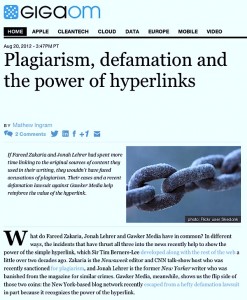
GigaOm’s Mathew Ingram agrees. In his article Plagiarism, defamation and the power of hyperlinks he refers to court cases where hyperlinks were found to have provided ‘ample evidence of what the post was referring to’.

He highlights this key sentence from a court judgement declining a defamation claim: “Statements are generally considered to be nonactionable opinion when the facts supporting the opinion are disclosed.” (emphasis added) *

That’s just an unintended consequence for me. As a habit, I like to lay out the reasons for my (yes, sometimes harsh) judgements … as we discussed in How to have a FAIR argument. (Or maybe I’m just ‘verbose’ … according to some people who are whatever-the-opposite-of-a-fan-is.)

It’s easy for the offended party to dodge the argument and just smear their critics, as I recounted here:

This outraged spruiker launched what I used to call the ‘projectile vomit defence’: spinning around like a whirling dervish, spraying bile, abuse, disinformation and paranoia at his target. (In this case, me.)

It’s far better to address criticism directly, lay out a counter-argument — as tough as you like — focussing on statements, claims, inaccuracies, actions … and, where possible, leave character assessments or assessments of mental state etc out of it.

People whom I have regarded as strong-minded and up for a bit of good debate, people who in other contexts seem capable of rational or robust argument, surprise me: Rather than engaging, they descend into insults and slagging — or ‘sledging’ as they call it — celebrating an almost drunken, threatening pugnaciousness. (‘NFWAB‘)

Sadly, by their reactions, some of them have shown conclusively that they can dish it out, but they can’t take it. (sigh)

– P

* As Mathew says, the practice of keeping note of sources of information and where you got material you’re quoting is also useful protection for avoiding inadvertent plagiarism. We’ve discussed that before — acknowledging the source, giving credit, costs you nothing.

Art. Sometimes it surprises.

20120821-210152.jpg

‘Lives of Grass’ by Mathilde Roussel

Visit this page at www.designboom.com to see more.

– P

“HPPrintSettings plug in” crash on OSX

If you’re having trouble printing to an HP printer after installing the latest (Aug 2012) HP drivers update rolled out via Apple Software Update (er, like I was today crash, crash, crash after installing it last night), here’s a fix:
[Thanks to Upton666 at Apple Support Communities who pointed this out]

Upton666
Re: Problem with new HP Printer Software
11/08/2012 9:10 AM (in response to stevemcc)
In Finder navigate to Macintosh HD / Library / Printers / hp / PDEs. Right (control) click on ‘hpPostScriptPDE.plugin’ and ‘Show Package Contents’.

Then open the Contents folder and you will find a plugins folder. DELETE IT and your printer will work.

The old 2.09 version did NOT have this folder and plugin.

https://discussions.apple.com/thread/4192329?start=15&tstart=0
Whew!
– P

UPDATE 24/8/12: Looks like a fix (v2.11) has been pushed through the Software Update system:

I installed it and all is (still) well.

He who passively accepts evil is as much involved in it as he who helps to perpetrate it

That’s a quote from Martin Luther King.

One of the themes of this blog (apologies to those who don’t like recurring topics) is whistle blowers (as I write this, 66 posts are so tagged).

I believe in supporting and encouraging them. As I have explained, I think the *urge* to tell the truth, despite possible cost or consequences, in the face of likely reprisals and threats is courageous.

Here’s a good article In Praise of Whistleblowers – Yes, Even Julian Assange on Forbes. It’s by Steven Berglas, who describes himself thus: “I wrangle with the psychological challenges of life and business.” (Not a bad mission statement, it seems to me.)

Read it if you care. I recommend it. (Look out for the Albert Einstein quote at the end. It’s a humdinger.)

– P