I lived around the corner from this sign in Howick for a few years but don’t recall seeing any ducks — crossing or waiting to cross. Was it a joke?
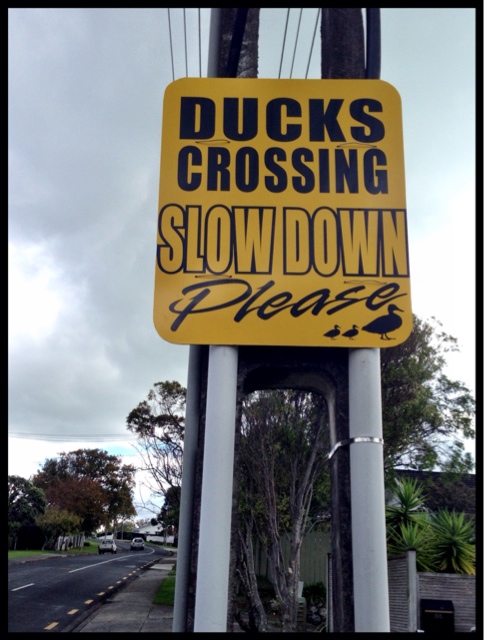
I lived around the corner from this sign in Howick for a few years but don’t recall seeing any ducks — crossing or waiting to cross. Was it a joke?

In Steven Price’s recent article Opening the door to bloggers first published in Australia’s Gazette of Law and Journalism and now reproduced at the INFORRM (The International Forum for Responsible Media) blog, he lays out this point of view:
New Zealand’s 600 or so bloggers are invariably careless, partisan, malicious or deranged, and are generally incapable of seeing any difference between their views on any particular issue and someone else’s idea of “the facts”.
‘Invariably’? Gee, Steven, that’s a bit disparaging, isn’t it? Speaking as a journalist, who blogs, that’s not how I see New Zealand’s bloggers, even though I am critical of some of them. (But ‘deranged’?)
Price’s article is worth a read. In part he presents a nice summary of the arguments for-and-against or the likelihood of bloggers in any numbers being attracted to the NZ Press Council’s offer of membership — however that evolves.
For my own part, I doubt there will be many bloggers who will want to pay hundreds of dollars to join [the Press Council].
What’s in it for them? Some may welcome the sense of legitimacy it bestows. They are journalists too, see? No longer the poor relations. Readers and sources may be more inclined to trust them if they know that standards are being enforced.
It may also help bloggers in arguing for source protection, exemption from the Privacy Act, and access to courtrooms and the parliamentary press gallery, for example.
A bigger attraction may be the waiver that many Press Council complainants are required to sign.
Complaining is free, but complainants have to promise not to sue in court. This waiver is of very questionable legality – there’s a serious question about whether forcing complainants to forgo their rights of access to court is void for public policy reasons – but it has never been challenged.
You can see why this waiver system might be bait for bloggers. What’s more, the Press Council cannot award damages or costs.
Big bloggers such as Whale Oil, Public Address and Kiwiblog have indicated willingness to consider signing up.
A prediction: if Whale Oil joins, he will withdraw in rage after the first complaint against him is upheld and make it his mission in life to ridicule and smear everyone associated with the Press Council, their children, neighbours, gardeners and pet labrador Boomer.
How will it work for the others? The obvious first question is: what standards will apply?
Surely bloggers won’t be expected to display the sort of balance that is supposed to be a staple of mainstream journalism. Will the same conflict of interest rules apply?
Others have noted that the Statement of Principles includes a requirement to disclose any financial inducements and avoid obligations to news sources.
Does that describe the political blogosphere? Comment and fact must be distinguished. …
Those issues Price raises — conflict of interest, disclosure of financial inducements — if they were a membership requirement, they would neatly exclude the wolf-in-sheep’s-clothing PR attack blogs which so duplicitously undertake ‘campaigns’ for their ‘clients’ … with no disclosure.
For instance I know Cameron Slater tried to defend his running such undeclared ‘PR lines’ on his Whaleoil blog on the basis that the attack lines fit in with his personal political beliefs. (Listen to the audio here. Maybe Steven Price’s ‘deranged’ label is fairer than I first thought?) Slater denied being paid … although admitting he ‘demanded’ money. Hmm.
I had reason recently, in the context of discussion about a disingenuous lobby group peddling some of its “non-partisan” wares, to remember the quote:
“It is difficult to get a man to understand something when his job depends on not understanding it.” —Upton Sinclair
Here’s another twist on it from Russell Brand:
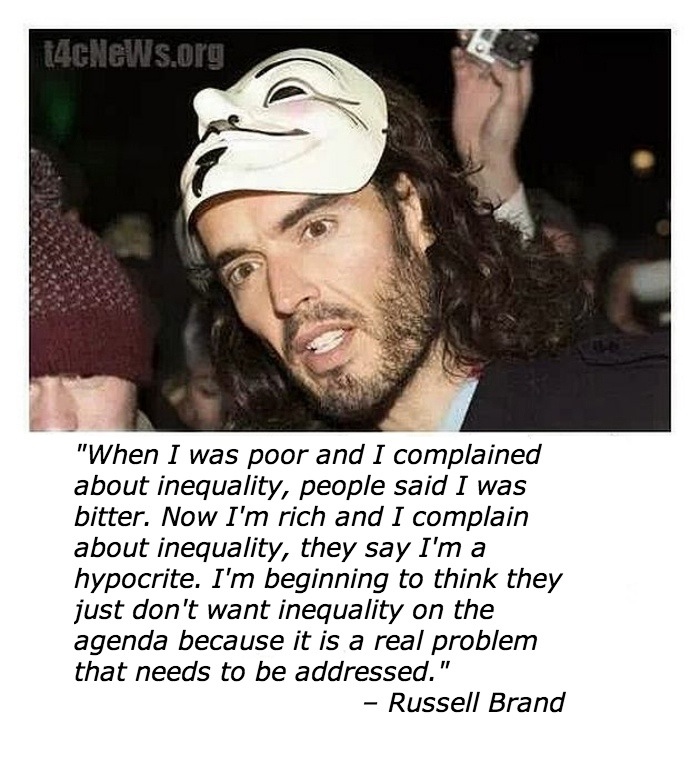
Via @caffeine_addict on Twitter
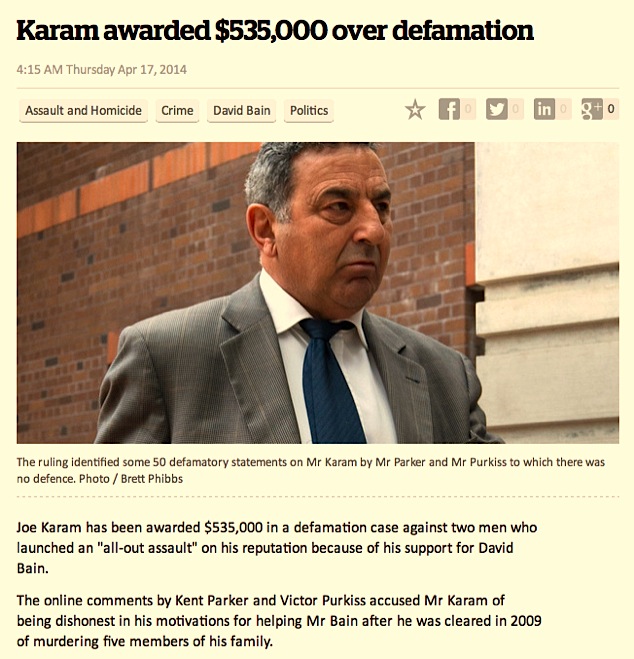
click to read at NZ Herald
This defamation case should be a shot across the bows of various internet wide-boys who think ‘defence of truth’ or ‘opinion honestly held’ is some kind of magic elixir or Get Out of Jail Free card. It’s worth noting the oh-so-easy-to-reach-for-until-you’re-tested ‘truth defence’ in this case was abandoned during the trial.
In her ruling, released yesterday, the judge [Justice Patricia Courtney] identified about 50 defamatory statements published on Facebook and on a private website by Mr Parker and Mr Purkiss — members of the Justice for Robin Bain group — to which there was no defence.
She ordered Mr Parker to pay damages of $350,500 and Mr Purkiss to pay $184,500.
She further punished the men by awarding indemnity costs against them because they “behaved egregiously” in choosing to use the defence of truth at the trial last October.
The indemnity costs ordered could be in the region of $500,000 according to the report.
More often than not, it seems to me, defamation actions are a game a ‘Chicken’ — Which party has the nerve to hold out? Many such cases (and other litigation) are settled out of court. In this case, a four year legal action and trial (not apparently delayed by any argument about whether the online publishers of the statements at issue were ‘a news medium’ or not) has ended in significant defeat for those who carried out the online attacks on Joe Karam, however sincerely held their beliefs. One of the defendants Mr Parker has announced his intention to appeal the decision.
Listen to the language around the protracted online reputation attacks directed at Joe Karam, viz: Continue reading →

Click to view on Twitter
And bless her for invoking Rob Ford. Sad the NZ Herald doesn’t seem to get the reference and quotes her as if she was serious. see: Seinfeld star explains nude Rolling Stone cover: I was drunk. How dumb.
– P

Cyanide & Happiness @ Explosm.net
Yeah, it ain’t right. You know?
– P
PS. The image file name is: imjustkiddingobamathisisonlyalittlejokedontputmeonanywatchlistswhosthatknockingonmydoor
waitnonononohelloamericanothingtoseeherekeepconsumingkeepenjoyingthekardashians.png
After a few hours, I realized we were walking downhill. The ice fog, steaming up from the snow about us, gave me the impression we were walking inside a tunnel and, dissipating now, lifted that dark heaviness one feels when in tunnels. A new stillness came over me. I dare say I felt somewhat lighthearted, considering all that had gone before.
Lilith too was improving. Her body, morphing back into its human form, seemed to break the terrible grief that had assuaged her over Lincoln’s passing. Her grief remained but I felt it subside to a point that did not literally have me falling to the ground in despair every time Lincoln, our good dog, crossed her mind. Continue reading →
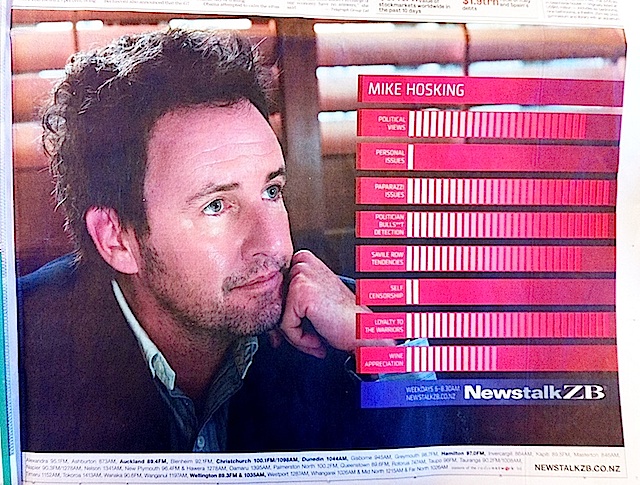
From a must-read new article by Ezra Klein at Vox: How politics makes us stupid showing that often what conditions us to resist changing our minds in response to new information (i.e. learn) is partisanship …
Imagine what would happen to, say, Sean Hannity if he decided tomorrow that climate change was the central threat facing the planet. Initially, his viewers would think he was joking. But soon, they’d begin calling in furiously. Some would organize boycotts of his program. Dozens, perhaps hundreds, of professional climate skeptics would begin angrily refuting Hannity’s new crusade. Many of Hannity’s friends in the conservative media world would back away from him, and some would seek advantage by denouncing him. Some of the politicians he respects would be furious at his betrayal of the cause. He would lose friendships, viewers, and money. He could ultimately lose his job. And along the way he would cause himself immense personal pain as he systematically alienated his closest political and professional allies. The world would have to update its understanding of who Sean Hannity is and what he believes, and so too would Sean Hannity. And changing your identity is a psychologically brutal process.
It is Keynes who is quoted as saying, “When the facts change, I change my mind. What do you do sir?”
Well, not so easy! As Klein points out: “Individuals subconsciously resist factual information that threatens their defining values.”
Yeah, that’s the whole thing with allowing (suffering from?) our paradigms which act to filter out facts that don’t support them. See this post, Negative campaigning and comments following.
Throw in a bunch of membership-of-this-club-means-I-let-others-do-my-thinking-for-me and, well, a recipe for ignorance. Wilful ignorance.
– P
h/t John Gruber
By the way, this, from Steven Price, The news according to Mike Hosking, is well worth a read.
Wow. More to those language choices on the DVD than meets the eye, huh?
(Excellent song too. Moving.)
– P
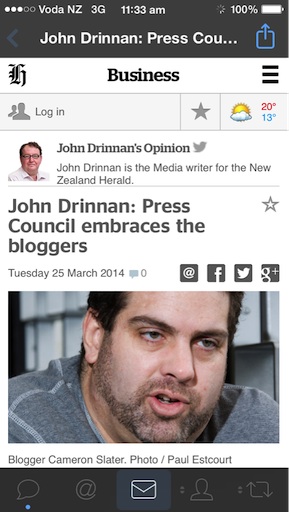
More discussion on the Press Council move to embrace new media … with a few different points of view — including a sound bite of my own.
The NZ Herald‘s media columnist John Drinnan, I think, ‘gets’ the distinction between blogging as self-expression/discussion/current affairs and ‘blogging’ as a dirty, abusive, weaponised PR campaign … which we’ve discussed here a bit now and then.
See: John Drinnan: Press Council embraces the bloggers (NZ Herald)
The question for many is whether treating blogs under the same rules as newspapers will make blogs more careful or diminish the stature of traditional media. Even among bloggers like Peter Aranyi there are concerns,
Some bloggers seeking legitimisation as ‘news media’ …through membership of the Press Council – should more properly be applying for membership of the Public Relations Institute, said Aranyi who has written a lot about a culture of attacks in some blogs.
Let me expand on those thoughts of mine …
Some bloggers seeking legitimisation as ‘news media’ — perhaps, later this year, through membership of the Press Council — should more properly be applying for membership of the Public Relations Institute. That would be a more honest umbrella for their activities. But even there, members are required to be honest, ‘accurate and truthful’ in their endeavours on behalf of their clients.
Honesty
We are accurate and truthful in advancing the interests of those we represent and in communicating with the public.
from PRINZ Code of Ethics (PDF)
Anyone can blog. That’s freedom of speech. But clearly not every ‘new media’ enterprise is a ‘news medium’ — not by a long chalk. It’s pretty clear that some blogs and bloggers take their partisanship to a highly personal level.
Some run political and business vendettas, and engage in ongoing abusive public campaigns to unfairly denigrate or corrode the reputation of others.
That’s not journalism.
In some cases, those activities can be seen to be a commercial enterprise, or in support, or at the service of such enterprises. Cameron Slater’s efforts to demean striking watersiders using personnel files leaked by someone at the Ports of Auckland come to mind.
One might think bringing the online cowboys under the Press Council, with its complaints system and standards for ‘accuracy’ would be a good thing.
Well, maybe. But, as the target of a particularly nasty online campaign wrote last year: Some of them are no more journalists than they are brain surgeons. (see: Target of Cameron Slater’s ‘campaign’ speaks up)
– P
Here’s the Press Council’s press release: NZ Press Council to extend coverage, gain new powers (PDF)
Oh crikey. (click to read Graham Cluley’s article)
See this article by UK-based computer security specialist Graham Cluley Just previewing an Outlook email could infect your computer. Microsoft warns of zero-day flaw.
Just previewing it? Gah! I remember when Microsoft Office macros were shown to be able to be exploited to infect computers. I ran my (since departed) MS Office suite with the ‘Disable Macros’ option selected, and was, you know, careful what I clicked on. But previewing a message now?
Bleurgh.
In the context of news last week about the NSA (reportedly) sensing malware around the planet, I can see why people within real reason for security maintain some equipment that is never connected to the internet — ‘air-gapped’.
This, from a fascinating article in the New York Times How Laura Poitras Helped Snowden Spill His Secrets makes the point:
Once she began working on her surveillance film in 2011, she raised her digital security to an even higher level. She cut down her use of a cellphone, which betrays not only who you are calling and when, but your location at any given point in time. She was careful about e-mailing sensitive documents or having sensitive conversations on the phone. She began using software that masked the Web sites she visited. After she was contacted by Snowden in 2013, she tightened her security yet another notch. In addition to encrypting any sensitive e-mails, she began using different computers for editing film, for communicating and for reading sensitive documents (the one for sensitive documents is air-gapped, meaning it has never been connected to the Internet).
These precautions might seem paranoid — Poitras describes them as “pretty extreme” — but the people she has interviewed for her film were targets of the sort of surveillance and seizure that she fears. William Binney, a former top N.S.A. official who publicly accused the agency of illegal surveillance, was at home one morning in 2007 when F.B.I. agents burst in and aimed their weapons at his wife, his son and himself. Binney was, at the moment the agent entered his bathroom and pointed a gun at his head, naked in the shower. His computers, disks and personal records were confiscated and have not yet been returned. Binney has not been charged with any crime.
I’m still struck by how the US government cancelled Edward Snowden’s passport without any charges & trial or any apparent due process, in an effort to strand him stateless — trapping him in Moscow airport.
Who can you trust?
– P
See also: Beware the ubiquitous PDF? Really?

Who needs training & qualifications? Some bloggers are keen to be seen as journalists. pic: Sosca.org (click)
The Southland Times Editorial: Discomforting scrutiny is worth a read. The editorial is a reference to the news that the NZ Press Council wants to offer a warm embrace to bloggers — perhaps to shore up its membership. And relevance? (Am I being too cynical?)
Although, describing a judge’s decision as of “dullardly calibre” because you see an issue differently, based on a fraction of the background material in a defamation case (!), makes me think the (anonymous?) editorial writer is warming up for his or her own opinionated blog. Welcome along.
The council’s decision to expand its membership further highlights the dullardly calibre of the decision from Judge Charles Blackie late last year that Whale Oil blogger Cameron Slater isn’t a journalist, so isn’t entitled to rely on the protections, such as they are, that protect journalists’ sources. The judge appeared to have taken a steer from a Law Commission report critical of blogging practice but then to have either overlooked or disregarded the commission’s final report which did acknowledge bloggers’ media status.
My own view of the sideshow that is attack blogger Cameron Slater grasping for ‘news medium’ status (and source protection) for his dreck-filled, abusive and [allegedly] defamatory ravings* as he tries to fend off accountability for a prolonged and abusive campaign against a failed Auckland businessman hasn’t changed since I wrote this: Part of the news media? or a “PR blog” dedicated to “destroying” reputations?.
It seems to me that IF it turns out (i.e. is proven or shown to be likely) that Slater did his hit-job on the businessman as a commercial venture … well, in my view he’s got no business being on the Press Council’s membership list, however much they lower their standards.
Continue reading →
via Robot … well worth watching:
Pay attention to what he says about the risks of speaking out versus the risks of ‘exposure’ of the material (PRISM etc). Yet, without the courage to face those, where would we be?
Remember, Daring — if there was no risk it wouldn’t take guts.
“I did not do this to be safe. I did this to do what was right.
I’m not going to stop my work in the public interest just to benefit myself.”
— Edward Snowden
Here’s a crucial section (audio clip) from the talk, where Snowden exposes governmental calls of ‘Terrorism threat!’ as a fig leaf for what spy agencies want to do anyway. According to Snowden, Terrorism threat is ‘a cover for action’:
We’re not immune to the deployment of that ‘talking point’ here in lil ol’ New Zealand. You might recall this from Justifying mass surveillance with ‘terror threat’ is a right wing talking point during the GCSB power expansion debate (NZ Prime Minister John Key speaking):
What does that make you think?
– P
From the Colliding Worlds department, here’s an article I just posted at the Empower Education website …

Click to read this article at www.EmpowerEducation.com
– P
via Jason Kottke who says:
“Tatia Pilieva asked 20 strangers to kiss for the first time and filmed it. The result is surprisingly sweet.”
So right. I can feel the endorphins from here. Lovely.
– P