Of trumpets

(image: buelahman.files.wordpress.com)

In response to Perry’s comment:

“Anyone who finds it necessary to self-proclaim their religious virtue should be treated with great caution”

Yes Perry, I agree – your litmus test is useful. But context is everything.

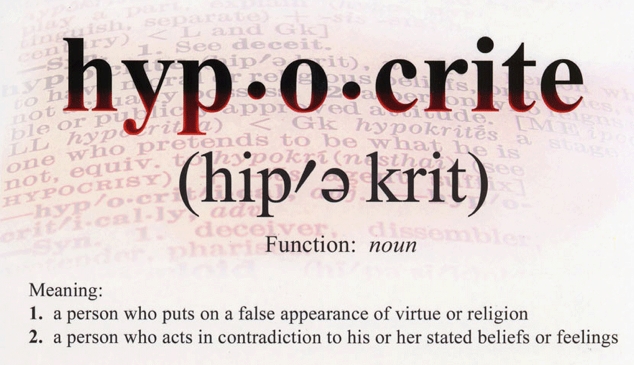
A “mask” of self proclaimed virtue in business (or, more accurately, SALES, like the spruikers we discuss here occasionally) can conceal skulduggery … in spite of the “trust me, god talks to me“.

For instance, a few years back it was novel to have someone overtly claiming in their marketing that ‘serving God and helping the poor in Fiji’ was the goal of his money-making ventures. In a charitable work context, sure, tell me all about your religion and how you’re operating to fulfil the call you feel god has placed on your life, how you are racing to shift your family to Fiji so you can help directly etc etc.

But as the raison d’etre for running property “trading workshops”, hawking your mate’s rural subdivision, or profiting from property sales to people asking for advice? Er, that sounds dodgy to me. (And not just me, apparently, judging by some recent comments.)

And when I feel cynical, or have reason to be suspicious of your loudly, repeatedly claimed, supposedly god-inspired, I’ve-turned-over-a-new-leaf “integrity” … and watch how you operate and who you partner up with … well, it sounds like a confidence-trick. It reminds me of an illusionist’s misdirection so the punters don’t notice sleight of hand.


But also of interest to me in the Lewis article is the dichotomy between the ethics of “the market” and the generally-accepted morality of (sorry to put it this way Perry) Judeo-Christian society in which many of us try to operate. You know: honesty, fair-dealing, avoiding usury.

• Where does one go in one’s head for predatory, crooked, dishonest behaviour and LIES such as Lewis points out in his Goldman Sachs article to be “OK”?
• Where does one go in one’s head to routinely publish promotional exaggeration and LIES of the sort that so-called truth-loving christians have peddled to part the naive and gullible from their cash?
• As highlighted in the discussion about Dean Letfus, Steve Goodey, Shaun Stenning and US tax liens, how does one mentally/morally shift from: ‘US tax liens are snake oil, stay away!’ to ‘Let me help you get really rich, really fast using … US Tax liens’?

The risk in making any public call or appeal for a higher standard (as Lewis does, as I do) is that it can open one to “Who the hell do you think you are to say such things?” responses and trigger a frantic search for “dirt” — real or imagined — with which to attempt to discredit the ‘critic’… which regularly happens to Aussie real estate advocate Neil Jenman. (Or attract barely-coherent, hassling threats of ‘legal action’, as David Whitburn recently experienced.)


Live by the ethical assumptions of your market – or change your soul?

image: http://exper.3drecursions.com/2006/07/24/living-soul/

Liars Poker and The Big Short author Michael Lewis responds to the SEC’s fraud charges against Goldman Sachs on Bloomberg …

The Bond Market Will Never Be The Same After Goldman

First para:

If you happen to be sitting on the Goldman Sachs bond-trading floor life must feel horribly unfair.

You did nothing worse than live by the ethical assumptions of your market — any money-making event short of obviously illegal is admirable — and now your own grandfather thinks you’re some kind of monster.

Your world feels upside down: What was right is now wrong; what was good is now bad; what once felt like winning now feels like losing.

That attitude: “any money-making event short of obviously illegal is admirable” is how I think several reptiles in our own market operate.

Then, in some cases, they compound their nauseating display of cognitive dissonance by trumpeting their religion, their ‘ethics’ and their [alleged] ‘love for the truth’. Yik.

Michael Lewis (as always) far more insightful than we have any right to expect, shares this call:

The masses will be curious to know, for instance, how you became blinded to the very simple difference between right and wrong.

… What begins as an effort to change your business may well end up as
an attempt to change your soul.

Impressive. Worth reading here at Bloomberg. A+

So what do we think?

New Auckland Super City logo …

Auckland Super City logo designed by Jim Dean.

.

The logo for the new Auckland Council will be a red Pohutakawa
encircled by a green koru circle.

Not bad at all. It’ll get criticised, but personally, I like it and appreciate the elements of traditional native motif. (As you might expect with a blog called The Paepae.com)

A little background here from the NZ Herald.

How convenient

While we’re on the topic of authenticity and journalistic ethics…

Research into the only known film of the Anzac campaign has revealed that soldiers identified as Australians are New Zealanders and Irishmen….

Soldiers in a vivid trench fighting scene thought to have been of Australians were the 5th Royal Irish Fusiliers at Suvla Bay, and soldiers shown carrying water through the trenches to the frontline at Quinn’s Post were from the Wellington Infantry Battalion.

Mis-identification of the soldiers in Bean’s film had been deliberate, and was done because of the need to show an Australian narrative, Dr Pugsley said.

“Gallipoli had become the iconic centrepiece of the Australian achievements in the First World War, and so he looked at all these images and assessed how he could tell the Australian story with them,” he said.

“He didn’t want to clutter up his story line by referring to New Zealanders on the frontline because really, when you look at it, there’s far more footage of New Zealanders on the frontline than there is of Australians.

That would blur the story too much, so they became Australian.

Hmm, yes. I see.
from NZ Herald Gallipoli fraud – they’re Kiwis, not Australians

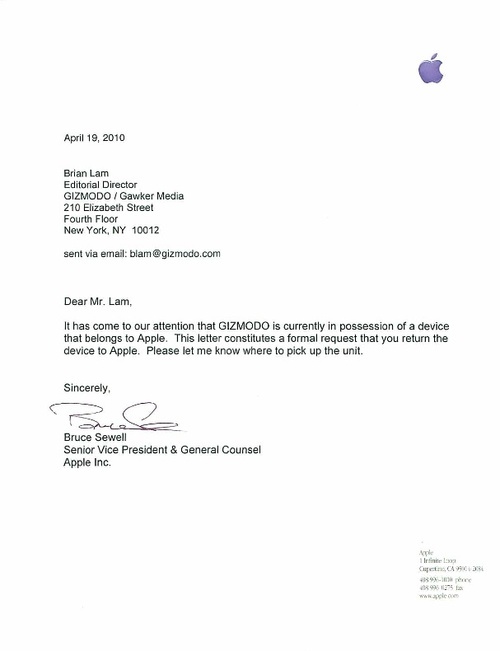
4G iPhone – Lost or stolen?

Next iPhone or prototype? image: nzherald.co.nz

Stolen, in my view, and poor media ethics to boot.

Here’s Jeff Bercovici‘s “Why Apple Could Sue Gawker Over ‘Lost’ iPhone Story”.

I understand the moral calculus they used. We all feel intuitively that picking up something that someone else left behind is not as bad as seizing it by force, stealth or deception. But in the eyes of the law, it’s still stealing. And buying stolen goods is a crime.

In those rare cases where a journalist commits a crime and receives the benefit of prosecutorial discretion, it’s usually because he can demonstrate there was a compelling public interest at stake. There is no such interest here. The only parties who benefited from Gizmodo’s story are Gawker Media and Apple’s competitors.

I’m not normally one to root for manufacturers over journalists, or for Goliath over David. But what Gawker Media did here was egregious. I doubt Steve Jobs will sue, but if he does, he will have justice on his side.

I understand the plain ol’ curiosity and feelings of ‘competitive pressure’ the guys at Gizmodo felt … but they handled this badly, trying to white-wash the finder/thief’s actions in fencing the ‘hot’ item to them. Other media declined.

Dean Letfus: the reputation he deserves?

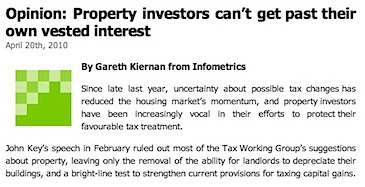
Someone emailed me a link to an article by property economist Gareth Kiernan of Infometrics in which he sets out to debunk (pull the legs off) arguments proffered by some self-proclaimed ‘property experts’ like spruiker Dean Letfus in defence of the tax treatment of property investment.

…So I don’t buy into the whole “social service” argument.

I’ve also been exasperated by arguments put forward by other “experts” such as Dean Letfus saying that “people will literally have nowhere to live” and “the end result is a … chronic housing shortage and massive rental increases.”

In response to these assertions, consider the following argument…

I’ve got a lot of time for Gareth. He’s directly helped me with data for several of my or my authors’ books including Olly Newland’s The Day the Bubble Bursts and aided my meagre understanding of the power of trends in property markets.

I talk with Gareth every few months and always enjoy hearing his views. He brings a rigorous, careful analysis of the figures and (as economists do) explains things in terms of hindsight — what’s been happening. That’s not a criticism. I like him and respect him.

So his (fairly light, I thought) pre-Budget opinion piece at interest.co.nz is worth reading, whether you agree with everything he says or not. What also interested me (and the person alerting me to it) was some of the reader comments responding to the article which reveal a level of (dis)respect for Dean Letfus.

He’s clearly made an impression on some other folks… someone even quoted posts from this blog! Meanwhile, Gareth himself is obviously not too impressed with Dean Letfus either … although I don’t recall ever discussing the subject with him.

I remember Dean Letfus (sometimes spelt Dean Leftus) described generally well-respected BNZ chief economist Tony Alexander as ‘a crazed sadistic basher of other commentators’ and suggested he suffered from rabies(!) Hardly a rational suggestion.

He also described Olly Newland’s advice as ‘drivel’ before later grudgingly admitting that gee, maybe experienced ‘old school’ type investors like Olly had actually learned some worthwhile things through ‘the crucible of experience’ that Mr Instant Expert hadn’t realized. So it seems fair enough to me that the slick and self-aggrandising “expert” should cop a wee bit of criticism himself.

Debunked: Self-proclaimed property expert Dean Letfus in full flight

Here’s a sampling of the comments, courtesy of interest.co.nz (including Andrew King’s view – “The first thing [Gareth] got completely wrong was believing Dean Letfus was an expert in property.” Zing!): Continue reading →

The ethical answer is to side with the victim

A nice example of thinking it through to journalistic integrity from Andy Ihnatko on the rumour and scuttlebutt about the possibly stolen ‘new 4th generation iPhone’ that was ‘found in a bar’. [cough splutter]
Key quote:

Let’s get back to my original question: what would I have done?
We’ll never know for sure. But I suspect that I would have thought very hard and then gone with my first impulse: return the phone to Apple. If it’s been stolen, then Apple is the victim of a crime and the ethical answer is to side with the victim.

Bravo.

And he’s right. People have a lot of explaining to do.
Probably they’ll just smear the critic (as usual).

UPDATE:

Should they have to ask?
(After it’s been photographed, dismantled, photographed, publicised as a ‘scoop’?)

Before the deluge – Jackson Browne

Some of them were dreamers
And some of them were fools
Who were making plans and thinking of the future
With the energy of the innocent
They were gathering the tools
They would need to make their journey back to nature
While the sand slipped through the opening
And their hands reached for the golden ring
With their hearts they turned to each other’s heart for refuge
In the troubled years that came before the deluge Continue reading →

Great graphic!

I don’t know anything about this event (click on the image to read a description) but the graphic just pulled me in. Great work!

Logo for 'emotional mastery through the Tao'

I don’t have any association with this event. I don’t know if the logo image is original to ‘Kim Knight – Qi Gong Instructor Auckland’ or not, but I like it.

A few thoughts on copyright

image: bartastechnologies.com

Intellectual property can seem very like real property, especially when it is yours, and not some faceless corporation’s. As a result people feel that once they own it—especially if they have made it—they should go on owning it, much as they would a house that they could pass on to their descendants.

from a short but good Economist article on copyright suggesting copyright terms be shortened.

We look at things through the prism of our own experience, me as much as anyone, so when I consider copyright issues like this I recall past episodes where my or my authors’ intellectual property has been appropriated or claimed by others for commercial gain — and I’m all for protecting it. Tightly.

Whether it comes to standing on the shoulders of giants or debating the nonsense spouted by rogues or legends-in-their-own-lunchboxes, I think the safe path is to acknowledge your sources competently and get on with it.

Robert Kiyosaki encouraged this with a saying: “Always acknowledge the source of power”. e.g. it cost nothing for him and Marshall Thurber the creator of the ‘Money and You’ workshop to acknowledge the ‘keys to co-operation’ section of the course featuring the Prisoner’s Dilemma game, owed a lot to Robert Alexrod’s work on co-operation … rather than posing as the originator of that stuff. (It also meant when we came across Axelrod’s material in much more detail later, I didn’t feel gypped.)

The model I learned at university:

thesis > anti-thesis > synthesis
(which becomes the new thesis and the cycle goes on)

… does it for me.
(Sidenote: I also absorbed that academic intolerance for plagiarism is near total.)

“Don’t argue with me, argue with the model.”
— Buckminster Fuller

If, in 5 minutes or 50 years time, someone wants to refer to a concept or a checklist I presented in one of my books, well, Yay! Whether they agree or disagree doesn’t matter. If they fairly attribute and summarise my model then rip it to pieces while offering or developing their own model, using mine as a stepping stone, that’s terrific. Thus, knowledge advances.

That’s completely different to them ripping off my book virtually word-for-word and claiming the information presented in it as their own material, without acknowledgement. See, that’s theft — and sadly common in the get-rich-quick, shortcuts-to-success universe some people dwell in … and promote.

For me, a big issue is when people claim ‘authorship’ of an arrangement of information to commercially exploit it.

As we discussed recently in relation to the Facebook photos of a spruiker on stage in women’s underwear, the act of publishing them isn’t a copyright issue in the sense that there’s no commercial exploitation of the images. (Nor is it an invasion of privacy, in my view, when so many images exist on the internet. Nor defamatory unless they are fake — defamation relies on the publication of untrue statements being damaging.)

Trademarks — another angle

My companies own a number of trademarks. There is nothing to stop people tattooing those trademarks on their bodies or hanging a poster of them up in their bedroom, or spray-painting them on the roof of their car, or critically evaluating the design of them in an online discussion forum. The issue emerges when they commercially misuse my trademarks or something confusingly similar to market their own goods or services. The purpose of a trademark is to indicate origin, not to holus-bolus stop people using stylized images of stars or apples.

Note: Expressing any opinion of these things naturally opens one to charges of inconsistency or hypocrisy. Let me say it first: I am not perfect. I try to acknowledge sources, even many of the images on this site, but I don’t claim to be 100% squeaky clean. If I have offended your copyright or trademark, drop me a line and we’ll sort it out. – regards, Peter Aranyi.

Is cloud-based e-mail ‘private’? Depends who you ask!

From Google’s friend-of-the-court submission to a case where the US Dept of Justice is trying to get access to Yahoo users’ e-mail for law enforcement officers to read:

“…users who store their e-mail in the cloud enjoy a reasonable expectation of privacy that is protected by the U.S. Constitution.”

“Society expects and relies on the privacy of e-mail messages just as it relies on the privacy of the telephone system,”

Like, Yah! Why would anyone agree to use a cloud-based system otherwise?

Check out the CNET story here and marvel at the DOJ’s slippery definition of e-mail as ‘electronic storage’ — therefore not needing a search warrant. (!)

PS Is ‘cloud-based’ a real term? I used it, but, … Based? On Cloud? Hmmm.

SEC says “FRAUD”

So the SEC says Goldman Sachs defrauded Its own investment ‘clients’ and cooperated with Paulson & Co to effectively weight the bets against them — bundling bad debt then betting against the bundle.

Engineering failing investments to sell to ‘the little people’, retail investors or ‘pigs’ is a time-honoured (but dishonourable) tactic on Wall St. (See Liar’s Poker by Michael Lewis.)

So much so that there’s a ghastly saying about the sharemarket:

“The pigs go to the Market to get slaughtered.”
.

It’s ugly but it’s true.

The extension of the definition of ‘pigs’ to include these victims (below) is a development…

Goldman told investors that the bonds would be chosen by an independent manager. In the case of Abacus 2007-AC1, however, Goldman let Mr. Paulson select mortgage bonds that he believed were most likely to lose value, according to the complaint.

Goldman then sold the package to investors like foreign banks, pension funds and insurance companies, which would profit only if the bonds gained value. The European banks IKB and ABN Amro and other investors lost more than $1 billion in the deal, the commission said.

“Goldman wrongly permitted a client that was betting against the mortgage market to heavily influence which mortgage securities to include in an investment portfolio,”

— SEC statement quoted in NY Times

Note, like the Lombard charges, these are ALLEGATIONS at this stage.

Bill O’Reilly is a shallow man

Watch this to see how shallow and glib a denial can be.

Bloggers aren’t journalists?

I commented earlier in ‘Neither one nor the other‘ that blogging isn’t considered journalism by many.

Now Google boss Eric Schmidt has sparked some anger by saying the same thing. He missed a point which Curt Hopkins at Read Write Web in a post titled Google’s Schmidt to Bloggers: Drop Dead! was good enough to point out — many of us bloggers ARE journalists…

First, I am a journalist. I mean an I-worked-for-a-newspaper, I-was-a-stringer-for-Reuters, I-was-a-host-for-NPR, I-freelanced-for-Newsweek type journalist, the sort of journalist our CEO friend was presumably talking about. But I’ve also been a blogger since 2004. This blog I now write for is in the top ten of blogs for readership and has a sterling rep for…can you guess? JOURNALISM, you blowhard.

How many journalists blog? How many bloggers are journalists? How many blogs are chockablock with journalism? This motif of the whirly-eyed blogger in his pajamas was getting stale before I started my blog. (And for the record, I haven’t owned pajamas since I was old enough to shave.)

Hopkins also pointed to the conflicted action of Schmidt/Google ‘blackballing’ CNET journalists over a Google and privacy story.

Worth reading.

National Security Agency chief says his iPad is ‘wonderful’

We’re not sure what this means, if anything, about the security of Apple products. But in a [US] congressional hearing today, Apple’s wonder-tablet received the very unofficial endorsement of the country’s top security geek.

Calls it “wonderful”.
via Forbes