
Settlement of legal action as a ‘peace premium’


I was fascinated by the language New York Attorney General Eric Schneiderman used yesterday to describe a settlement agreement between multiple US government agencies and JP Morgan Chase bank over its actions in the Global Financial Crisis, reported as:

NEW YORK (TheStreet) — New York State Attorney General Eric Schneiderman on Tuesday announced a groundbreaking $13 billion mortgage settlement between JPMorgan Chase (JPM_) and multiple government authorities.
“Today’s settlement is a significant, but by no means final step, by the Federal Housing Finance Agency’s Office of the Inspector General, the Department of Justice and the New York Attorney General’s Office and our other law enforcement partners, to hold accountable those who commit acts of fraud and deceit,” Schneiderman said in a press release.
Schneiderman, who heads President Obama’s Residential Mortgage-Backed Securities Working Group, said JPMorgan’s settlement will include $4 billion in assistance to distressed homeowners and $9 billion in cash payments. He also said that the deal will cover all civil claims by government authorities related to residential mortgage-backed securities (RMBS) sales by JPMorgan, Bear Stearns and Washington Mutual before 2009.
Schneiderman said $2 billion of the overall settlement will not be tax deductible, but that early on regulators had agreed to treat Bear Stearns and Washington Mutual liabilities as deductible.
JPMorgan acquired Bear Stearns when the investment bank was faced with bankruptcy amid a liquidity crisis in March 2008. Washington Mutual was shuttered by regulators in September 2008, after which it was sold to JPMorgan by the Federal Deposit Insurance Corp.
A major sticking point between JPMorgan and the Justice department was the language under which the company would be expected to admit some fault in its mortgage securitization and sales activities.
“JPMorgan acknowledged it made serious, material misrepresentations to the public — including the investing public — about numerous RMBS transactions,” Schneiderman said on Tuesday.

All very intriguing, and one can just imagine how strenuously JP Morgan would have worked to try to evade any admission of guilt, fault or liability (for its ‘acts of fraud and deceit’). That’s an unfortunate aspect of human nature I’ve observed recently — someone wriggling to try to avoid acknowledging their own dead-obvious guilt.
Continue reading →

Wonderful

20131117-215732.jpg

Kinda like: Heads we win, Tails they lose …?

– P

Via James Clark

Lily Allen – genius

I remember referring to a dodgy bit of ‘research’ (cough) sponsored by a beer company(!) which purported to a ‘finding’ that Lily Allen was a ‘negative twitterer’… which made me laugh, a lot, and was, I suspect, more a case of them not getting the edge, the sarcasm and the real-world social analysis which this intelligent observer (Ms Allen) shares with her audience. She fingers double standards in a way that is undeniable.

Here’s her latest (warning: some racy content, explicit language — e.g. ‘Forget your balls and grow some tits’ — and references to Robin Thicke’s misogyny):

Just fabulous.

– P

via popjustice.com and @CaitlinMoran

Watch this MacBook’s fate and try not to wince

– P

via tastefullyoffensive.com. Thanks to AK.

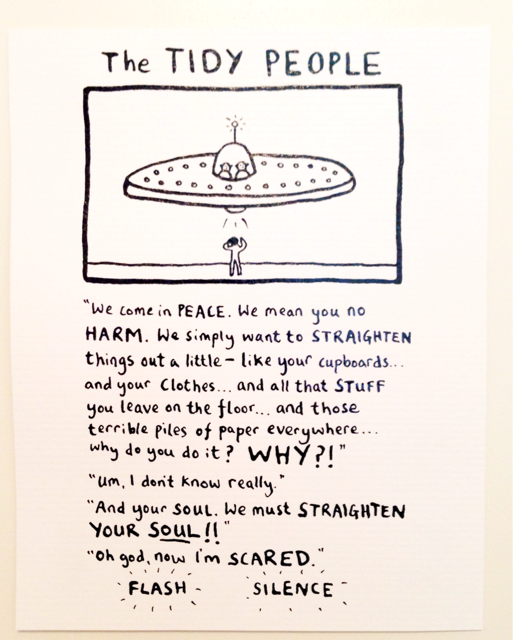
Spotted in the thinking room of a friend’s house …

tidy-people.jpg

Gulp.*

– P

* particularly the bit about piles of paper/stuff on the floor.

After the storm. You may have to go further than you thought.

After my 5 km this morning I rocked up to the beach looking forward to a swim …

Beach closed 1398

Oops. Probably the effect of the overloaded storm water system in the recent heavy rain. Either that or — as one of my fellow swimmers suggested this morning — so much dog shit on the beach it skewed the water quality testing thingy. “They look for faecal matter, you know,” she said. “Just swim out further.”

Yeah, sometimes one has to go further than you thought you wanted to go, to take steps you hadn’t thought you needed to take — to avoid the excrement in your environment.

– P

Puffery. Lies by another name?

the_tm9_turf_mat_credit_toyota_roof_garden

I saw the emergence recently of a new ‘grassroots’ lobbying group and, unlike some spluttering online commenters, chuckled to see the personnel involved.

It would be unfair and potentially misleading to call David Farrar, Jordan Williams and John Bishop members of a government/public relations rogues’ gallery, so I won’t.

And anyway, seriously, how could anyone scold a fellow who promotes himself in such a charming fashion on Twitter …

Disarming potted bio from Jordan 'I am not a lobbyist, oh hang on, yes I am this week' Williams.

Disarming potted bio from Jordan “I am not a lobbyist! Oh hang on. Yes I am this week.” Williams.

In related news, I spotted this article, The Perils of Puffery by Nicholas Mason mentioned by Andrew Sullivan at The Dish — eloquent as ever, in a reference to 18th-Century Sock Puppets.

What marketing theorists now call “astroturfing” was first dubbed “puffery” nearly 300 years ago and has remained one of advertising’s most effective tools ever since. The first widespread reports of puffery came in 1730s England, where a number of journalists and wits remarked on the recent shift from straightforward, unembellished announcements of goods for sale to elaborate schemes to trick consumers into buying shoddy merchandise.

Yeah, it’s like that y’all.

Some people will say anything they can (doesn’t matter whether it’s true) to gain an advantage.

Are you my sugar daddy?

David Farrar’s twee reference to ‘modest seed funding’ (below) obscures, it seems to me, the sugar daddy (or sugar daddies) behind his new ‘grassroots’ group.

We approached friends, colleagues and acquaintances and asked them if they were willing to support a dedicated voice for taxpayers, and many of them said yes. With some modest seed funding, we appointed Jordan as the Executive Director, gained some office space and started the job of having staff and volunteers scrutinising central and local government spending.

Peter Shirtcliffe’s name immediately sprang to my mind, given his reported backing of Jordan Williams’s last pre-election lobby group/PR campaign/set of training wheels, the failed anti-MMP effort which became so fixated on Winston Peters as ‘king maker’ — jettisoning its own ‘Pledges to New Zealand‘ to ‘Play the ball not the man’ among others things, along the way.

David Farrar’s launch epistle mentions ‘scrutinising’. That’s a great word.

Let’s do some of that.

Watch this space.

– P

Stress kills. Some more thoughts about litigation

From the Otago Daily Times

The death of the leading criminal defence lawyer Greg King was a wake-up call over the pressures facing some defence lawyers, Prof Mark Henaghan said yesterday.
Prof Henaghan, who is dean of the University of Otago Law Faculty, was commenting yesterday at an outdoor memorial service on campus, attended by about 50 people, including several senior Dunedin lawyers.
At the early evening service honouring the memory of Mr King, an Otago law graduate, a kowhai tree was planted near the Water of Leith to mark the occasion.
The Society of University of Otago Law Students said it had organised the event to honour one of the most esteemed graduates of both the faculty and the university.
The coroner found in October that Mr King’s death in Wellington in November 2012 had been self-inflicted. And a note left by him described being “totally burnt out” after taking on so many criminal defence cases.

I read that Greg King took his own life after suffering what the coroner’s report called a “massive breakdown”, describing his own state in his suicide note as “exhausted, unwell, disillusioned, depressed and haunted”.

It really saddens me to think of one of our country’s brightest lawyers coming under such strain and pressure, and seeing no way out. Terribly sad.

My heart goes out to Greg King’s family.

SG-foyer.jpg

The real ‘costs’ of litigation

Having myself been involved in pursuing a civil litigation in the past (for copyright infringement) I know it can be stressful (and expensive) for the parties involved … but I had not seen it as such for the lawyers.

With all due respect to lawyers (and no reflection on Greg King) there’s something about the way the system works, particularly in civil litigation, that sometimes sees legal professionals emerge as the only ‘winners’ in a dispute — their clients milked of whatever fees can be wrung out of them, the parties exhausted and disillusioned.

By a drip-drip-drip, lawyers bill their clients. Fair enough. Sometimes the process is necessary and even educational. I learnt the word ‘lacuna’ from one of my lawyers, when he was describing why the (relatively) quick-and-easy legal strategy we’d initially decided on might possibly not work … putting us on a more expensive path. Rats!

Clearly, there’s far less at stake in a civil dispute than there is in a murder case of the sort Greg King specialised in, or even, say, in a ‘white-collar crime’ case (e.g. fraud, embezzlement, criminal deceit, conspiracy, using a document to deceive, etc.) … those cases the Financial Markets Authority, the Serious Fraud Office, and the Commerce Commission have been pursuing with such élan lately in their ‘clean up’ efforts.

There must be enormous stress in a court prosecution, where the defendant doesn’t have the option available in most civil disputes: reaching a settlement agreement to shut things down.
Continue reading →

Another brick crumbles

Remember Facebook announced they were going to remove the ability to not be ‘found’ on their network by ‘non friends’? (Facebook. le sigh.)

Well, it’s rolling out … I just got this email …

Service with a smile, so long as you do it their way.

Service with a smile, so long as you do it their way.

Note the use of language: ‘old setting’ you’ve ‘used in the past’. (Actually, no, I use it NOW Facebook. You’re taking away something I use now.)

– P

Xero. Things that make you go ‘Hmmm…’

It can’t be just me that reads a line like this …

It’s been less than three weeks since Xero’s valuation passed through the $3 billion mark.
[Now it’s $4 billion]

… and thinks, Hmm. Bubble-ish?

Click to read at NZHerald.co.nz

Click to read at NZHerald.co.nz

I’ve got no insider or any other knowledge of the Xero company nor do I own any shares in it, nor its competitors.

I remember someone years ago asking me: Would you ever buy a stock at its all-time high?
Hmm. Probably not, I replied. Cautiously, maybe.
Well if you wouldn’t, you would have missed out on a ten year bull run on Microsoft shares, he said.
Oh.

– P

The escape of exnzpat, Part 16

An unexpected place


Mia drove.

Her big, wide car slowed as it turned on Erehwon Street’s narrow lane.  She felt the house before she saw it.  Its breath was hot, stale, and stank of death.  It came to her, carried easily within the porous membranes of the hot summer air.  She pushed it away and took in the rest of the street.

Tall oaks lined the street and many of the homes were shaded in delightful relief from the sun above.  All but number φ had a cool pleasant look to them.  The house sat back a ways.  It was bare of trees but for a few whiskered shrubs that seemed to wilt before the house and the towering sun overhead.

The lawn was kept, but it was untidy with weeds that crawled like snake-vine across it; their pale, leafy heads quailed and squabbled under the sun’s unrelenting heat.

There was an untidy fringe of hedge under the front windows.  Blanched and stickled with thorn the hedge had rubbed and scratched at the house, helping the sun in its job of peeling away its already faded paint.

The house was a very sorry thing to look at.  And the bare lawn behind it and its brown boarded windows projected a character of neglect.  Mia saw two cars parked in its driveway, but even so, it was easy to tell that no one lived within the house’s forgotten walls.  To normal eyes, the house was pathetic.

But Mia saw more, for her sight was not normal. Continue reading →

Close your eyes and listen to what John Palino said

Maybe it’s my background in radio journalism, or the fact that I have what educators call an ‘auditory learning style’ (or maybe these are the same thing?) but sometimes I find the pictures on TV distracting, or obscuring of the heart of a matter.

Yes I know, of course, there are times when the body language of an interviewee — their unspoken but very real communication — tells the story.

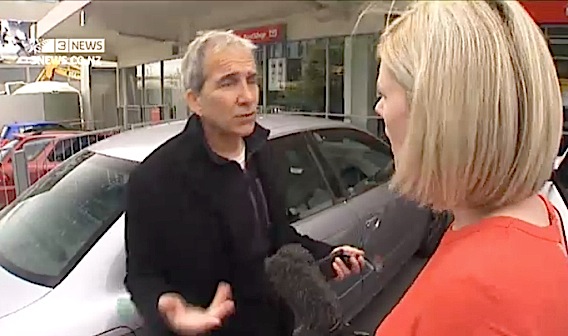
I watched Campbell LIVE’s intrepid Rebecca Wright doorstep Auckland mayoral candidate John Palino (video here if you haven’t seen it) and, sure, it was awkward.

Click to watch the video at Campbell LIVE

Click to watch the video at Campbell LIVE

But LISTEN to the conversation/confrontation (pick one) below, and see what you think …
Continue reading →

Spotted on a wall. Fill in the last part.

humansbeinghuman

I saw this incomplete* slogan on a wall near where I parked for the Armageddon expo at the weekend. Looks like the ‘artist’ was interrupted, because a school caretaker would probably have made more impact if they’d been washing it off.

What do you think the last word(s) would have been?

– P

* Or maybe it’s gestalt?

Dumb headline apart, this exchange between Keller & Greenwald on journalism is a great read

Click to read at NYTImes.com

Click to read at NYTImes.com

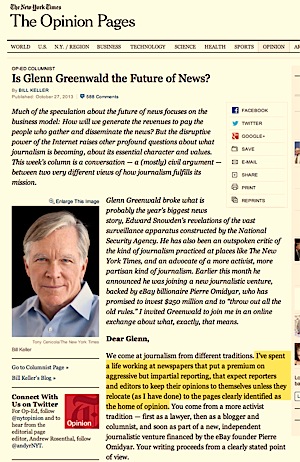
A seriously good read. Go ahead: Is Glenn Greenwald the Future of News? — NYTimes.com

We come at journalism from different traditions. I’ve spent a life working at newspapers that put a premium on aggressive but impartial reporting, that expect reporters and editors to keep their opinions to themselves unless they relocate (as I have done) to the pages clearly identified as the home of opinion. You come from a more activist tradition — first as a lawyer, then as a blogger and columnist, and soon as part of a new, independent journalistic venture financed by the eBay founder Pierre Omidyar. Your writing proceeds from a clearly stated point of view.

My reaction to it may be different to yours. So, let me know.

This is relevant too:

from Alan Rusbridger, editor of The Guardian, in an article about the Edward Snowden revelations, The Snowden Leaks and the Public — New York Review of books

The Guardian itself inhabits an editorial space that is quite distinct from most American newspapers. British papers have grown up with less reverence for the notions of objectivity and detachment that can, rightly or wrongly, preoccupy some of our American colleagues. The paper started as The Manchester Guardian—an outsider to the sometimes cozy world of Fleet Street. Though it’s long since dropped “Manchester” from its masthead, its mentality is still that of the outsider—and it’s fair to say that it is regarded by some British journalists with the sort of distrust that members of a club feel about visitors.

– P

Update: Summary of the Keller/Greenwald interchange by Mathew Ingram here —
Glenn Greenwald vs. the NYT’s Bill Keller on objectivity and the future of journalism

Social engineering!

It’s GST return time in my empire. Look what fell out of the envelope …

You want to do it by paper? Pay for your own stamps, sucker.

You want to do it by paper? Pay for your own stamps, sucker.

This is, of course, just a day or two after NZ Post announced the laying off of hundreds of posties because falling mail volumes means they’ll be dropping urban ‘standard post’ delivery back to three days a week. (See: Hundreds of posties to lose jobs, deliveries cut — Radio NZ News)

What an interconnected world we live in.

– P